

Is this an emergency or can it wait?
Treat it as urgent if there is water on the floor, a burning smell, sparking or food at risk, and stop using the appliance. Otherwise it can wait for a normal appointment. Call (844) 578-2720 and the dispatcher will triage it with you on the line.
Call (844) 578-2720 for the next available window.
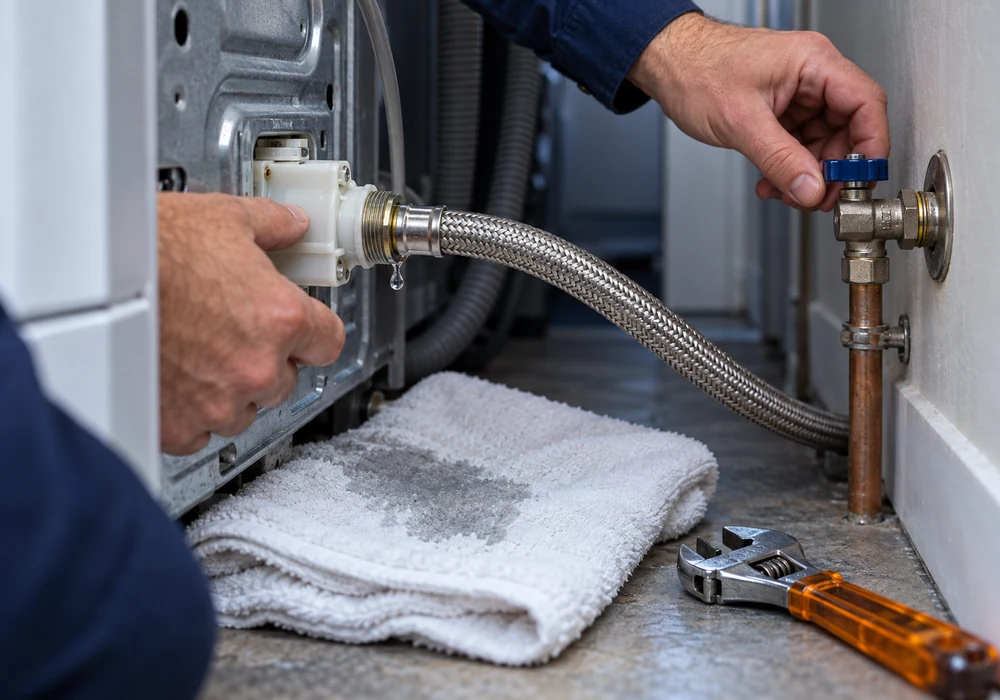
Symptoms that match this problem
- Puddle appearing on the floor during or after a cycle
- Water seeping from under the front of the appliance
- Damp or lifting flooring beside or beneath the unit
- Water stain on a ceiling in the room below
- Musty smell near the appliance
- Drip audible from behind the unit between cycles
What to do and what to avoid
| Do this | Do not do this |
|---|---|
| Close the supply valve to that appliance straight away | Do not run another cycle to see whether it leaks again |
| Switch off the circuit at the breaker if water is near an outlet | Do not stand in standing water to reach an appliance |
| Mop up standing water before it reaches the subfloor | Do not assume a small leak will stay small |
| Note exactly when in the cycle the water appears | Do not ignore a stain on the ceiling below |
| Note where the water emerges from, front, side or underneath | Do not move a loaded appliance full of water |
| Put down towels and check again after an hour to gauge the rate |
What causes it, ranked by likelihood
Technicians work through these in roughly this order, because starting with the cheapest and most common cause saves you money.
- 1
Failed door seal or gasket
Most likelyOn front-load washers and dishwashers the door seal takes constant wear, and the lower corners fail first. Water appears at the front of the machine during the cycle.
- 2
Supply hose or fitting failure
Very commonInlet hoses and compression fittings fail at kinks or with age. Because these sit under constant mains pressure, this is the one leak that continues between cycles and causes the worst damage.
- 3
Blocked drain causing overflow
CommonA blocked filter or drain path means water backs up and escapes at the weakest point rather than draining away. Fix the blockage and the leak stops.
- 4
Blocked defrost drain on refrigeration
CommonOn refrigerators and freezers a blocked drain tube backs meltwater up until it overflows the pan and runs onto the floor.
- 5
Cracked tub, pump housing or spray arm
Less commonA physical crack in a water-carrying component. Often intermittent and only leaking at certain points in the cycle, which makes it harder to trace.
- 6
Overfilling from a failed valve or sensor
Least likelyThe machine admits more water than the tub can hold because the inlet valve will not close or the level sensor misreads.
How a technician works through it
Stop the water
Close the supply valve behind or beneath the appliance, turning clockwise until it stops. For a refrigerator or ice maker this is often a small valve under the sink or in the basement.
Make it electrically safe
If water is near an outlet or extension lead, switch off that circuit at the breaker before you step into the area or reach for the appliance.
Note the timing and location
Record when in the cycle the water appears and where it emerges. Front means the door seal, side or rear means a hose or fitting, underneath means the pump, tub or drain.
Dry and observe
Mop the area completely and put down dry towels. Checking in an hour tells you whether the leak is continuous, which means mains pressure, or cycle dependent.
Book a diagnosis
Call with the timing and location noted. Those two facts narrow the cause substantially and decide which parts travel to you.
Stop the water before you diagnose anything
The order matters here more than with any other appliance fault, because the damage accumulates while you investigate.
Close the supply valve to that appliance first. For a washer or dishwasher it is behind or beneath the unit. For a refrigerator or ice maker it is often a small valve under the sink or in a basement. Turn it clockwise until it stops.
Then make it electrically safe. If water has spread anywhere near an outlet or an extension lead, switch off that circuit at the breaker before you step into the area. Do not stand in standing water to reach behind an appliance and unplug it, which is the most common way people get hurt dealing with a leak.
Only then start looking for the cause. A leak under mains pressure does not wait politely while you work out where it is coming from.
Two observations identify most leaks
Where the water appears and when it appears narrow the cause substantially, and both cost nothing to note.
Water at the front of a front-load washer or a dishwasher, appearing during the cycle, is almost always the door seal. These seals take constant wear and fail at the lower corners first, where water sits.
Water at the side or rear, present between cycles as well as during them, points at a supply hose or fitting. This is the important distinction: supply components sit under constant mains pressure, so they leak continuously whether the appliance is running or not. These cause the worst damage because they do not stop.
Water underneath, appearing only at a specific point in the cycle, points at the pump, the tub or the drain path. A blocked drain is worth singling out, because the machine is not really leaking at all. Water is backing up and escaping at the weakest seal, and clearing the blockage resolves the leak.
Why small leaks are not small
A leak under an appliance does not spread across the floor the way a spilled glass does. It runs along the underside of the cabinet, down into the gap at the edge of the flooring, and into the subfloor beneath.
That is why the first visible sign is often not a puddle but lifting laminate, a soft patch of floorboard, a musty smell, or a stain on the ceiling of the room below. By the time any of those appear, water has been present for a while and has reached the structure.
The practical consequence: do not run another cycle to check whether it leaks again. You already know it leaks. Each confirmation cycle adds water to places you cannot see and cannot dry, and it converts an affordable appliance repair into a flooring or ceiling repair as well.
What the repair usually costs
| Repair | Typical range | Market |
|---|---|---|
| Service call and diagnosis | $79 | Waived on approval |
| Washing machine repair | $140 to $400 | mid-size city |
Typical completed-repair ranges including parts and labor; your technician confirms the exact price on site before any work begins.

When to stop troubleshooting and unplug it
- Water near an electrical outlet or extension lead is a shock hazard. Switch off the circuit at the breaker before stepping into the area.
- Close the supply valve before investigating. A mains pressure leak does not pause while you look for it.
- A ceiling stain in the room below means water has been running for a while and has reached the structure. Treat that as urgent.
- Never stand in standing water to reach or unplug an appliance.
More guidance: CPSC appliance recall notices (opens in a new tab) · FTC Consumer Advice (opens in a new tab) · Energy.gov energy saving guidance (opens in a new tab)
Book the right service
Related problem guides
Get this fixed in your area
Appliance Leaking Water, common questions
What should I do first with a leaking appliance?
Close the supply valve to that appliance, then switch off its circuit at the breaker if water is anywhere near an outlet. Mop the standing water before it reaches the subfloor. Only then start working out the cause, because a mains pressure leak does not pause while you investigate.
How do I find where the leak is coming from?
Two observations do most of the work. Where does the water emerge, and when? Front of the machine during a cycle points at the door seal. Side or rear, continuous between cycles, points at a supply hose under mains pressure. Underneath points at the pump, tub or drain.
Is a small appliance leak urgent?
More than it looks. A slow leak under a machine runs into the subfloor rather than across the surface, so the damage is invisible until flooring lifts or a ceiling below stains. Supply hose leaks are the genuinely urgent ones because they run under constant pressure, cycle or no cycle.
How much does it cost to fix a leaking appliance?
Completed repairs typically run $120 to $460 including parts and labor. A door seal, inlet hose or drain tube sits at the lower end. A cracked tub or pump housing reaches the upper end, and on an older machine that is where replacement often makes better sense.
Why is water pooling under my refrigerator?
Usually a blocked defrost drain tube, which backs meltwater up until it overflows the drain pan. A failed door gasket produces condensation that runs down the cabinet and does the same thing. A split ice maker supply line is the third possibility and the most urgent of the three.
Can I keep using the appliance until the technician arrives?
No, and this is the one piece of advice worth following strictly. Each cycle adds water to a floor that is already wet and pushes more of it into places you cannot see. If the leak is on a supply hose, closing the valve is the only thing that actually stops it.