

Is this an emergency or can it wait?
Treat it as urgent if there is water on the floor, a burning smell, sparking or food at risk, and stop using the appliance. Otherwise it can wait for a normal appointment. Call (844) 578-2720 and the dispatcher will triage it with you on the line.
Call (844) 578-2720 for the next available window.
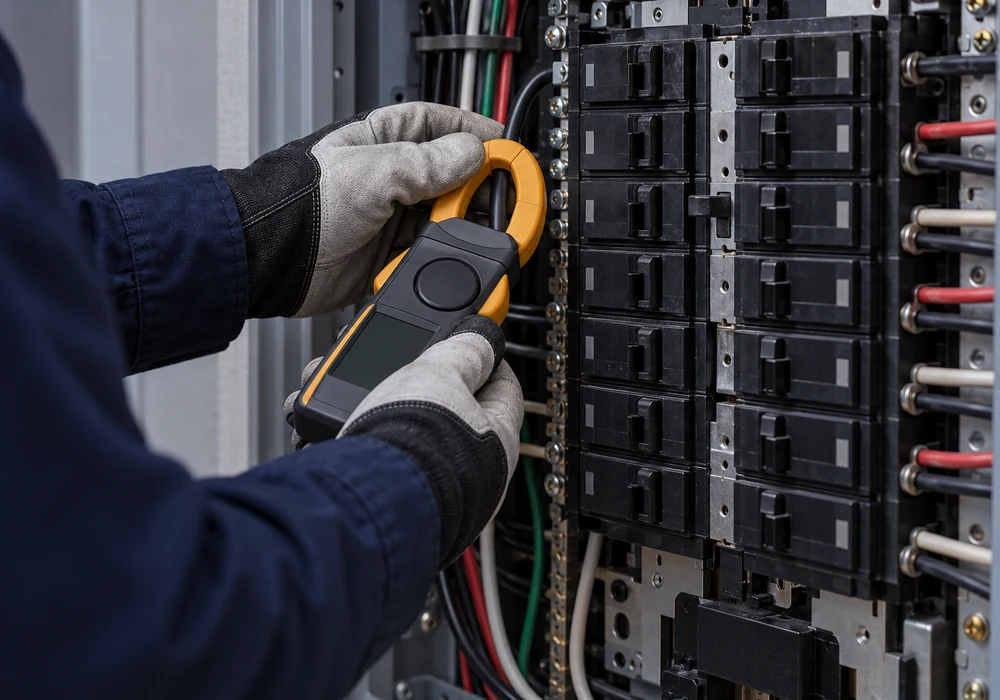
Symptoms that match this problem
- Breaker trips as soon as the appliance starts
- Breaker trips partway through a cycle
- GFCI outlet trips rather than the panel breaker
- Burning or hot plastic smell near the appliance or outlet
- Scorch marks on the plug or outlet
- Lights dim noticeably when the appliance starts
What to do and what to avoid
| Do this | Do not do this |
|---|---|
| Unplug the appliance and see whether the breaker then holds | Do not keep resetting the breaker repeatedly |
| Check whether other appliances on the same circuit also cause trips | Do not fit a higher rated breaker or fuse to stop the tripping |
| Inspect the plug and cord for scorching, melting or crushing | Do not use an extension lead or adapter for a large appliance |
| Note whether it trips at startup or partway through a cycle | Do not bypass or tape over a GFCI that keeps tripping |
| Note whether it is a GFCI outlet or the panel breaker that trips | Do not continue using an appliance with a burning smell |
| Call an electrician if the breaker trips with everything unplugged |
What causes it, ranked by likelihood
Technicians work through these in roughly this order, because starting with the cheapest and most common cause saves you money.
- 1
Failing motor winding
Most likelyA motor with degrading insulation draws excess current, especially at startup. Common in compressors, pumps and drive motors, and typically trips the breaker immediately on start.
- 2
Heating element shorted to ground
Very commonA cracked element in a dryer, oven or dishwasher leaks current to the chassis. Often trips partway through a cycle once the element heats and the crack opens.
- 3
Damaged power cord or plug
CommonA cord crushed behind an appliance or a plug with scorched or loose contacts. One of the few causes that is visible without any test equipment.
- 4
Moisture reaching electrical components
CommonWater from a leak reaching a terminal block, motor or control board. Frequently trips a GFCI rather than the panel breaker, which is a useful distinction.
- 5
Failed start relay or capacitor
Less commonThe component that manages motor startup has failed, so the motor draws locked-rotor current for too long and trips the breaker.
- 6
Circuit overloaded or breaker worn
Least likelyToo many loads on one circuit, or a breaker weakened by age and repeated tripping. The only cause where the appliance itself is not at fault.
How a technician works through it
Isolate the appliance
Unplug the suspect appliance and reset the breaker. If it now holds, the fault is in that appliance. If it trips again with nothing plugged in, you need an electrician rather than us.
Note the timing
Record whether the trip happens the instant it starts or partway through a cycle. Startup trips point at motors, relays and capacitors; mid-cycle trips point at heating elements.
Inspect the cord and plug
Look for crushing, melting, scorch marks or a loose fit in the outlet. Visible damage here is both a likely cause and a reason to stop using the appliance now.
Identify what tripped
Check whether it was a GFCI outlet or the panel breaker. A GFCI trip points strongly at moisture or a ground leak, which narrows the diagnosis.
Book a diagnosis
Tell the dispatcher which appliance, whether it trips at startup or mid cycle, and whether a GFCI or the panel breaker tripped. Those three facts shape the whole visit.
The breaker is protecting you, not malfunctioning
This is the one appliance fault where the instinct most people have is the wrong one. A tripping breaker feels like an inconvenience caused by an oversensitive switch, so the natural response is to reset it and carry on.
A breaker trips because current exceeded what the circuit can safely carry, or because current is leaking somewhere it should not. Both conditions damage wiring and both start fires. The breaker is the only thing standing between the fault and the inside of your walls.
Resetting it once, to establish which appliance is responsible, is reasonable. Resetting it repeatedly to finish the laundry is not. And fitting a higher rated breaker or fuse to stop the tripping is the single most dangerous thing you can do here, because it removes the protection while leaving the fault exactly where it was.
Two questions that narrow it immediately
Before anyone visits, two observations do most of the diagnostic work.
First, when does it trip? A trip at the instant the appliance starts points at the motor side: degrading winding insulation, a failed start relay, or a failed capacitor leaving the motor drawing locked-rotor current. A trip partway through a cycle points at a heating element, because a cracked element only leaks current to the chassis once it has heated and the crack has opened. That is why a dryer or dishwasher can run perfectly for ten minutes and then trip every time.
Second, what tripped? A GFCI outlet and a panel breaker detect different things. A panel breaker responds to overcurrent. A GFCI responds to current leaking to ground, which points strongly at moisture reaching a terminal block, motor or control board. If a GFCI is the one tripping, say so when you call, because it changes where the technician looks first.
The test that decides who you need to call
This takes two minutes and determines whether you need us at all.
Unplug the suspect appliance and reset the breaker. If the breaker now holds and stays held, the fault is inside that appliance and an appliance technician is the right call.
If the breaker trips again with the appliance unplugged, the fault is in the circuit itself, the wiring or the breaker. That is a licensed electrician’s work, not ours, and no amount of appliance repair will resolve it. We would much rather tell you that on the phone than charge you a service call to find out.
While you are there, look at the plug and cord. Scorch marks, melted plastic, a loose fit in the outlet or a cord crushed behind the appliance are all visible without test equipment, and any of them is a reason to stop using the appliance today rather than at the weekend.
What the repair usually costs
| Repair | Typical range | Market |
|---|---|---|
| Service call and diagnosis | $79 | Waived on approval |
| Dryer repair | $130 to $380 | mid-size city |
Typical completed-repair ranges including parts and labor; your technician confirms the exact price on site before any work begins.

When to stop troubleshooting and unplug it
- A breaker that trips is doing its job. Never fit a higher rated breaker or fuse to stop it, which removes the protection and creates a fire risk.
- Repeatedly resetting a breaker against a live fault is genuinely dangerous. Resetting once to confirm is reasonable; resetting repeatedly is not.
- Stop using the appliance immediately if there is any burning smell, hot plastic smell or scorching on the plug or outlet.
- Never bypass or tape over a GFCI that keeps tripping. It is detecting current leaking to ground, which is the exact hazard it exists to prevent.
- If the breaker trips with every appliance unplugged, stop and call a licensed electrician rather than an appliance technician.
More guidance: CPSC appliance recall notices (opens in a new tab) · US Fire Administration home fire prevention (opens in a new tab) · FTC Consumer Advice (opens in a new tab)
Book the right service
Related problem guides
Get this fixed in your area
Appliance Tripping the Breaker, common questions
Is it safe to keep resetting the breaker?
No. Resetting once to confirm which appliance is responsible is reasonable. Resetting repeatedly against a live fault is not, because each reset sends fault current through damaged insulation or a shorted component. The breaker is protecting the wiring, and overriding it repeatedly is how electrical fires start.
Why does the breaker only trip partway through the cycle?
That timing points strongly at a heating element. A cracked element leaks current to the chassis only once it has heated and the crack has opened, so the appliance runs normally for several minutes first. Dryers, ovens and dishwashers all show this pattern.
Why does it trip the instant the appliance starts?
Startup trips point at the motor side. A motor with degrading winding insulation draws excess current, and a failed start relay or capacitor leaves the motor drawing locked-rotor current far too long. Compressors, drain pumps and drive motors are the usual candidates.
My GFCI trips rather than the breaker. Does that matter?
It is a genuinely useful clue. A GFCI detects current leaking to ground rather than simple overload, so it points strongly at moisture reaching electrical components or a component shorted to the chassis. Never tape over or bypass a GFCI that keeps tripping, because that is exactly the hazard it prevents.
Could the breaker itself be the problem?
Occasionally. Breakers weaken with age and repeated tripping, and a worn one can trip below its rated load. It is the least likely cause though, so it is ruled out rather than assumed. If the breaker trips with every appliance unplugged, the fault is in the wiring and you need an electrician.
How much does this kind of repair cost?
It depends entirely on what is drawing the current. A power cord or start relay sits at the low end of the $115 to $520 band. A heating element is mid range. A failed compressor or motor reaches the top, and on an older appliance that is often where replacement becomes the better option.