

Is this an emergency or can it wait?
Treat it as urgent if there is water on the floor, a burning smell, sparking or food at risk, and stop using the appliance. Otherwise it can wait for a normal appointment. Call (844) 578-2720 and the dispatcher will triage it with you on the line.
Call (844) 578-2720 for the next available window.
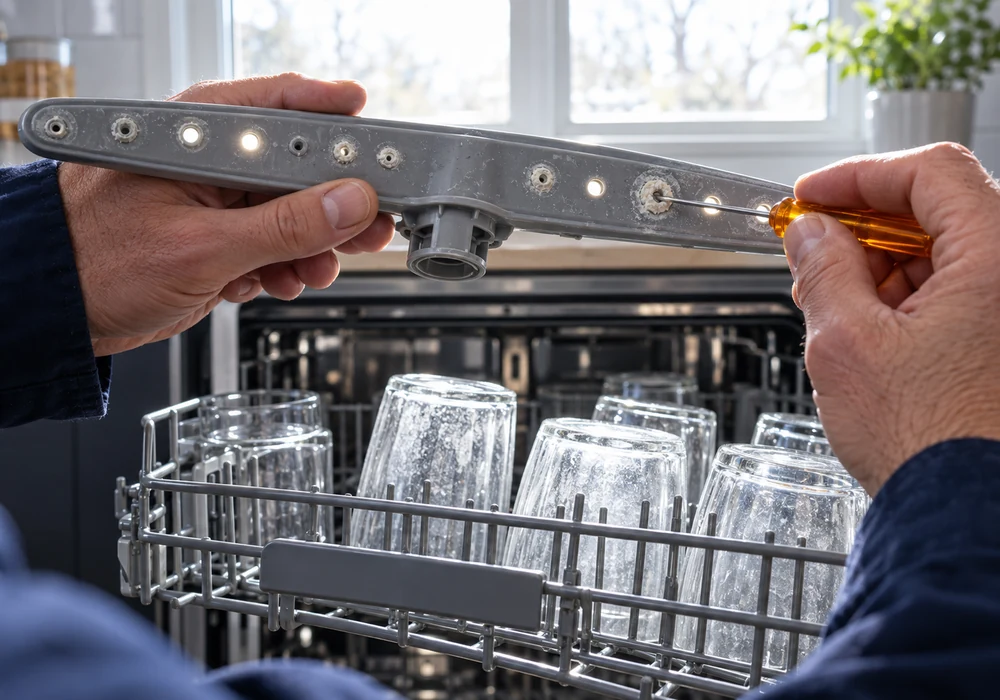
Symptoms that match this problem
- Food residue still on dishes after a full cycle
- Upper rack noticeably worse than the lower
- White film or gritty deposit on glassware
- Detergent tablet only partly dissolved
- Dishes not drying as well as they used to
- Performance declining gradually over months
What to do and what to avoid
| Do this | Do not do this |
|---|---|
| Spin each spray arm by hand after loading to confirm it turns freely | Do not pre-rinse dishes completely clean |
| Hold the spray arms up to the light and clear blocked jets with a toothpick | Do not load tall items where they can foul a spray arm |
| Remove and rinse the filter basket | Do not overload the racks so items shield each other |
| Scrape solids off plates but skip the full rinse | Do not use old or damp detergent tablets |
| Run the hot tap at the sink before starting a cycle | Do not mix bleach with descaling products inside the machine |
| Use a descaling product if you are in a hard water area |
What causes it, ranked by likelihood
Technicians work through these in roughly this order, because starting with the cheapest and most common cause saves you money.
- 1
Blocked spray arm jets
Most likelyFood debris and hard water scale narrow the holes in the spray arms, so pressure drops and whole sections of the rack get little water. The upper rack suffers first because it is furthest from the pump.
- 2
Loading blocking arm rotation
Very commonA tall item such as a baking tray or a pot handle fouls the spray arm and stops it turning. An entire section then receives no water. No part has failed at all.
- 3
Hard water scale build-up
Very commonMineral scale coats the spray arms, the heating element and the circulation pump, reducing both pressure and water temperature over time. This is why the decline feels gradual.
- 4
Blocked filter restricting circulation
CommonA clogged filter starves the circulation pump, so there is not enough clean water to spray. Often paired with standing water in the base.
- 5
Failing circulation motor
Less commonThe pump that drives water to the spray arms is weakening, so pressure is insufficient throughout the machine rather than in one section.
- 6
Water inlet valve or temperature fault
Least likelyNot enough water entering, or water arriving too cool for the detergent to work. Detergent needs genuinely hot water to dissolve and act.
How a technician works through it
Spin the spray arms
After loading, turn each arm by hand through a full rotation. If anything stops it, move that item. This takes two seconds and resolves a large share of complaints.
Clear the spray jets
Remove the arms where they unclip, hold them up to the light and push a toothpick through any hole that looks narrowed. Rinse them through from the inside.
Clean the filter
Twist out the filter basket, rinse under a tap and brush off the greasy film. A starved pump cannot generate spray pressure.
Check the water temperature
Run the kitchen hot tap until it is genuinely hot before starting a cycle. Detergent needs hot water to dissolve and act, and a long pipe run can mean the machine fills with cool water.
Descale the machine
In a hard water area, run a dishwasher descaler through an empty hot cycle. Repeat every few months as maintenance rather than waiting for symptoms.
Water is not reaching the dishes
A dishwasher has one real job: deliver hot water with detergent in it to every surface in the machine. When dishes come out dirty, the question is almost always where that water failed to go, not whether the machine is running.
The upper rack is the diagnostic clue. It sits furthest from the circulation pump and receives water last, so it is the first place performance drops when pressure falls. If the lower rack is acceptable and the upper rack is poor, you are looking at a pressure or distribution problem rather than a detergent or temperature problem.
Start with the spray arms. Unclip them where the design allows, hold them up to the light, and look at the jets. Narrowed or blocked holes are easy to see once you know to look, and a toothpick clears them. Rinse the arms through from the inside afterwards to flush out what you have dislodged.
The two-second check nobody does
Before any of that, there is a check that resolves a surprising proportion of these complaints and takes no time at all.
After loading the machine, turn each spray arm by hand through a complete rotation. If a baking tray, a pot handle, a chopping board or a tall glass stops it, that arm will not rotate during the cycle, and an entire section of the rack will receive almost no water.
People then conclude the machine has lost pressure, when nothing has failed. Moving one item fixes it. Doing this habitually as you close the door costs nothing and prevents the most common cause of disappointing results.
Hard water explains the slow decline
If the machine has been getting gradually worse over a year or two rather than failing suddenly, hard water is the likely explanation.
Dissolved minerals deposit scale on every surface the water touches. Inside the spray arms it narrows the jets. On the heating element it insulates, so the water runs cooler than the cycle intends. In the circulation pump it adds friction. Each effect is small; together they produce exactly the slow decline people describe, and no single part has actually failed.
The white film on your glassware is the visible version of what is happening inside the machine. Running a dishwasher descaler through an empty hot cycle every few months is genuine maintenance in a hard water area rather than an optional extra, and it keeps both the results and the machine’s service life where they should be.
What the repair usually costs
| Repair | Typical range | Market |
|---|---|---|
| Service call and diagnosis | $79 | Waived on approval |
| Dishwasher repair | $135 to $390 | mid-size city |
Typical completed-repair ranges including parts and labor; your technician confirms the exact price on site before any work begins.

When to stop troubleshooting and unplug it
- Never mix cleaning products inside the machine. Bleach combined with some descalers produces hazardous fumes.
- Switch the circuit off at the breaker before reaching into the sump, and expect broken glass among the debris.
- Keep detergent, especially tablets and gel packs, out of reach of children. They are a recognised poisoning risk.
- Let the machine cool before reaching inside after a hot cycle.
More guidance: CPSC appliance recall notices (opens in a new tab) · ENERGY STAR appliance guidance (opens in a new tab) · FTC Consumer Advice (opens in a new tab)
Book the right service
Related problem guides
Get this fixed in your area
Dishwasher Leaving Dishes Dirty, common questions
Why are my dishes still dirty after a full cycle?
Water is almost certainly not reaching them. Blocked spray arm jets, an arm that cannot rotate because an item is fouling it, or a starved circulation pump all leave whole sections of the rack essentially unwashed. The upper rack suffers first because it is furthest from the pump.
Should I rinse dishes before loading them?
Scrape off solids but skip the rinse. Modern detergents are formulated to work against some soil, and most machines have a soil sensor that will run a shorter, weaker cycle if the water comes back clean. Scraping protects the filter without undermining the wash.
Why is there a white film on my glassware?
That is hard water scale, and it tells you the same minerals are building up inside the machine. Scale narrows the spray jets and coats the heating element, which is why cleaning performance declines slowly rather than failing suddenly. A descaler used regularly addresses both.
How much does it cost to fix a dishwasher that is not cleaning?
Completed repairs typically run $120 to $440 including parts and labor. If the fault is blocked spray arms or a clogged filter you are paying for the service call and clearance rather than a part. A failing circulation motor sits at the upper end of that range.
Does water temperature matter?
Considerably. Detergent needs genuinely hot water to dissolve and act on grease, and a dishwasher at the end of a long pipe run can fill with cool water that has been sitting in the pipe. Running the kitchen hot tap until it runs hot before starting a cycle often improves results noticeably.
Why is my detergent tablet only partly dissolved?
Either the water is not hot enough to dissolve it, or the dispenser door is being blocked by a large item in the lower rack so the tablet never reaches the wash water properly. Check both. A damp or old tablet that has started to harden will also fail to dissolve.