

Is this an emergency or can it wait?
Treat it as urgent if there is water on the floor, a burning smell, sparking or food at risk, and stop using the appliance. Otherwise it can wait for a normal appointment. Call (844) 578-2720 and the dispatcher will triage it with you on the line.
Call (844) 578-2720 for the next available window.
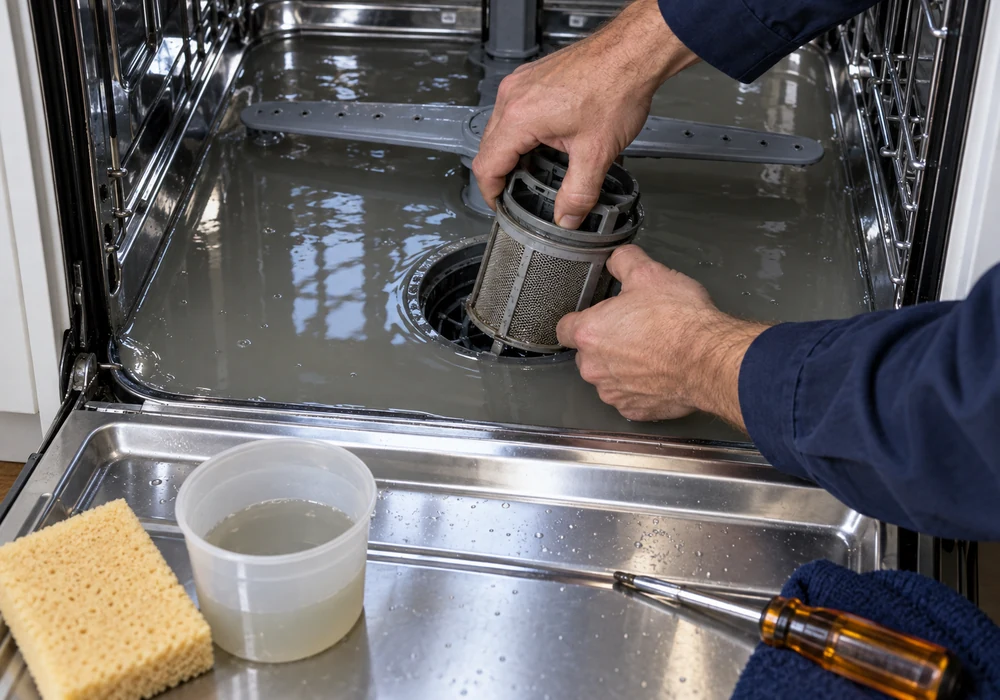
Symptoms that match this problem
- Pool of water in the base after every cycle
- Dishes come out wet and smelling stale
- Gurgling from the sink while the dishwasher runs
- Cycle appears to finish early
- Error code relating to drainage
- Standing water looks dirty rather than clear
What to do and what to avoid
| Do this | Do not do this |
|---|---|
| Scoop out the standing water with a cup and a sponge first | Do not pour drain cleaner into the dishwasher |
| Remove and rinse the filter basket under a running tap | Do not keep running cycles, which stresses a pump already blocked |
| Check the sump beneath the filter for glass, seeds and labels | Do not reach into the sump without switching off the circuit |
| Confirm the disposal plug was removed if a disposal was fitted recently | Do not use bare hands in standing water that may contain broken glass |
| Check the drain hose for crushing behind the machine | Do not mix cleaning products inside the machine |
| Run a nearby sink to rule out a household drain blockage |
What causes it, ranked by likelihood
Technicians work through these in roughly this order, because starting with the cheapest and most common cause saves you money.
- 1
Blocked filter or sump
Most likelyFood debris, broken glass, labels and seeds collect in the filter basket and the sump beneath it. Clearing it is often the whole repair and requires no parts at all.
- 2
Garbage disposal plug left in place
Very common after a disposal installNew disposals ship with a plug in the dishwasher inlet that must be knocked out before connection. If it was left in, the dishwasher cannot drain from its very first cycle.
- 3
Blocked or kinked drain hose
CommonDebris collects at bends, or the hose is crushed behind the machine. A high drain loop that has slipped down also lets water run back into the base.
- 4
Failed drain pump
CommonThe pump has failed, often after running against a blockage. Usually audible as a hum with no water movement, or silence where the pump should run.
- 5
Air gap blocked
Less commonWhere fitted, the air gap on the countertop collects debris and blocks the drain path. Often visible as water spilling from the air gap cap during a cycle.
- 6
Float switch or control fault
Least likelyThe machine misreads the water level and never commands the drain. Diagnosed after the mechanical causes are cleared.
How a technician works through it
Remove the standing water
Scoop out as much as you can with a cup, then soak up the rest with a sponge or towel. You need the base dry to see and reach the filter.
Clean the filter and sump
Twist out the filter basket, rinse it under a tap and brush off any film. Check the recess beneath for broken glass, fruit seeds and bottle labels, which are the usual finds.
Check the disposal connection
If a garbage disposal was fitted recently, confirm the dishwasher inlet plug was knocked out. This single oversight is behind a large share of these calls.
Inspect the drain hose
Look behind the machine for a crushed hose, and confirm the high drain loop is still secured up under the countertop rather than hanging down.
Book a diagnosis
If the filter is clear and the connections are right, the pump, air gap or float switch needs testing. Note any error code and whether the pump hums, then call.
Start with the filter, because it is usually the answer
A dishwasher drain fault sounds mechanical, and most of the time it is nothing of the sort. The filter basket in the base catches everything that comes off the dishes, and beneath it sits a sump where the heavier items settle.
What accumulates there is remarkably consistent: fruit seeds, bottle and jar labels, fragments of broken glass, grains of rice, and a greasy film binding it all together. Once that mass covers the drain opening, the pump cannot move water past it and the cycle ends with a full base.
The useful part is that clearing it needs no parts. Scoop out the standing water, twist out the filter, rinse it under a tap, and clean the recess below. Switch the circuit off at the breaker first, and use a cloth rather than bare fingers, because broken glass in a dishwasher sump is common enough to assume it is there.
The disposal plug catches everyone
If your dishwasher stopped draining shortly after a garbage disposal was fitted, stop looking at the dishwasher. New disposals are supplied with a moulded plug sealing the dishwasher inlet, because not every installation connects a dishwasher to it. That plug has to be knocked out with a screwdriver before the dishwasher drain hose goes on.
When it is missed, the dishwasher has nowhere to drain to from its very first cycle, and the symptom appears immediately after what was supposed to be an unrelated improvement to the kitchen. It is a five-minute correction and one of the most frequent findings we report back.
Rule out the house drain before calling us
One check is worth doing because it determines which trade you need. Run the nearby sink while the dishwasher is attempting to drain.
If the sink drains slowly, or you hear pronounced gurgling, or water backs up into the sink, the restriction is in the shared household drain rather than in the appliance. Gurgling specifically means the dishwasher is pushing water into a line that cannot accept it fast enough, forcing air back through the sink trap.
In that situation a plumber will resolve it and an appliance technician will not, and we would far rather tell you that on the phone than charge you a service call to discover it.
What the repair usually costs
| Repair | Typical range | Market |
|---|---|---|
| Service call and diagnosis | $79 | Waived on approval |
| Dishwasher repair | $135 to $390 | mid-size city |
Typical completed-repair ranges including parts and labor; your technician confirms the exact price on site before any work begins.

When to stop troubleshooting and unplug it
- Switch off the dishwasher circuit at the breaker before reaching into the sump. Standing water and live electrics together are a shock hazard.
- Standing water often contains broken glass. Use a cloth or gloves rather than bare fingers when clearing the sump.
- Never mix cleaning products inside the machine. Bleach combined with some descalers produces hazardous fumes.
- Water that has reached the subfloor or an outlet needs the circuit isolated before mopping.
More guidance: CPSC appliance recall notices (opens in a new tab) · FTC Consumer Advice (opens in a new tab)
Book the right service
Related problem guides
Get this fixed in your area
Dishwasher Not Draining, common questions
Why is there always water in the bottom of my dishwasher?
Something in the drain path is blocked. The filter and sump collect food debris, broken glass and bottle labels, and that is the most common cause by a wide margin. Clearing it needs no parts at all, which makes this one of the cheaper appliance faults to resolve.
My dishwasher stopped draining right after a new disposal was fitted. Why?
Almost certainly the dishwasher inlet plug. New garbage disposals ship with a plug sealing that inlet, and it has to be knocked out before the dishwasher drain hose is connected. If it was missed, the dishwasher cannot drain at all. It is a quick fix and a very common oversight.
How much does it cost to fix a dishwasher that will not drain?
Completed repairs typically run $120 to $440 including parts and labor. If the fault is simply a blocked filter or sump, you are paying for the service call and the clearance rather than any part. A failed drain pump sits mid range, and a control fault higher.
Can I clear the blockage myself?
Often yes. Scoop out the standing water, twist out the filter basket, rinse it, and check the recess underneath. Switch the circuit off at the breaker first, and use a cloth rather than bare fingers because broken glass is a frequent find in there.
Should I use drain cleaner in my dishwasher?
No. Drain cleaners are formulated for plumbing pipework, not for the pump seals, plastic components and food-contact surfaces inside a dishwasher. They can damage the machine and leave residue on your dishes, and they will not clear the kind of debris that actually causes this.
Why does my sink gurgle when the dishwasher drains?
The dishwasher is pushing water into a drain line that cannot accept it quickly enough, so air is forced back through the sink trap. That points at a partial blockage in the shared drain or disposal rather than in the dishwasher, which changes whether you need a plumber.