

Is this an emergency or can it wait?
Treat it as urgent if there is water on the floor, a burning smell, sparking or food at risk, and stop using the appliance. Otherwise it can wait for a normal appointment. Call (844) 578-2720 and the dispatcher will triage it with you on the line.
Call (844) 578-2720 for the next available window.
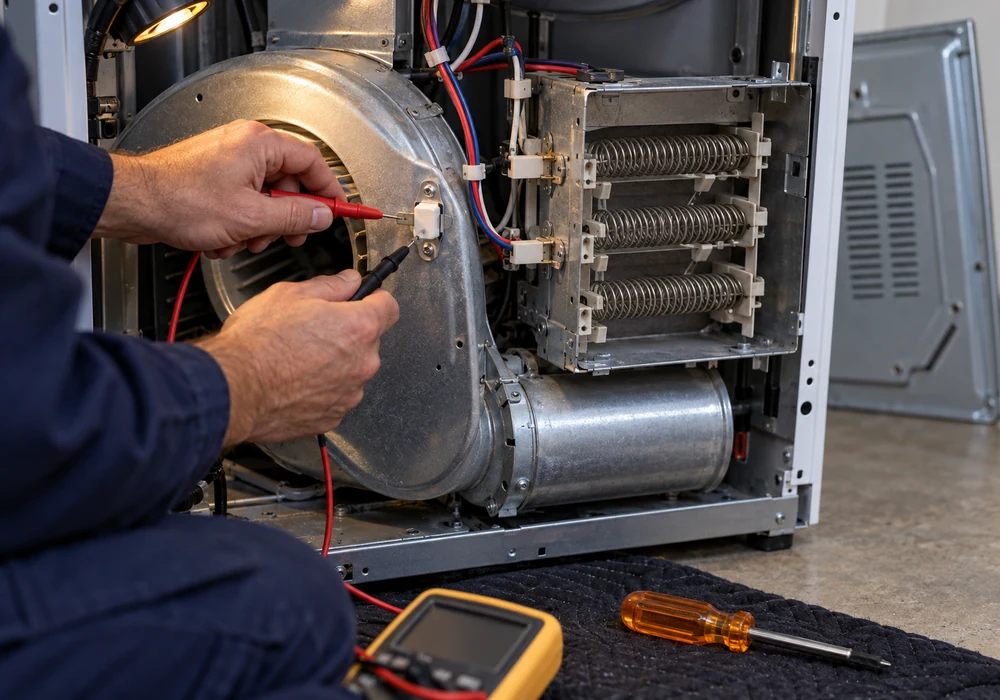
Symptoms that match this problem
- Drum tumbles normally but the air stays cold
- Clothes still damp after a full cycle
- Cycle finishes much faster than usual
- No warmth at the exterior vent while running
- Burning smell during or after the cycle
- Machine stops partway through and will not restart
What to do and what to avoid
| Do this | Do not do this |
|---|---|
| Clean the lint filter and check the housing beneath it | Do not keep running cycles hoping it will recover |
| Pull the dryer forward and inspect the transition hose for crushing | Do not run the dryer with the duct disconnected |
| Check the exterior vent flap opens freely when the dryer runs | Do not vent a dryer into a crawl space, attic or garage |
| Feel for warm airflow at the exterior vent during a cycle | Do not replace a thermal fuse without clearing the airflow restriction |
| Confirm both breakers are on, because electric dryers use a double-pole breaker | Do not continue using a dryer that smells of burning |
| Note whether the machine is gas or electric before you call |
What causes it, ranked by likelihood
Technicians work through these in roughly this order, because starting with the cheapest and most common cause saves you money.
- 1
Tripped thermal fuse
Most likelyA one-time safety device that cuts the heating circuit after an overheat. It almost always trips because restricted airflow caused the overheat, so the vent is the real fault.
- 2
Failed heating element
Very commonOn electric dryers the resistive element eventually breaks. Often visible as a blistered or split coil. The drum still turns because the motor circuit is separate.
- 3
Restricted vent or ducting
Very commonA packed filter, crushed transition hose or clogged duct run traps moist air in the drum. This causes repeated overheating, which is what trips fuses and kills elements.
- 4
Failed igniter or gas valve coils
Common on gas modelsOn a gas dryer the igniter must glow hot enough to open the safety valve. A weakened igniter glows but never reaches the threshold, so no gas burns.
- 5
Cycling thermostat failure
Less commonThe thermostat that regulates drum temperature has failed open, so the element or burner never switches on.
- 6
Control board fault
Least likelyThe board is not commanding the heating circuit. Least common and diagnosed after the heating components and airflow are checked.
How a technician works through it
Clear the lint filter and housing
Remove the filter, wash it if it has a film on it, and check the slot beneath for accumulated lint. A filter that looks clean can still be coated with a film that blocks air.
Check the transition hose
Pull the dryer forward. Look for a flexible hose crushed between the machine and the wall, which is one of the most common findings on this fault.
Test the exterior vent
With the dryer running, check the exterior flap. It should open with clear warm airflow. A flap held shut by lint or a nest blocks the entire system.
Check both breakers
An electric dryer runs on a double-pole breaker. If one half has tripped the drum will still turn while the heating circuit stays dead, which looks exactly like this fault.
Book a diagnosis
If airflow is clear and the breakers are fine, the fuse, element, igniter or thermostat needs testing. Note whether it is gas or electric, then call.
The fuse is a symptom, not the disease
The most common finding on a dryer that tumbles without heat is a tripped thermal fuse. It is a one-time safety device that permanently opens the heating circuit when the machine overheats, and replacing it is inexpensive.
What matters is why it tripped. A dryer overheats because the hot air it produces cannot leave. The heat builds in the cabinet, the cycling thermostat cuts the element, the machine cools slightly, the element returns, and the loop repeats. Each cycle stresses the fuse a little more until it finally opens for good.
So the fuse failed, but the vent caused it. Replacing the fuse alone and handing back the machine means the new fuse will trip too, usually within weeks. That is why a technician works through the entire airflow path before fitting any electrical part: the lint filter and its housing, the transition hose behind the machine, the duct run through the wall, and the exterior vent flap.
Check the breakers before you check anything else
This one catches a lot of people, and it costs nothing to rule out. An electric dryer runs on a double-pole breaker, which supplies two legs of 120 volt power that together give the 240 volts the heating element needs. The motor only needs one leg.
If one half of that breaker trips, the dryer behaves in a very specific way: the drum tumbles normally, the controls light up, the cycle runs, and absolutely nothing heats. It is indistinguishable from a failed element without testing, and switching the breaker fully off and back on sometimes resolves it outright.
Gas dryers do not have this failure mode, so establishing whether your machine is gas or electric before you call genuinely speeds up the visit.
The fire risk deserves a plain statement
Clothes dryers are a well-documented cause of home fires, and failure to clean them is the leading contributing factor. Lint is highly combustible, and a restricted vent provides both the fuel and the heat.
This is why a burning smell from a dryer is the one symptom on this page that should stop the cycle immediately rather than at the end of the load. Unplug the machine or switch off its breaker and leave it alone until it has been inspected. Routine prevention is simple: clean the filter after every load, have the duct cleared annually, use rigid or semi-rigid metal duct rather than foil flexible hose where possible, and keep the space behind the machine clear.
What the repair usually costs
| Repair | Typical range | Market |
|---|---|---|
| Service call and diagnosis | $79 | Waived on approval |
| Dryer repair | $130 to $380 | mid-size city |
Typical completed-repair ranges including parts and labor; your technician confirms the exact price on site before any work begins.

When to stop troubleshooting and unplug it
- A burning smell from a dryer is urgent. Stop the cycle, unplug the machine or switch off its breaker, and do not run it again until it has been inspected.
- Lint accumulation in the duct run is a recognised contributing factor in home dryer fires. Clean the filter after every load and clear the duct annually.
- Never run a dryer with the duct disconnected or vented indoors. Moist lint-laden air has to leave the building.
- On a gas dryer, any gas odour means leaving the building and calling your gas utility or 911 from outside before anything else.
More guidance: US Fire Administration home fire prevention (opens in a new tab) · CPSC appliance recall notices (opens in a new tab) · Energy.gov energy saving guidance (opens in a new tab)
Book the right service
Related problem guides
Get this fixed in your area
Dryer Not Heating, common questions
Why does my dryer turn but not heat?
The motor circuit and the heating circuit are separate, so the drum can tumble perfectly while nothing heats. On electric dryers the usual causes are a tripped thermal fuse or a failed heating element. On gas models it is the igniter or the gas valve coils. All are standard van-stock parts.
Why did my thermal fuse trip in the first place?
Because the dryer overheated, and it overheated because air could not leave. The fuse is a symptom rather than the disease. Replacing it without clearing the vent restriction guarantees the new one trips too, which is why a technician checks the full airflow path first.
How much does it cost to fix a dryer that will not heat?
Completed repairs typically run $115 to $430 including parts and labor. A thermal fuse, igniter or thermostat sits at the low end of that range, and a heating element slightly above it. A control board reaches the top but is the least likely cause.
Could a tripped breaker explain it?
On an electric dryer, yes, and it is worth checking first. These run on a double-pole breaker supplying two legs of power. If one leg trips, the motor still has enough to turn the drum while the heating element has nothing, which looks exactly like a failed element.
Is a dryer that is not heating dangerous?
The lack of heat is not itself dangerous, but the reason behind it often is. Restricted airflow causes repeated overheating, and lint in a hot duct is how dryer fires start. If there is any burning smell, stop immediately and do not run the machine again until it is inspected.
Gas or electric, does the repair differ?
Yes. Electric dryers fail at the heating element and thermal fuse. Gas dryers fail at the igniter, the flame sensor and the valve coils. Costs are broadly similar, but any gas repair is leak-checked before the visit closes, which adds a little time to the appointment.