

Is this an emergency or can it wait?
Treat it as urgent if there is water on the floor, a burning smell, sparking or food at risk, and stop using the appliance. Otherwise it can wait for a normal appointment. Call (844) 578-2720 and the dispatcher will triage it with you on the line.
Call (844) 578-2720 for the next available window.
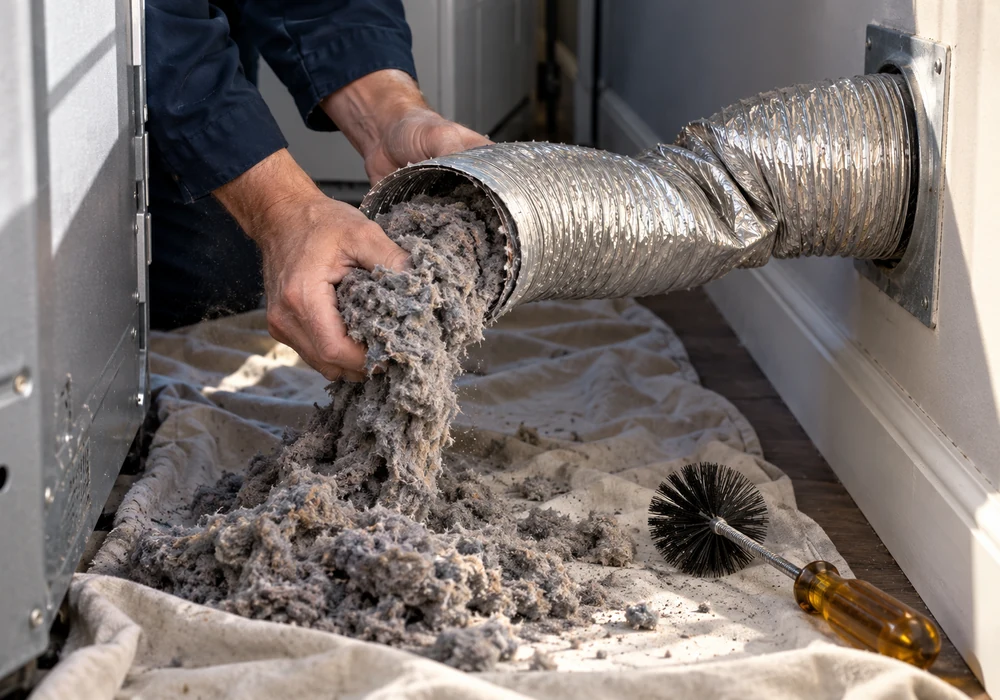
Symptoms that match this problem
- Two or three cycles needed to dry one normal load
- Clothes come out hot but still damp
- Laundry room becomes humid while the dryer runs
- Weak or no airflow at the exterior vent
- Cabinet or drum feels unusually hot to touch
- Machine shuts off early then restarts fine
What to do and what to avoid
| Do this | Do not do this |
|---|---|
| Wash the lint filter in warm soapy water and let it dry fully | Do not run the dryer with a blocked or disconnected duct |
| Pull the dryer forward and straighten the transition hose | Do not use long flexible foil ducting if rigid duct will fit |
| Check the exterior vent flap opens fully when the dryer runs | Do not overload the drum to save time, which makes drying worse |
| Hold a hand at the exterior vent to feel airflow strength | Do not ignore a hot cabinet, which indicates heat is not leaving |
| Wipe the moisture sensor bars inside the drum with a little rubbing alcohol | Do not assume the heating element is at fault before checking airflow |
| Dry full but not overpacked loads |
What causes it, ranked by likelihood
Technicians work through these in roughly this order, because starting with the cheapest and most common cause saves you money.
- 1
Clogged duct run or exterior vent
Most likelyLint accumulates along the duct and at the exterior flap until airflow collapses. Moist air stays in the drum, so clothes stay damp no matter how long the machine runs.
- 2
Crushed transition hose
Very commonThe flexible hose behind the machine gets crushed when the dryer is pushed back against the wall. A kink of a few inches can halve the airflow.
- 3
Lint filter film
Very commonFabric softener and dryer sheets leave an invisible film on the filter mesh that blocks air while looking perfectly clean. Washing the filter restores it.
- 4
Moisture sensor coated with residue
CommonSoftener residue on the sensor bars makes the dryer misread damp clothes as dry and end the cycle early, which reads as needing several cycles.
- 5
Blower wheel damage
Less commonA cracked or clogged blower wheel moves far less air than it should, producing the same symptom as a blocked duct with a clear duct.
- 6
Weak heating element or thermostat
Least likelyPartial heating failure produces long cycles rather than no heat. Diagnosed after airflow is confirmed clear, because airflow is the cause far more often.
How a technician works through it
Test the filter for film
Hold the lint filter under running water. If the water pools on the mesh instead of running straight through, softener residue is blocking it. Wash it with warm soapy water and a soft brush.
Check airflow at the exterior vent
Run the dryer and hold your hand at the outside vent. You should feel strong warm airflow. Weak or no flow means a restriction somewhere along the duct run.
Straighten the transition hose
Pull the dryer forward and look at the hose behind it. Remove any crushing or sharp kink and leave enough clearance when you push the machine back.
Clean the moisture sensor
Find the two metal strips inside the drum near the filter opening and wipe them with rubbing alcohol on a cloth. Residue here causes early cycle termination.
Book a duct clearance or diagnosis
If the filter and hose are clear but airflow at the vent is still weak, the duct run needs clearing. If airflow is strong and cycles are still long, call for a diagnosis.
This is an airflow problem until proven otherwise
A dryer does not dry clothes by heating them. It dries them by passing hot air through them, picking up moisture, and carrying that moisture out of the building. Heat is only half the mechanism, and the half that fails most often is the carrying away.
That is why long cycles point so reliably at airflow. If the moist air cannot leave, it recirculates inside the drum, already saturated and unable to pick up any more water. The clothes become hot and stay damp, which is precisely the symptom people describe. Running a second and third cycle does not help, because nothing has changed about the air.
Work along the path in order. The lint filter and its housing come first, then the transition hose behind the machine, then the duct run through the wall, then the exterior vent flap. A restriction anywhere along that chain produces the same result, and finding it is usually a matter of feeling the airflow at the outside vent while the machine runs.
The invisible filter blockage
This is worth singling out because it defeats almost everyone. A lint filter can look spotless and still be substantially blocked.
Fabric softener and dryer sheets deposit a fine waxy film on the filter mesh. It is transparent, it does not look like lint, and it builds up over months. The test takes ten seconds: hold the filter under a running tap. Water should pass straight through the mesh. If it pools or beads on the surface, the mesh is blocked and the dryer has been fighting it for a long time.
Washing the filter in warm soapy water with a soft brush restores it completely. Doing that every few months, if you use softener or sheets, prevents the problem recurring.
Why the moisture sensor matters
Most modern dryers do not run for a fixed time on auto cycles. They sense how damp the clothes are through two metal strips inside the drum and stop when the reading says dry.
Those strips accumulate the same softener residue as the filter, and residue insulates them. The sensor then reads damp clothes as dry and ends the cycle early, which the household experiences as needing two or three cycles to finish a load. Wiping the bars with rubbing alcohol on a cloth takes a minute and is worth doing before booking anything.
What the repair usually costs
| Repair | Typical range | Market |
|---|---|---|
| Service call and diagnosis | $79 | Waived on approval |
| Dryer repair | $130 to $380 | mid-size city |
Typical completed-repair ranges including parts and labor; your technician confirms the exact price on site before any work begins.

When to stop troubleshooting and unplug it
- Restricted airflow causes repeated overheating, and lint in a hot duct is a recognised cause of home fires. Treat poor airflow as a safety issue, not just an inconvenience.
- Stop using the dryer immediately if you notice any burning smell, and do not run it again until inspected.
- Never vent a dryer into a crawl space, attic, garage or indoor room. The moist lint-laden air must leave the building.
- Unplug the machine before removing the filter housing or any panel.
More guidance: US Fire Administration home fire prevention (opens in a new tab) · Energy.gov energy saving guidance (opens in a new tab) · ENERGY STAR appliance guidance (opens in a new tab)
Book the right service
Related problem guides
Get this fixed in your area
Dryer Takes Too Long, common questions
Why does my dryer take three cycles to dry one load?
Almost always restricted airflow rather than a heating problem. A dryer works by carrying moisture out of the drum in hot air, and if that air cannot leave, the moisture stays put. The clothes get hot but never dry, no matter how many cycles you run.
My lint filter looks clean. Can it still be blocking air?
Yes, and this catches almost everyone. Fabric softener and dryer sheets leave an invisible film on the mesh. Hold the filter under running water, and if the water pools rather than passing straight through, the mesh is blocked. Wash it with warm soapy water and a soft brush.
How often should the dryer duct be cleaned?
Once a year for a typical household, and more often with a long duct run, a large family or frequent bedding loads. Cleaning the lint filter after every load is a separate job and does not substitute for clearing the duct, where the dangerous accumulation actually happens.
Could this be a heating fault rather than airflow?
It can be, but airflow is far more common and should be ruled out first. A partially failed element or thermostat produces long cycles rather than no heat at all. A technician checks the full airflow path before condemning any heating component, because the reverse order wastes your money.
Why does my laundry room get humid when the dryer runs?
Because moisture that should be leaving through the duct is escaping into the room instead. That means a disconnected or leaking duct, or a vent so restricted that air is backing up. It is worth investigating promptly, since persistent indoor humidity causes problems of its own.
Does overloading the dryer make it slower?
Significantly. Air has to circulate between the items to pick up moisture, and an overpacked drum leaves no room for that. Counterintuitively, two properly sized loads often finish faster than one crammed load, and they put far less strain on the belt and motor.