

Is this an emergency or can it wait?
Treat it as urgent if there is water on the floor, a burning smell, sparking or food at risk, and stop using the appliance. Otherwise it can wait for a normal appointment. Call (844) 578-2720 and the dispatcher will triage it with you on the line.
Call (844) 578-2720 for the next available window.
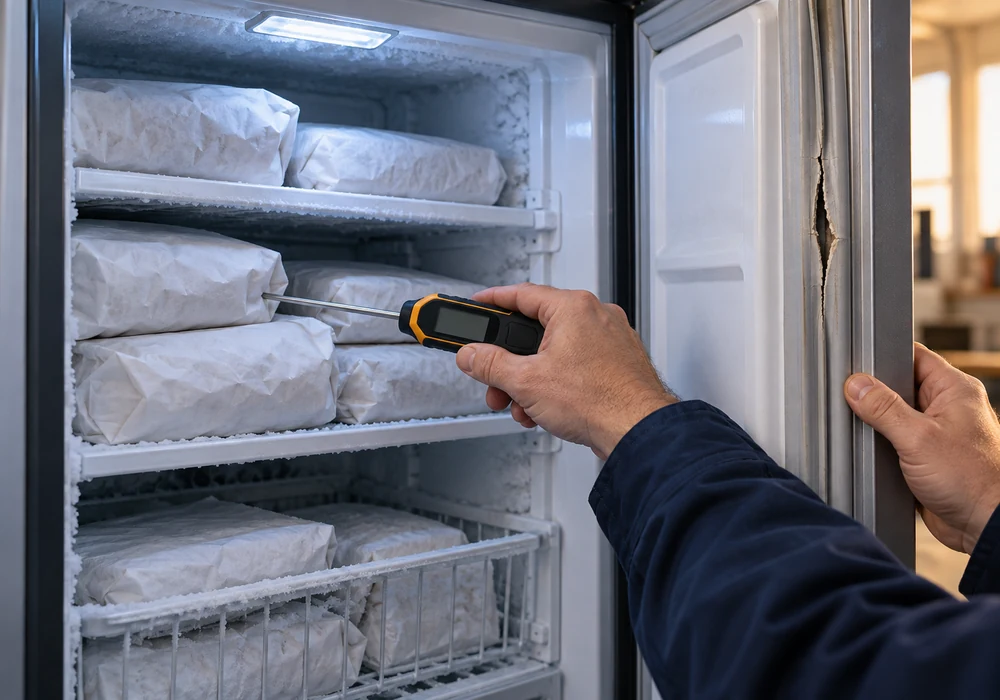
Symptoms that match this problem
- Ice cream soft and food partly thawed
- Heavy frost building up within days of clearing it
- Compressor running almost continuously
- Condensation or ice around the door edges
- Puddle of water on the floor beneath the unit
- Unit noticeably hot along the sides
What to do and what to avoid
| Do this | Do not do this |
|---|---|
| Keep the door closed as much as possible while you wait | Do not keep opening the door to check whether it is improving |
| Move the highest-value food to a cooler with ice in one pass | Do not pack food tightly against the rear air vents |
| Check the door seals all the way round for splits or hardening | Do not chip ice off the coil with anything sharp |
| Close the door on a sheet of paper and check it grips at several points | Do not attempt to add refrigerant yourself |
| Vacuum the condenser coils if they are accessible | Do not assume food is safe based on appearance alone |
| Confirm the unit is rated for its location if it sits in a garage |
What causes it, ranked by likelihood
Technicians work through these in roughly this order, because starting with the cheapest and most common cause saves you money.
- 1
Defrost heater or thermostat failure
Most likelyThe defrost cycle is no longer clearing the evaporator coil, so frost accumulates until air cannot pass through it. The compressor runs constantly while the compartment slowly warms.
- 2
Door gasket failure
Very commonA hardened, split or distorted seal lets warm moist room air in continuously. Frost forms near the door rather than evenly on the coil, and the unit never stops running.
- 3
Condenser coils clogged
CommonDust packed around the coils stops heat leaving the appliance. Common in garages and basements, and the single most preventable cause here.
- 4
Condenser fan failure
CommonThe fan that moves air across the condenser has stopped, so heat cannot be rejected. The cabinet runs hot and cooling performance drops away.
- 5
Blocked defrost drain tube
Less commonMeltwater cannot escape, refreezes in the base and eventually blocks airflow. Often first noticed as water on the floor rather than as a temperature problem.
- 6
Sealed system or refrigerant fault
Least likelyA leak or restriction in the refrigerant circuit. Least common and most expensive, requiring an EPA Section 608 certified technician.
How a technician works through it
Check the door seal
Close the door on a sheet of paper at several points around the frame. If it slides out easily anywhere, the gasket is not sealing there.
Look for the frost pattern
Even heavy frost across the rear panel points at the defrost system. Frost concentrated near the door edges points at the gasket.
Feel the cabinet sides
A cabinet that is hot to touch suggests heat is not being rejected, which points at clogged condenser coils or a failed condenser fan.
Clean the condenser coils
With the unit unplugged, vacuum the coils. In a dusty garage or basement this is often the whole fault.
Protect the food and book a diagnosis
Move the valuable items to a cooler, leave the door shut, and call with a note of the frost pattern and whether the cabinet felt hot.
The frost pattern tells you which fault you have
Two very different problems both produce a warm freezer full of frost, and you can separate them by looking at where the frost is.
Even, heavy frost spread across the rear interior panel means the defrost cycle is not working. The coil behind that panel runs below freezing and collects moisture continuously; a heater melts it off on a schedule. When the heater or its thermostat fails, nothing clears it, and the build-up eventually blocks airflow completely. The compressor then runs without pause while the compartment warms, which is why these units feel like they are working hard and achieving nothing.
Frost concentrated around the door edges, with condensation on the frame, means the seal has failed. Warm humid room air is being drawn in continuously and condensing on the first cold surface it reaches. A gasket can fail by hardening with age, splitting, or being distorted by something stored against the door for months. This is among the cheapest repairs in appliance work and among the most commonly ignored.
Heat has to go somewhere
The third category is heat rejection. A freezer works by moving heat from inside the cabinet to the room, and the condenser coils are where that heat leaves. If they are packed with dust, or the fan that moves air across them has stopped, the heat stays in the appliance.
The symptom is distinctive: the cabinet sides or rear feel hot to the touch, and the compressor runs almost continuously. Garages and basements are the worst environments for this because of the dust load. Vacuuming accessible coils once or twice a year is genuine maintenance, and in a dusty location it is sometimes the entire fault.
Protect the food first
The food is usually worth more than the repair, particularly in a chest freezer holding bulk purchases. The single most valuable thing you can do is stop opening the door.
A full freezer left closed holds safe temperature for around 48 hours. Half full, about 24. Decide in one pass which items are worth moving to a cooler packed with ice, do it quickly, and then leave the lid shut. Checking every hour is the fastest way to lose everything. Where the unit has been warm for longer than those windows, follow food safety guidance rather than judging by appearance.
What the repair usually costs
| Repair | Typical range | Market |
|---|---|---|
| Service call and diagnosis | $79 | Waived on approval |
| Refrigerator repair | $160 to $450 | mid-size city |
| Washing machine repair | $140 to $400 | mid-size city |
| Dryer repair | $130 to $380 | mid-size city |
| Oven and range repair | $150 to $420 | mid-size city |
| Dishwasher repair | $135 to $390 | mid-size city |
Typical completed-repair ranges including parts and labor; your technician confirms the exact price on site before any work begins.

When to stop troubleshooting and unplug it
- Refrigerant work is restricted by law to technicians holding EPA Section 608 certification. Never attempt to recharge a sealed system.
- A full freezer holds safe temperature for roughly 48 hours closed, and about 24 hours half full. Each opening costs hours of that margin.
- If water has reached an outlet or extension lead, switch the circuit off at the breaker before mopping.
- Unplug the unit before vacuuming coils or removing any panel.
More guidance: CPSC appliance recall notices (opens in a new tab) · ENERGY STAR appliance guidance (opens in a new tab) · EPA Section 608 refrigerant rules (opens in a new tab)
Book the right service
Related problem guides
Get this fixed in your area
Freezer Not Freezing, common questions
How long will food stay frozen if the freezer fails?
Roughly 48 hours in a full freezer if you keep the door closed, and about 24 hours if it is half full. A packed freezer holds temperature far better than an empty one because the frozen mass itself acts as a cold store. Opening it repeatedly is what destroys that margin.
Why is my freezer frosting up so fast?
Either the defrost system has failed or warm moist air is getting in. A failed defrost heater or thermostat leaves frost on the coil permanently. A split door gasket admits humid room air that condenses as frost near the door. The frost pattern distinguishes the two.
How much does freezer repair cost?
Completed repairs typically run $140 to $520 including parts and labor. A door gasket, thermostat or defrost heater sits at the lower end of that range. Compressor and sealed-system work reaches the top, and on an older unit that is where replacement usually makes better sense.
Can I put a freezer in the garage?
Only if it is rated for the temperature range the garage actually reaches. Standard freezers are designed for a conditioned room, and a hot summer garage pushes them outside their rated ambient. Garage-ready models exist and are worth the difference in those installations.
Why is there water on the floor under my freezer?
Most often a blocked defrost drain tube, which backs meltwater up until it overflows the pan. A failed door gasket also produces condensation that runs down the cabinet. Both are affordable repairs, but mop the water promptly so it does not reach the flooring or an outlet.
Is a freezer not freezing worth repairing?
Usually yes. Freezers are long-lived, often 12 to 16 years, and the common faults here are gaskets, thermostats, defrost components and fans, all modest parts. The exception is sealed-system work on a unit past about year twelve, where a replacement is normally better value.