

Is this an emergency or can it wait?
Treat it as urgent if there is water on the floor, a burning smell, sparking or food at risk, and stop using the appliance. Otherwise it can wait for a normal appointment. Call (844) 578-2720 and the dispatcher will triage it with you on the line.
Call (844) 578-2720 for the next available window.
Symptoms that match this problem
- Loud hum with no grinding and no rotation
- Unit stops after a few seconds and goes silent
- Reset button on the underside has popped out
- Burning electrical smell from under the sink
- Water draining very slowly or not at all
- Rattling that preceded the hum
What to do and what to avoid
| Do this | Do not do this |
|---|---|
| Switch the disposal off at the wall switch immediately | Do not keep flipping the switch to try to free it |
| Switch off the breaker supplying the disposal before reaching anywhere near it | Do not put your hand into the chamber under any circumstances |
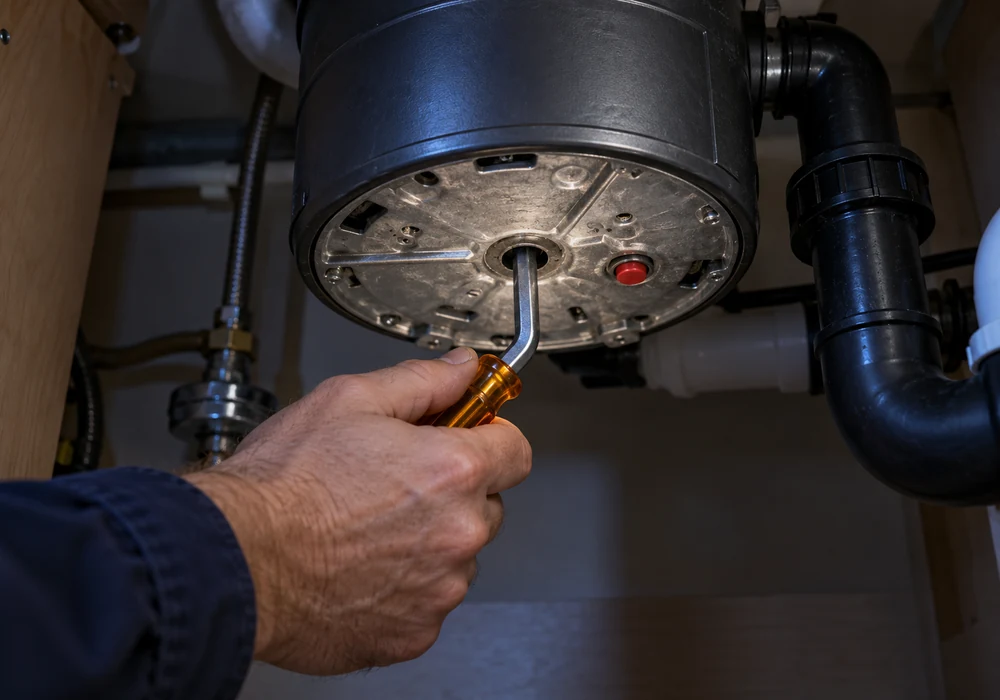
| Use the hex wrench in the socket on the underside to free the flywheel | Do not use a broom handle to lever the flywheel from above |
| Press the red reset button on the underside after clearing a jam | Do not pour drain cleaner into a jammed disposal |
| Remove debris with tongs or pliers, never fingers | Do not run it with a burning smell present |
| Run cold water while using the disposal in future |
What causes it, ranked by likelihood
Technicians work through these in roughly this order, because starting with the cheapest and most common cause saves you money.
- 1
Jammed flywheel
Most likelySomething is physically blocking the grinding plate, and the hum is the stalled motor trying to turn it. Cutlery, fruit pits, bones and bottle caps are the usual culprits.
- 2
Fibrous waste wrapped around the flywheel
Very commonCelery strings, corn husks, onion skins and artichoke leaves wrap rather than break up, binding the plate progressively until it stops.
- 3
Tripped overload reset
Very common after a jamThe thermal overload on the underside has tripped to protect the motor. The unit then goes completely silent, which people often read as a worse fault.
- 4
Seized bearing from long disuse
CommonA disposal unused for months, as in a holiday home, can seize from corrosion. Often freed with the hex wrench and then run normally.
- 5
Failed start capacitor
Less commonThe motor hums because it cannot start rotating rather than because anything is jamming it. Diagnosed once the chamber is confirmed clear.
- 6
Failed motor
Least likelyThe motor windings have failed. Because a replacement unit costs little more than the labor to repair one, this usually means replacement.
How a technician works through it
Switch it off at once
Turn off the wall switch. A humming disposal is a stalled motor drawing heavy current, and it overheats within seconds rather than minutes.
Isolate the power
Switch off the breaker supplying the disposal. Never rely on the wall switch alone before working near the chamber.
Free the flywheel
Find the hex socket in the centre of the underside and fit the supplied wrench, or a quarter inch hex key. Work it back and forth until the flywheel turns freely.
Remove the obstruction
Look into the chamber with a torch and lift out what you find using tongs or long pliers. Never use your fingers, even with the power off.
Reset and test
Press the red reset button on the underside, restore power, run cold water and switch on briefly. If it still hums, the capacitor or motor needs testing.
Switch it off before you do anything else
The hum is not the disposal trying to work. It is a stalled electric motor drawing heavy current against an obstruction it cannot move, and it converts almost all of that current into heat.
The timescale matters. A stalled motor overheats in seconds, not minutes, and the thermal overload exists precisely because people keep flipping the switch hoping it will break through. Every attempt adds heat. Enough attempts and an inexpensive jam becomes a failed motor, which on a disposal usually means replacing the whole unit.
So the first action is to turn off the wall switch. The second is to switch off the breaker supplying the disposal, because the wall switch alone is not adequate isolation for working anywhere near the chamber.
The hex wrench is the repair
This is one of very few appliance faults we actively encourage people to tackle, because the manufacturers designed it to be tackled.
Look at the centre of the underside of the unit. There is a hex socket there, and disposals ship with a small L-shaped wrench that fits it, usually clipped to the body or left in a drawer. A quarter inch hex key works equally well.
With the breaker off, fit the wrench and work it back and forth. You are turning the flywheel directly, and the rocking motion breaks whatever is wedged between the plate and the grinding ring. When it turns freely through full rotations, the jam is cleared.
Then look into the chamber with a torch and remove what you find, using tongs or long pliers. Never use fingers, even with the power off, because the grinding ring edges are sharp and because a cherished rule in this trade is that hands do not go in there.
Finally, press the red reset button on the underside, restore power, run cold water, and switch on briefly.
Why jams happen
Four categories of waste cause almost all of them, and none are obvious unless someone has said so.
Fibrous material is the worst offender. Celery strings, corn husks, onion skins and artichoke leaves wrap around the flywheel instead of breaking up, binding it progressively over weeks. Coffee grounds and eggshells behave differently: they grind finely but then settle as a dense paste downstream, so the symptom is slow draining rather than a jam. Grease enters as a liquid and solidifies as it cools in the pipe. Bones, fruit pits and bottle caps simply stop the plate outright.
Two habits prevent most of this. Run cold water rather than hot, because cold keeps fats solid enough to be carried away instead of coating the pipe. And feed waste in small amounts with the water already running, rather than filling the chamber and then switching on.
What the repair usually costs
| Repair | Typical range | Market |
|---|---|---|
| Service call and diagnosis | $79 | Waived on approval |
| Refrigerator repair | $160 to $450 | mid-size city |
| Washing machine repair | $140 to $400 | mid-size city |
| Dryer repair | $130 to $380 | mid-size city |
| Oven and range repair | $150 to $420 | mid-size city |
| Dishwasher repair | $135 to $390 | mid-size city |
Typical completed-repair ranges including parts and labor; your technician confirms the exact price on site before any work begins.

When to stop troubleshooting and unplug it
- Never put a hand into the grinding chamber, even with the power off. Use tongs or pliers.
- Switch off the breaker, not just the wall switch, before working near the disposal.
- A humming disposal is a stalled motor. Switch it off immediately, because it overheats within seconds and will destroy itself.
- Stop and call if there is a burning electrical smell from under the sink.
More guidance: CPSC appliance recall notices (opens in a new tab) · FTC Consumer Advice (opens in a new tab)
Book the right service
Related problem guides
Get this fixed in your area
Garbage Disposal Humming, common questions
Why does my garbage disposal hum but not spin?
The flywheel is jammed and the hum is the motor stalled against it. Switch it off at the wall immediately, because a stalled motor draws heavy current and overheats within seconds. Most disposals have a hex socket underneath that lets the flywheel be freed manually once the power is isolated.
Can I free the jam myself?
Usually yes, and it is one of the few appliance repairs we genuinely encourage attempting. Switch off the breaker, fit the supplied hex wrench into the socket in the centre of the underside, and work it back and forth. Then lift out the obstruction with tongs, never with fingers.
What is the red button on the bottom for?
It is the thermal overload reset. After a jam the motor protection trips and the unit goes completely silent, which people often mistake for a worse fault. Clear the jam first, then press the reset button firmly. If it trips again straight away, the jam is still there.
How much does it cost to fix a humming disposal?
Completed repairs typically run $95 to $280 including parts and labor. Clearing a jam sits at the low end, and you are largely paying for the service call. If the motor itself has failed, a replacement unit usually costs little more than the labor to repair the old one.
Is it worth repairing or should I replace it?
Jams, reset trips, gasket leaks, splash guards and drain elbows are all worth repairing. A failed motor, or a leak weeping from the body of the unit rather than a connection, is not, because the internal seal cannot be renewed. We will tell you plainly which you have.
What should I never put down a disposal?
Fibrous material such as celery and corn husks wraps the flywheel rather than breaking up. Coffee grounds and eggshells form a paste that settles downstream. Grease solidifies in the pipe. Bones and fruit pits jam it outright. Cold water and small quantities are the two habits that matter most.