

Is this an emergency or can it wait?
Treat it as urgent if there is water on the floor, a burning smell, sparking or food at risk, and stop using the appliance. Otherwise it can wait for a normal appointment. Call (844) 578-2720 and the dispatcher will triage it with you on the line.
Call (844) 578-2720 for the next available window.
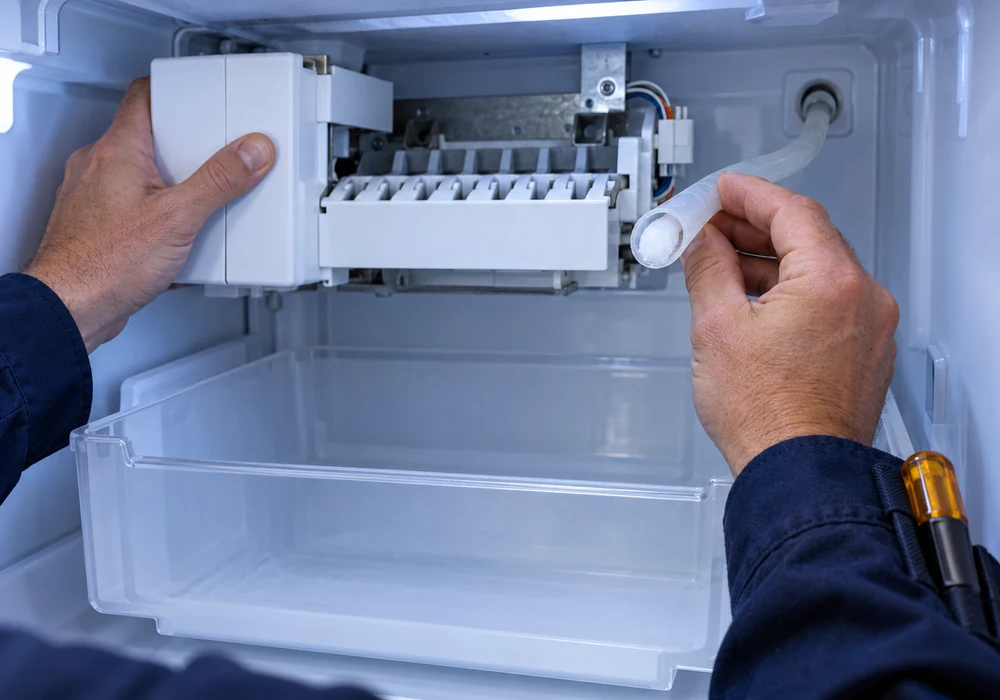
Symptoms that match this problem
- No ice at all while the refrigerator cools normally
- Hollow or half formed cubes
- Ice production much slower than it used to be
- Water dispenser also slow or not working
- Ice tastes or smells unpleasant
- Visible plug of ice in the fill tube
What to do and what to avoid
| Do this | Do not do this |
|---|---|
| Check when the water filter was last changed | Do not force ice out of the mould with a metal tool |
| Confirm the supply valve behind the refrigerator is fully open | Do not use hot water to melt a frozen fill tube |
| Check whether the water dispenser also runs slowly | Do not ignore water pooling behind the refrigerator |
| Look for a plug of ice in the fill tube | Do not assume the module has failed before checking the filter |
| Confirm the ice maker is switched on in the control panel | Do not leave an old filter in place to save money |
| Check the freezer is holding a proper freezing temperature |
What causes it, ranked by likelihood
Technicians work through these in roughly this order, because starting with the cheapest and most common cause saves you money.
- 1
Saturated water filter
Most likelyA filter past its service life restricts flow long before it blocks completely. The commonest cause by a wide margin, and the one fix that needs no technician at all.
- 2
Supply valve closed or partly closed
Very commonThe valve behind or beneath the refrigerator has been closed or knocked, often after unrelated plumbing work. Costs nothing to check and resolves the fault outright.
- 3
Frozen fill tube
CommonA plug of ice blocks the tube that fills the mould. Both a symptom and a cause, because it recurs until the underlying temperature or flow issue is addressed.
- 4
Failed water inlet valve
CommonThe valve that admits a measured amount of water is no longer opening fully or at all. Produces no ice or persistently hollow cubes.
- 5
Ice maker module or thermostat failure
Less commonThe module that ejects cubes, or the thermostat that decides when they are frozen, has failed. The mould may fill but never cycle.
- 6
Door switch or dispenser fault
Least likelySome units pause ice production based on door state. A failed switch can therefore stop production with nothing else wrong.
How a technician works through it
Change the water filter
Check the service date and replace it if it is past six months. This is the single most common cause and needs no technician, so it is always the first step.
Check the supply valve
Locate the valve behind or beneath the refrigerator and confirm it is fully open. A partly closed valve gives exactly these symptoms.
Test the dispenser
Run the water dispenser. Slow flow there as well confirms a supply restriction rather than an ice maker fault, which narrows things considerably.
Inspect the fill tube
Look for a plug of ice in the small tube feeding the mould. If present, the mould is not filling and the blockage needs clearing and the cause addressed.
Book a diagnosis
If the filter is current, the valve is open and the dispenser flows well, the inlet valve, module or thermostat needs testing. Note what you checked, then call.
Follow the water, in order
An ice maker is a simple machine bolted to a complicated one. A valve admits a measured amount of water, a mould holds it against the freezer’s cold, a thermostat decides when it has frozen, and a motor ejects the cubes. When no ice appears, the useful question is whether water arrived at all.
The reason this matters is that the causes line up in a clear order of likelihood, and the cheapest are first. Work backwards from the mould:
The water filter is the most common cause by a wide margin. Filters restrict flow progressively as they saturate, so performance declines for months before it stops. Replacing one costs the price of the filter and needs no technician. Check the date before you do anything else.
The supply valve is next, and costs nothing. Valves behind or beneath a refrigerator get closed or knocked during unrelated plumbing work, and a partly closed valve produces exactly these symptoms.
The fill tube follows. A plug of ice in the small tube feeding the mould blocks filling entirely. It is worth noting that this is both a symptom and a cause: it tends to recur until whatever allowed it to freeze is addressed, which is often the fill tube heater.
Only then does the inlet valve itself come into question, and after that the module and thermostat.
Hollow cubes are the early warning
If your cubes have been getting smaller, or coming out hollow with a frozen shell and a void inside, that is the same fault caught earlier. Water is arriving, but not enough of it, so the mould partly fills and freezes around the gap.
It is worth acting at this stage rather than waiting for production to stop. The same restriction left alone progresses to no ice at all, and a fill tube that repeatedly freezes eventually needs its heater replaced as well. Changing the filter when cubes start looking hollow often prevents the whole sequence.
The leak nobody sees coming
The one genuinely urgent ice maker fault is the supply line. These are typically plastic tubing with compression fittings, routed behind a heavy appliance that nobody moves, and they fail at kinks or after freezing and splitting.
Because the line sits under constant mains pressure, a failure runs continuously, often behind a cabinet, until flooring lifts or a ceiling below stains. If you find water behind or beneath the refrigerator, close the supply valve first and investigate second. When the unit is next pulled out for cleaning, inspecting that line costs nothing, and a braided stainless replacement is a worthwhile upgrade.
What the repair usually costs
| Repair | Typical range | Market |
|---|---|---|
| Service call and diagnosis | $79 | Waived on approval |
| Refrigerator repair | $160 to $450 | mid-size city |
| Washing machine repair | $140 to $400 | mid-size city |
| Dryer repair | $130 to $380 | mid-size city |
| Oven and range repair | $150 to $420 | mid-size city |
| Dishwasher repair | $135 to $390 | mid-size city |
Typical completed-repair ranges including parts and labor; your technician confirms the exact price on site before any work begins.

When to stop troubleshooting and unplug it
- A leaking ice maker supply line runs continuously under mains pressure. Close the supply valve before investigating anything else.
- Sealed refrigerant work on the host refrigerator is restricted by law to EPA Section 608 certified technicians.
- If water has reached flooring or an outlet, switch the circuit off at the breaker before mopping.
- Never use a metal tool to free ice from the mould, which damages the mould and the heater beneath it.
More guidance: EPA Section 608 refrigerant rules (opens in a new tab) · CPSC appliance recall notices (opens in a new tab) · ENERGY STAR appliance guidance (opens in a new tab)
Book the right service
Related problem guides
Get this fixed in your area
Ice Maker Not Making Ice, common questions
Why is my ice maker not making ice when the fridge still cools?
Because cooling and ice making are separate systems, and the fault is almost always water not arriving rather than anything wrong with the refrigeration. Work backwards along the water path, starting with the filter, then the supply valve, the fill tube and the inlet valve. The filter is the most common answer.
How often should I change the water filter?
Every six months as a rule, or sooner if you notice taste changes or slower dispensing. In hard water areas the interval shortens. A neglected filter is behind a surprising share of the ice maker calls we attend, and replacing it is the one fix requiring no technician.
Why are my ice cubes hollow or only half formed?
The mould is not filling completely, which means restricted flow rather than a failed mechanism. It is the same family of causes as no ice at all, just caught earlier. Change the filter and check the supply valve before assuming a part has failed.
How much does ice maker repair cost?
Completed repairs typically run $110 to $330 including parts and labor. A fill tube heater or water inlet valve sits at the lower end, and a full ice maker module reaches the top. If the cause turns out to be the filter, you can resolve it yourself for the price of the filter.
Why does my ice taste bad?
Most often an overdue filter, which stops removing taste and odour long before it restricts flow enough to notice. Ice also absorbs odours from the freezer, so strongly flavoured uncovered food nearby transfers into it. Replace the filter, discard a few batches, and store food covered.
Is an ice maker fault worth repairing?
Usually yes, because the parts are inexpensive relative to the refrigerator they sit in and the labor is contained. Replacing a working refrigerator over an ice maker fault rarely makes sense. The exception is a unit already past year twelve facing other faults as well.