

Is this an emergency or can it wait?
Treat it as urgent if there is water on the floor, a burning smell, sparking or food at risk, and stop using the appliance. Otherwise it can wait for a normal appointment. Call (844) 578-2720 and the dispatcher will triage it with you on the line.
Call (844) 578-2720 for the next available window.
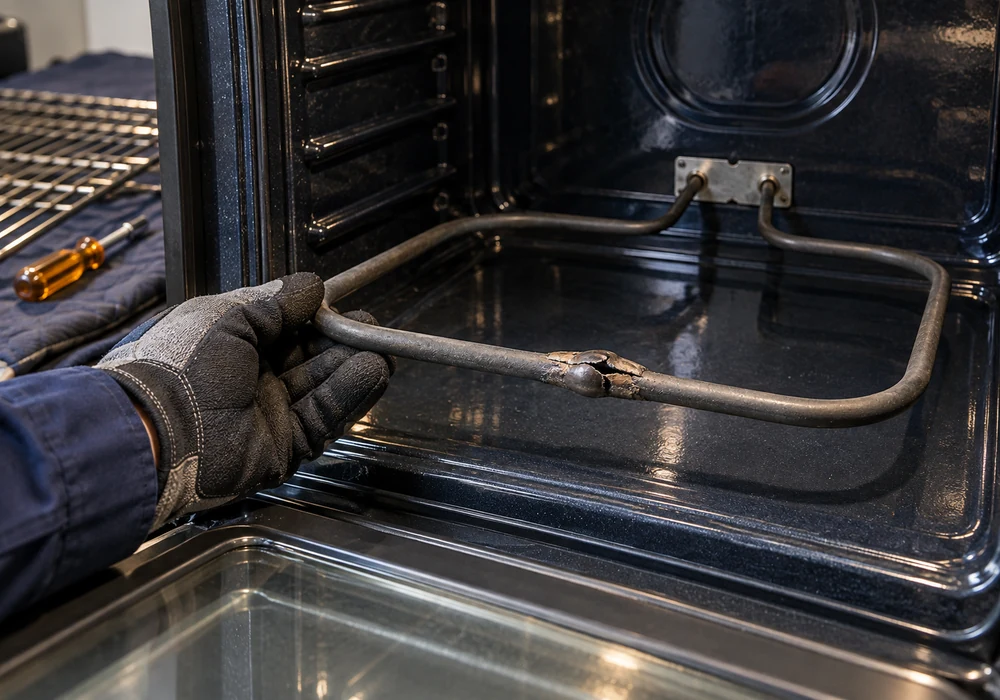
Symptoms that match this problem
- Oven stays cold while the control panel works normally
- Broil works but bake does not, or the reverse
- Gas igniter glows but the burner never lights
- Food browning on top but raw underneath
- Visible blister or split in the element
- Oven takes far longer than usual to preheat
What to do and what to avoid
| Do this | Do not do this |
|---|---|
| Look inside the cavity for a visible break or blister in the element | Do not touch an element that may still be hot |
| Test whether broil works when bake does not, and note which | Do not use the oven if you smell gas |
| Check both halves of the double-pole breaker on an electric oven | Do not force a door locked by an interrupted self-clean cycle |
| Note whether a gas igniter glows at all before the fault | Do not keep running the self-clean cycle to try to reset it |
| Use an oven thermometer to see whether it heats at all, just slowly | Do not bridge or bypass a temperature sensor |
| Note the exact model number from the plate inside the door frame |
What causes it, ranked by likelihood
Technicians work through these in roughly this order, because starting with the cheapest and most common cause saves you money.
- 1
Failed bake element
Most likely on electricThe resistive element has broken, often visibly blistered or split. Because bake and broil elements are separate, one can fail while the other works perfectly.
- 2
Weak or failed igniter
Most likely on gasThe igniter must draw enough current to open the safety gas valve. A weakened igniter still glows but never reaches that threshold, so no gas is released and nothing burns.
- 3
Failed temperature sensor
CommonThe control reads the wrong cavity temperature and cycles heat incorrectly. Can present as no heat, weak heat or wildly inaccurate baking.
- 4
Tripped breaker leg
Common on electricElectric ovens use a double-pole breaker. If one leg trips, the controls and light still work while the heating circuit has nothing.
- 5
Failed control board or relay
Less commonThe board is not switching power to the heating circuit. Often accompanied by unresponsive or erratic controls.
- 6
Gas valve coil failure
Least likelyThe safety valve will not open even with a healthy igniter. Diagnosed after the igniter is tested, since the igniter is far more often the culprit.
How a technician works through it
Check bake against broil
Run the broil setting briefly and see whether the upper element glows or the burner lights. If broil works and bake does not, you have an isolated bake element or bake relay fault.
Inspect the element visually
With the oven cold, look along the bake element for a blister, split or burnt section. A visible break confirms the diagnosis without any test equipment.
Check the breaker
On an electric oven, switch the double-pole breaker fully off and back on. A single tripped leg leaves the controls alive while the heating circuit has no power.
Watch the gas igniter
On a gas oven, set it to bake and watch the igniter through the lower panel. If it glows orange for more than a minute without the burner lighting, the igniter is weak.
Book a diagnosis
Note whether it is gas or electric, whether broil works, and the model number from the door frame plate. Then call so the right part travels with the technician.
Which half of the oven still works?
Ovens are easier to diagnose than most appliances because their heating is split into separate circuits, and testing one against the other narrows things immediately.
Run the broil setting briefly. On an electric oven, watch whether the upper element glows. On a gas oven, listen for the burner lighting. If broil works and bake does not, a great deal is ruled out at once: the power supply is fine, the controls are fine, the thermostat is reading something sensible, and the fault is isolated to the bake element or the relay that switches it. That is a straightforward and affordable repair.
If neither works, attention moves to the supply and the control board. On an electric oven that means the double-pole breaker, and this is worth checking before anything else because it is free. A single tripped leg leaves the clock, the light and the controls fully alive while the heating circuit has no power at all, which looks exactly like a failed element.
Gas ovens fail at the igniter
On a gas oven the igniter does more than light the gas. On most designs it is wired in series with the safety gas valve, and it must draw a specific current before that valve will open. The current draw is what proves to the appliance that the igniter is hot enough to ignite gas safely.
This produces a distinctive failure mode. As an igniter ages it still glows, often brightly, but its current draw falls below the threshold. The valve never opens, no gas is released, and you watch an orange glow for a minute or two followed by nothing. People reasonably conclude there is a gas supply problem when the igniter is the only part at fault.
Watching through the lower panel while the oven tries to light is genuinely diagnostic, so note what you see before calling.
The gas smell rule, stated plainly
Everything else on this page can wait for an appointment. This cannot.
If you smell gas near the range, leave the building and take everyone with you. Call your gas utility or 911 from outside. Do not switch anything on or off, including a light switch, and do not use a phone indoors. An appliance repair visit is not the next step; confirmation from the utility that the supply is safe is. We can attend afterwards, and we will ask whether that has happened.
The related warning is a yellow flame. A blue flame with a small yellow tip is normal. A broadly yellow, lazy or sooting flame means combustion is incomplete, and incomplete combustion of gas produces carbon monoxide. Stop using that burner and have it inspected.
What the repair usually costs
| Repair | Typical range | Market |
|---|---|---|
| Service call and diagnosis | $79 | Waived on approval |
| Oven and range repair | $150 to $420 | mid-size city |
Typical completed-repair ranges including parts and labor; your technician confirms the exact price on site before any work begins.

When to stop troubleshooting and unplug it
- If you smell gas near the range, leave the building with everyone in it and call your gas utility or 911 from outside. Do not switch anything on or off and do not use a phone indoors.
- A persistently yellow or sooting gas flame means incomplete combustion and therefore carbon monoxide. Stop using that burner.
- Let the oven cool completely before investigating a self-clean cycle stuck with the door locked, and never force the door.
- Switch off the circuit at the breaker before touching an element or removing any panel.
More guidance: US Fire Administration home fire prevention (opens in a new tab) · CPSC appliance recall notices (opens in a new tab) · ENERGY STAR appliance guidance (opens in a new tab)
Book the right service
Related problem guides
Get this fixed in your area
Oven Not Heating, common questions
Why will my electric oven not heat up?
The bake element is the most likely cause, and it often shows a visible blister or split once you look. Because bake and broil elements are separate circuits, one can fail while the other still works. A tripped leg on the double-pole breaker produces the same symptom and costs nothing to check.
My gas oven igniter glows but the burner never lights. Why?
The igniter has weakened. On most gas ovens it must draw enough current to open the safety gas valve, so an igniter that still glows visibly can be well below the threshold needed. It is a standard part and one of the more common gas oven repairs.
Broil works but bake does not. What does that mean?
It narrows the fault usefully. Bake and broil run on separate elements and separate relays, so one working proves the power supply, the controls and the thermostat are broadly fine. The fault is in the bake element itself or the relay that switches it.
How much does it cost to fix an oven that will not heat?
Completed repairs typically run $130 to $480 including parts and labor. An element, igniter or temperature sensor sits at the lower end. A control board reaches the top, and on a built-in wall oven a panel assembly can exceed it because the parts are brand-specific.
I smell gas near my oven. What should I do?
Leave the building immediately, taking everyone with you, then call your gas utility or 911 from outside. Do not switch anything on or off, do not use a light switch, and do not make the call indoors. This is not a repair call until the utility confirms the supply is safe.
My self-clean cycle finished and now the door is locked shut. Why?
The door lock motor or its switch has failed partway through, leaving the latch engaged. Let the oven cool completely first, because that cycle runs far hotter than normal cooking. Do not force the door, as that damages the latch and turns a modest repair into a larger one.