

Is this an emergency or can it wait?
Treat it as urgent if there is water on the floor, a burning smell, sparking or food at risk, and stop using the appliance. Otherwise it can wait for a normal appointment. Call (844) 578-2720 and the dispatcher will triage it with you on the line.
Call (844) 578-2720 for the next available window.
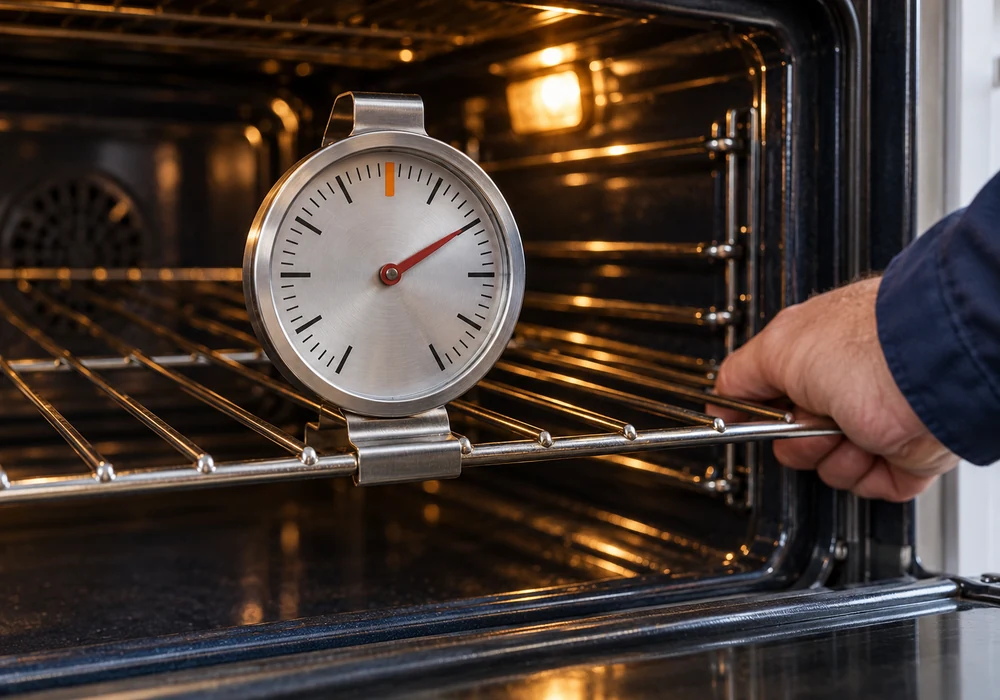
Symptoms that match this problem
- Baking consistently takes longer than the recipe says
- Food burning on one side and undercooked on the other
- Cakes sinking or failing to rise
- Oven thermometer reads well off the set temperature
- Kitchen heats up noticeably when the oven runs
- Preheat beep sounds long before the oven is actually hot
What to do and what to avoid
| Do this | Do not do this |
|---|---|
| Put an oven thermometer on the middle rack and compare it to the setpoint | Do not judge accuracy from the preheat beep, which is often optimistic |
| Let the oven fully stabilise for 20 minutes before reading it | Do not rely on the oven light to assess temperature |
| Check the door gasket all the way round for hardening or tears | Do not use the self-clean cycle as a fix, which stresses the controls |
| Check whether the door sits square against the frame | Do not pack the oven so full that air cannot circulate |
| Listen for the convection fan running on a convection setting | Do not keep increasing the setpoint to compensate without diagnosing it |
| Look in the manual for a calibration offset procedure |
What causes it, ranked by likelihood
Technicians work through these in roughly this order, because starting with the cheapest and most common cause saves you money.
- 1
Temperature sensor drift
Most likelyThe sensor reports the wrong cavity temperature so the control holds the oven at the wrong setpoint. The commonest cause of consistent inaccuracy, and an affordable part.
- 2
Door gasket failure
Very commonA hardened or torn seal lets heat escape continuously. The oven runs longer, cycles more and heats unevenly, because the loss is not uniform across the cavity.
- 3
Worn door hinges
CommonAs hinges wear the door sits slightly proud at one corner, and the resulting gap changes how the oven holds temperature even with a sound gasket.
- 4
Failed convection fan
Common on convection modelsWithout circulation the cavity develops hot and cold zones, producing the classic burnt on one side and raw on the other result.
- 5
Calibration offset needed
CommonMany ovens allow a calibration adjustment through the control panel. Small consistent errors are often correctable without any part at all.
- 6
Control board fault
Least likelyThe board is mismanaging the heating cycle. Least common, and diagnosed after the sensor, door and fan are checked.
How a technician works through it
Measure the actual temperature
Place an oven thermometer on the middle rack, set the oven to 350 degrees Fahrenheit, and let it run 20 minutes past the preheat beep before reading it.
Repeat the reading
Take two or three readings over half an hour. A consistent offset points at the sensor or calibration. A reading that swings widely points at the sensor or control board.
Check the door seal
Run a hand around the closed door, carefully, to feel for escaping heat. Inspect the gasket for hardening, splits or distortion, especially at the lower corners.
Check the convection fan
On a convection setting, listen for the fan. Silence where it should run explains uneven baking without any temperature error at all.
Calibrate or book a diagnosis
If the offset is small and consistent, your manual may allow a calibration adjustment. If it is large, inconsistent, or the door or fan is at fault, call for a diagnosis.
Measure it properly before anything else
Almost every conversation about oven accuracy starts with a guess, and guesses here are unreliable because the preheat beep is not a measurement. On many ovens it sounds when the sensor first touches the setpoint, well before the cavity walls and racks have absorbed enough heat to hold it.
Do this instead. Put an oven thermometer on the middle rack, set the oven to 350 degrees Fahrenheit, and leave it running for a full 20 minutes after the preheat beep before you read anything. Then take two or three more readings across the next half hour.
The pattern matters as much as the number. A consistent offset, say 25 degrees low every time, points at the temperature sensor or at a calibration setting that can be adjusted. A reading that swings widely, high then low then high, points at the sensor failing intermittently or at the control board mismanaging the cycle. Those are different repairs, and the readings tell a technician which to expect.
The door is part of the heating system
People think of an oven door as a lid. It is closer to being a wall, and when it stops sealing the oven cannot hold temperature properly no matter how accurate the sensor is.
A gasket that has hardened, split or been distorted lets heat escape continuously. The control responds by running the elements longer and cycling more often, so energy use rises while baking results get worse. Crucially, the loss is concentrated where the seal failed, which is why the symptom is usually uneven baking rather than a simple cool oven.
Hinges are the quieter version. As they wear, the door sits slightly proud at one corner and a small gap opens even with a perfect gasket. Two cues are worth noticing: a kitchen that heats up noticeably when the oven runs, and a door that feels warm to stand beside. Both point at the door before anything electrical.
Uneven is a different fault from inaccurate
It is worth separating these, because they lead different places.
Inaccurate means the whole cavity sits at the wrong temperature. That is the sensor, the calibration or the control.
Uneven means parts of the cavity are at different temperatures. On a convection model the first suspect is the fan, because its entire purpose is to eliminate those zones, and a silent fan explains burnt-on-one-side results with no temperature error at all. On a conventional oven, uneven results point back at the door seal, or simply at an overloaded cavity where air cannot circulate around the trays.
What the repair usually costs
| Repair | Typical range | Market |
|---|---|---|
| Service call and diagnosis | $79 | Waived on approval |
| Oven and range repair | $150 to $420 | mid-size city |
Typical completed-repair ranges including parts and labor; your technician confirms the exact price on site before any work begins.

When to stop troubleshooting and unplug it
- Let the oven cool completely before inspecting a gasket or reaching into the cavity.
- If you smell gas at any point, leave the building and call your gas utility or 911 from outside before anything else.
- Avoid the self-clean cycle while the oven has a known fault. It runs far hotter than cooking and stresses the latch, gasket and control board.
- Do not place an oven thermometer where it can contact an element directly.
More guidance: ENERGY STAR appliance guidance (opens in a new tab) · CPSC appliance recall notices (opens in a new tab) · Energy.gov energy saving guidance (opens in a new tab)
Book the right service
Related problem guides
Get this fixed in your area
Oven Temperature Inaccurate, common questions
How do I tell if my oven temperature is actually wrong?
Put an oven thermometer on the middle rack, set the oven to 350 degrees Fahrenheit, and let it run a full 20 minutes past the preheat beep before reading. Take two or three readings over half an hour, because a single reading taken too early will be misleading.
My oven is off by 25 degrees. Can that be adjusted?
Often yes. Many ovens allow a calibration offset through the control panel, and your manual will describe the procedure. That handles small consistent errors without any part. If the error is larger or varies between readings, the temperature sensor has usually degraded and needs replacing.
Why does my oven burn one side and undercook the other?
That pattern points at circulation rather than temperature. On a convection model a failed fan leaves hot and cold zones in the cavity. On any oven, a door that is not sealing squarely lets heat escape from one side, producing the same uneven result.
How much does it cost to fix an inaccurate oven?
Completed repairs typically run $130 to $480 including parts and labor. A temperature sensor or door gasket sits at the lower end of that band, hinges slightly above, and a convection fan motor mid range. A control board reaches the top but is rarely the cause.
Can a bad door seal really affect baking?
More than people expect. The gasket is part of the heating system, not just a lid. Continuous heat loss makes the oven run longer and cycle more often, and because the loss is concentrated where the seal has failed, the cavity heats unevenly rather than simply running cool.
Is the self-clean cycle making this worse?
It can. Self-clean runs the cavity far hotter than any cooking temperature, which stresses the door latch, the gasket and the control board. Technicians frequently see control failures shortly after a self-clean cycle, so using it sparingly on an oven with a known fault is sensible.