

Is this an emergency or can it wait?
Treat it as urgent if there is water on the floor, a burning smell, sparking or food at risk, and stop using the appliance. Otherwise it can wait for a normal appointment. Call (844) 578-2720 and the dispatcher will triage it with you on the line.
Call (844) 578-2720 for the next available window.
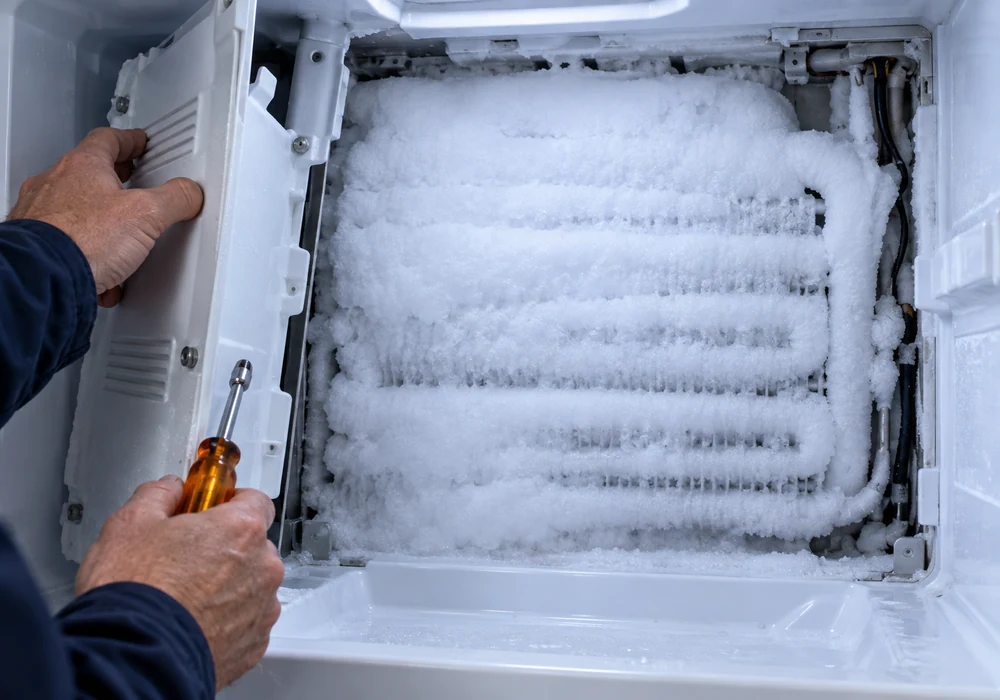
Symptoms that match this problem
- Freezer stays cold but the fresh food section warms up
- Compressor runs constantly without reaching temperature
- Heavy frost on the back wall of the freezer compartment
- Food spoiling faster than normal in the fridge section
- Unit feels hot along the sides or at the back
- No sound of air moving when the door is opened
What to do and what to avoid
| Do this | Do not do this |
|---|---|
| Check the freezer still feels properly cold, which narrows the fault considerably | Do not keep opening the doors to check the temperature |
| Listen for airflow when you open the freezer door | Do not turn the thermostat to its coldest setting, which will not fix a fault and may worsen frosting |
| Look for heavy frost on the back wall inside the freezer | Do not attempt to add refrigerant, which is illegal without certification and will not fix a leak |
| Vacuum the condenser coils at the back or underneath if they are accessible | Do not use a hairdryer or heat gun to melt frost off the coil |
| Confirm nothing is blocking the vents between the freezer and fridge sections | Do not leave a buzzing compressor running if the unit is not cooling at all |
| Move perishable food to a cooler while you wait |
What causes it, ranked by likelihood
Technicians work through these in roughly this order, because starting with the cheapest and most common cause saves you money.
- 1
Evaporator fan motor failure
Most likelyThe fan that pushes cold air from the coil into the compartments has stopped. The freezer often stays cold while the fridge warms, because the cold is produced but never moved. Opening the freezer and hearing no airflow is a strong indicator.
- 2
Defrost system failure
Very commonA failed defrost heater or thermostat lets frost build on the evaporator coil until air cannot pass through it. The unit runs continuously and cools less each day. Visible frost on the freezer back wall is the giveaway.
- 3
Condenser coils clogged
CommonDust and pet hair pack the coils so heat cannot leave the appliance. The compressor runs without achieving anything and the cabinet feels hot. This is the most preventable cause on the list.
- 4
Start relay failure
CommonThe relay that starts the compressor has failed, so the compressor hums or clicks but never runs properly. Usually audible as a buzzing or repeated clicking from the lower back of the unit.
- 5
Thermistor or temperature sensor fault
Less commonThe control board is reading the wrong temperature and so cycles cooling incorrectly. This can present as either warm food or unexpectedly frozen food in the fresh section.
- 6
Sealed system or refrigerant fault
Least likelyA leak or blockage in the refrigerant circuit. The least common cause and the most expensive, requiring an EPA Section 608 certified technician. Usually diagnosed only after the cheaper causes are ruled out.
How a technician works through it
Confirm which compartment has failed
Check whether the freezer is still properly cold. A cold freezer with a warm fridge points at airflow or defrost. Both compartments warm points at the compressor, condenser or sealed system.
Listen for the evaporator fan
Open the freezer and listen. On most units the fan runs with the door open or stops briefly. No airflow at all, with a cold coil, suggests a failed fan motor.
Inspect the freezer back wall for frost
Heavy even frost over the back panel means the defrost cycle is not clearing the coil. This narrows the fault to the defrost heater or defrost thermostat.
Clean the condenser coils
With the unit unplugged, vacuum the coils at the rear or behind the lower front grille. If the cabinet was running hot, this alone sometimes restores cooling within a day.
Book a diagnosis
If the fault is not airflow or dirty coils, the remaining causes need test equipment. Note which compartment failed, what you heard and whether frost was present, then call.
Start by working out which compartment failed
This single observation does more to narrow the fault than anything else. A refrigerator produces cold in one place, at the evaporator coil, and then distributes it to two compartments. Which compartment lost cooling tells you whether the problem is production or distribution.
If the freezer is still properly cold and only the fresh food section has warmed, cold is being produced normally and something is stopping it moving. That means the evaporator fan or a defrost failure that has iced the coil solid. Both are affordable repairs, and the compressor and sealed system are almost certainly healthy.
If both compartments have warmed, cold is not being produced. Now the condenser coils, the start relay, the compressor and the sealed system come into play. The cheap end of that list is dirty coils and a failed relay; the expensive end is the sealed system. A technician works through them in that order rather than jumping to the worst case.
Frost on the back wall is a diagnosis in itself
Open the freezer and look at the back panel. A thin even layer of frost is normal. A thick solid build-up covering the panel is not, and it means the defrost cycle is no longer clearing the coil.
This happens for a simple reason. The coil runs below freezing, so moisture from the air condenses on it as frost. A defrost heater melts that off on a schedule, controlled by a defrost thermostat. When either part fails, nothing clears the frost, and it accumulates until air can no longer pass through the coil at all. At that point the compressor runs continuously, the coil is bitterly cold, and almost no cold air reaches the compartments.
The useful part is that this fault is both common and inexpensive. The heater and thermostat are modest components, and once replaced the appliance usually returns to full performance.
What to do about the food
Food safety is the actual urgency here, not the appliance. A refrigerator above 40 degrees Fahrenheit puts perishables at risk within about four hours, and that clock began when the temperature rose rather than when you noticed the problem.
Move meat, dairy, eggs and leftovers to a cooler with ice in one pass. Decide quickly rather than opening the door repeatedly, because each opening loses what cold remains. If the freezer is still working, it will hold its contents for far longer, so leave it shut and concentrate on the fridge section.
What the repair usually costs
| Repair | Typical range | Market |
|---|---|---|
| Service call and diagnosis | $79 | Waived on approval |
| Refrigerator repair | $160 to $450 | mid-size city |
Typical completed-repair ranges including parts and labor; your technician confirms the exact price on site before any work begins.

When to stop troubleshooting and unplug it
- A compressor buzzing repeatedly while the unit fails to cool should be switched off at the wall. A relay trying to start a seized compressor draws heavy current and can overheat.
- Refrigerant work is restricted by law to technicians holding EPA Section 608 certification. Never attempt to recharge a sealed system yourself.
- If water has pooled under the unit and reached an outlet or extension lead, switch the circuit off at the breaker before mopping.
- Unplug the refrigerator before vacuuming condenser coils or removing any panel.
More guidance: CPSC appliance recall notices (opens in a new tab) · ENERGY STAR appliance guidance (opens in a new tab) · EPA Section 608 refrigerant rules (opens in a new tab)
Book the right service
Related problem guides
Get this fixed in your area
Refrigerator Not Cooling, common questions
Is a refrigerator not cooling an emergency?
It is urgent rather than dangerous. Food safety is the pressing issue, because a fridge above 40 degrees Fahrenheit puts perishables at risk within hours. Move food to a cooler and book the earliest window. It becomes a true emergency only if there is burning, sparking or water near an outlet.
How much does it cost to fix a fridge that is not cooling?
Most causes are modest. An evaporator fan, defrost heater, thermostat or start relay typically lands in the $160 to $450 range including parts and labor. A sealed-system or compressor fault reaches the top of the band and sometimes beyond, which is when replacement enters the conversation.
Why is my freezer cold but the fridge warm?
That split is one of the most useful symptoms in appliance work. Cold is being produced but not moved, which points at the evaporator fan or a defrost failure that has iced the coil. The sealed system and compressor are almost certainly fine, so this is usually an affordable repair.
Can dirty condenser coils really stop a fridge cooling?
Yes, and it is one of the more common causes we find. The coils reject heat from inside the appliance, and when they are packed with dust and pet hair that heat has nowhere to go. In a hot kitchen or garage the effect is enough to stop cooling entirely.
How long can food stay in a fridge that has stopped cooling?
Roughly four hours above 40 degrees Fahrenheit before perishables become a risk, and that clock starts when the temperature rises rather than when you noticed. Move meat, dairy and leftovers to a cooler with ice. Follow food safety guidance rather than appearance or smell.
Will turning the temperature dial colder help?
No, and it can make a frosting problem worse. If the fault is airflow, defrost or heat rejection, the appliance is already running as hard as it can. Turning the dial down just increases run time without improving cooling, which adds wear for no benefit.