

Is this an emergency or can it wait?
Treat it as urgent if there is water on the floor, a burning smell, sparking or food at risk, and stop using the appliance. Otherwise it can wait for a normal appointment. Call (844) 578-2720 and the dispatcher will triage it with you on the line.
Call (844) 578-2720 for the next available window.
Symptoms that match this problem
- Drum still full of water at the end of the cycle
- Machine stops mid cycle and will not progress
- Error code relating to drain or pump
- Humming from the pump with no water movement
- Clothes come out soaking because the spin never ran
- Door stays locked because water remains in the drum
What to do and what to avoid
| Do this | Do not do this |
|---|---|
| Run a drain or spin-only cycle to confirm the symptom | Do not keep restarting the cycle, which stresses a pump already running against a blockage |
| Check behind the machine for a crushed or kinked drain hose | Do not force the door open while water remains in the drum |
| Confirm the drain hose is not pushed more than a few inches into the standpipe | Do not reach into the filter housing without unplugging the machine first |
| Check whether a nearby sink is also draining slowly | Do not pour drain cleaner into the machine |
| Have towels and a shallow tray ready before opening any filter | Do not ignore water on the floor near an outlet |
| Note any error code shown on the display |
What causes it, ranked by likelihood
Technicians work through these in roughly this order, because starting with the cheapest and most common cause saves you money.
- 1
Blocked pump filter or impeller
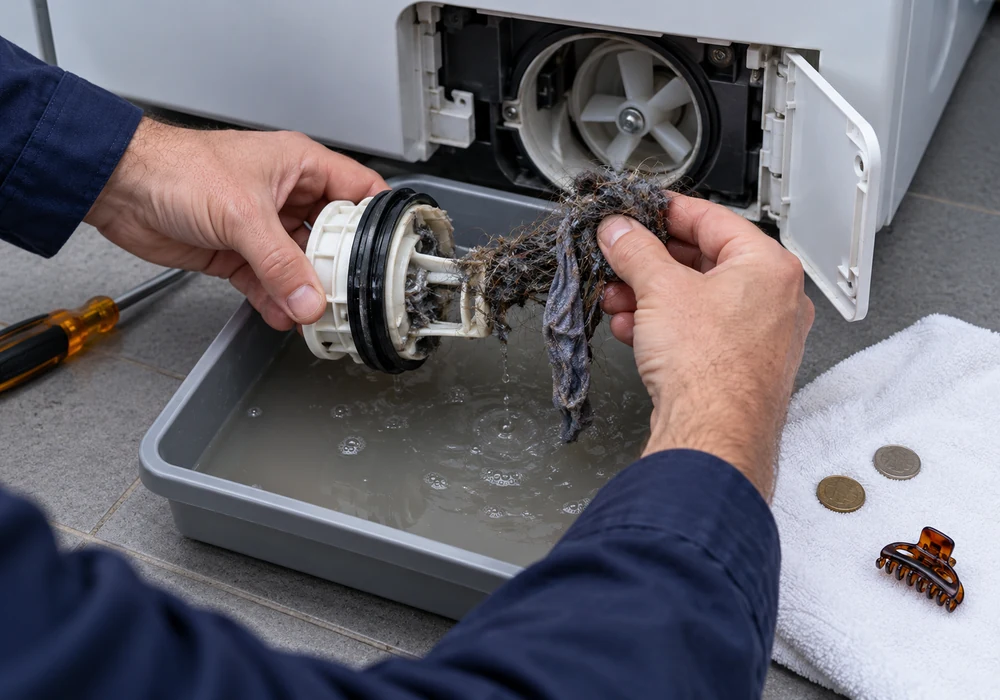
Most likelyCoins, hair clips, buttons and fabric scraps collect in the filter housing or wrap the pump impeller. The pump runs but moves no water, so the machine aborts the cycle.
- 2
Kinked or raised drain hose
Very commonA hose crushed behind the machine, or pushed too far down the standpipe, stops water leaving. Produces the exact same symptom as a blockage with nothing actually broken.
- 3
Failed drain pump
CommonThe pump motor itself has failed, usually after running against a blockage for a period. Often audible as a hum with no water movement, or as silence where the pump should run.
- 4
Blocked standpipe or house drain
CommonThe problem is in the household plumbing rather than the appliance. Suspect this if a nearby sink also drains slowly or the standpipe backs up and overflows.
- 5
Door lock assembly fault
Less commonSome machines will not run the drain and spin phases without confirmation that the door is latched. A failed lock switch can therefore present as a drain fault.
- 6
Control board or pressure sensor fault
Least likelyThe machine cannot sense the water level correctly, so it never commands the drain. Least common and diagnosed after the mechanical causes are ruled out.
How a technician works through it
Confirm with a drain-only cycle
Select a drain or spin-only program. If the pump hums but no water leaves, the drain path is blocked. If nothing happens at all, the pump or its control may have failed.
Check the drain hose
Pull the machine forward and look for a crushed or sharply kinked hose. Confirm it enters the standpipe only a few inches, because pushing it deeper creates a siphon that blocks drainage.
Rule out the house drain
Run a nearby sink. If it drains slowly or the standpipe backs up, the problem is household plumbing rather than the appliance.
Inspect the pump filter
Unplug the machine. Most front-loaders have an access panel at the lower front with a drain hose and filter behind it. Have towels ready, because several litres can come out.
Book a diagnosis
If the filter is clear and the hose is fine, the pump, lock or sensor needs testing. Note the error code and whether the pump hums, then call.
Confirm it is a drain fault before anything else
A drain or spin-only cycle takes a few minutes and tells you a great deal. Select it and listen carefully.
If you hear the pump hum or whine but the water level does not change, the pump is being powered and the drain path is blocked. That is the most common scenario by a wide margin, and the blockage is usually in the filter housing or wrapped around the pump impeller.
If you hear nothing at all where the pump should run, either the pump has failed electrically or the machine never commanded it. The second possibility is why a door lock fault sometimes masquerades as a drain problem: on many machines the drain and spin phases will not run without confirmation that the door is latched.
The important thing is to stop restarting the full cycle. A pump running repeatedly against a blockage is how an inexpensive clearance becomes a replacement pump.
The two checks that cost nothing
Before anyone visits, two things are worth looking at because they are free and they are frequently the whole answer.
First, pull the machine forward and look at the drain hose. A hose crushed between the cabinet and the wall, or kinked sharply where it rises, stops water leaving as effectively as any blockage. Check also how far it enters the standpipe: a few inches is correct, and pushing it deeper creates a siphon that can prevent drainage entirely or empty the drum continuously.
Second, run a nearby sink. If that drains slowly, or the standpipe backs up and overflows while the washer tries to pump, the blockage is in your household plumbing rather than in the appliance. That distinction matters because it means you need a plumber, not an appliance technician, and we would rather tell you that on the phone than charge you a service call to discover it.
What ends up in the pump
The contents of a blocked washer pump are remarkably consistent: coins, buttons, hair clips, bra wires, screws and twists of fabric from frayed hems. All of it gets past the drum and settles where the water slows down.
Checking pockets genuinely prevents this, and so does using a mesh bag for small or delicate items. On machines with an accessible filter, clearing it every few months as routine maintenance takes ten minutes and prevents the most common washer fault there is.
What the repair usually costs
| Repair | Typical range | Market |
|---|---|---|
| Service call and diagnosis | $79 | Waived on approval |
| Washing machine repair | $140 to $400 | mid-size city |
Typical completed-repair ranges including parts and labor; your technician confirms the exact price on site before any work begins.

When to stop troubleshooting and unplug it
- Unplug the machine before opening any access panel or filter housing. Standing water and live electrics are a genuine shock hazard.
- Do not force a locked door while water remains in the drum. Run a drain cycle first, or let the technician release it.
- Water that has reached an outlet or extension lead means switching the circuit off at the breaker before mopping.
- Expect several litres from the filter housing. Have towels and a shallow tray in place first.
More guidance: CPSC appliance recall notices (opens in a new tab) · FTC Consumer Advice (opens in a new tab)
Book the right service
Related problem guides
Get this fixed in your area
Washer Will Not Drain, common questions
Why is my washer full of water at the end of the cycle?
The machine could not clear the drum, so it stopped rather than attempting a spin. In most cases something is blocking the drain path, usually the pump filter, the impeller or the hose. A kinked hose or a blocked standpipe produces the same result with nothing actually broken.
Can I fix a blocked washer pump myself?
Often yes on a front-loader, where an access panel at the lower front hides the filter. Unplug the machine first and have towels ready, because several litres will come out. If the filter is clear and it still will not drain, the pump or a sensor needs testing.
How much does it cost to fix a washer that will not drain?
Completed repairs typically run $120 to $460 including parts and labor. Clearing a blockage or replacing a drain pump sits at the lower end of that range. A control board or pressure sensor fault reaches the upper end but is far less common.
Why does my washer hum but not pump the water out?
The pump motor is energised but the impeller cannot turn, which is what the hum is. Something is jammed in it, commonly a coin, a button or a twist of fabric. Running the cycle repeatedly in that state is how a cheap blockage becomes a failed pump.
How do I get the water out before the technician arrives?
Switch the machine off, then lower the drain hose into a bucket at floor level and let gravity do the work, swapping buckets as needed. On a front-loader the filter access at the lower front usually has a small drain hose for exactly this purpose.
Could the problem be my house plumbing rather than the washer?
Yes, and it is worth ruling out first because it changes who you call. Run a nearby sink. If that also drains slowly, or the standpipe backs up and overflows while the washer pumps, the blockage is in the household drain and you need a plumber rather than us.