

Is this an emergency or can it wait?
Treat it as urgent if there is water on the floor, a burning smell, sparking or food at risk, and stop using the appliance. Otherwise it can wait for a normal appointment. Call (844) 578-2720 and the dispatcher will triage it with you on the line.
Call (844) 578-2720 for the next available window.
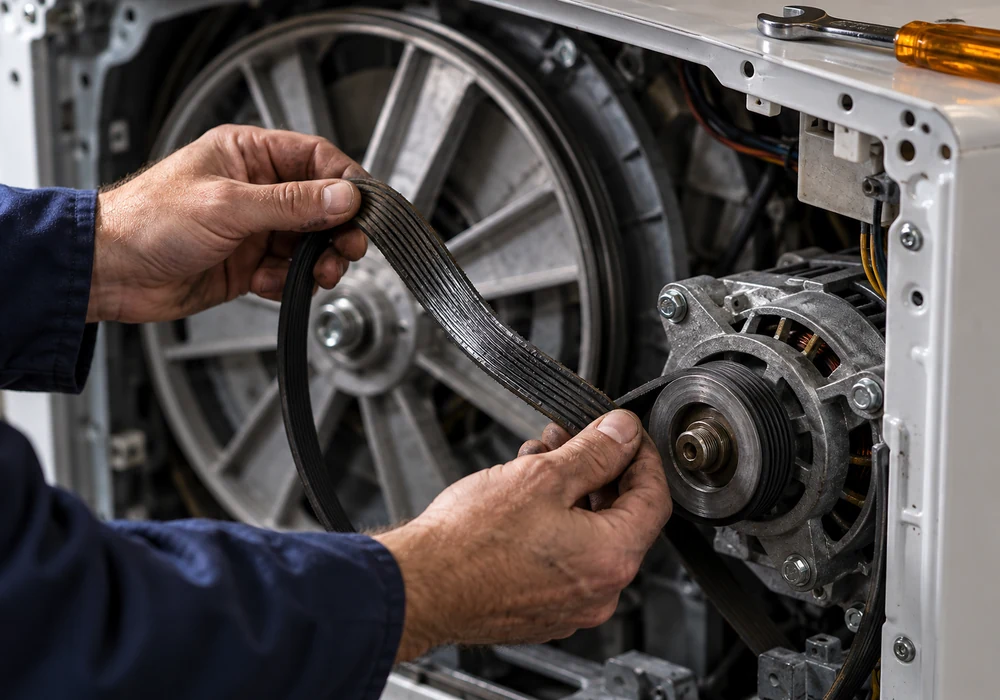
Symptoms that match this problem
- Water drains away but the drum never reaches spin speed
- Clothes come out soaking wet after a full cycle
- Drum turns slowly by hand with no resistance
- Machine pauses repeatedly trying to balance the load
- Burning rubber smell during the spin phase
- Loud bang or thumping as the drum tries to accelerate
What to do and what to avoid
| Do this | Do not do this |
|---|---|
| Redistribute the load by hand and run a spin-only cycle | Do not tape or jam the door lock to defeat the interlock |
| Remove any single heavy item and spin the rest | Do not keep rerunning full cycles, which wears the belt further |
| Check the machine is level and all four feet are firmly down | Do not continue using the machine if you smell burning rubber |
| Confirm the door clicks firmly shut rather than resting closed | Do not move a machine with water still in the drum |
| Note any error code on the display | Do not stack weight on top to stop it moving |
| Listen for whether the motor runs at all during the spin phase |
What causes it, ranked by likelihood
Technicians work through these in roughly this order, because starting with the cheapest and most common cause saves you money.
- 1
Door lock assembly failure
Most likelyThe machine will not spin without confirmation the door is latched, because a spinning drum behind an open door is a safety risk. A failed lock switch stops the spin while letting everything else run.
- 2
Unbalanced load detection
Very commonThe machine senses an off-centre load and refuses to accelerate, retrying and then giving up. A single heavy item such as a duvet or bath mat is the usual cause and is not a fault at all.
- 3
Worn or broken drive belt
CommonThe belt that links the motor to the drum has stretched or snapped. The motor runs, the drum does not, and a stretched belt slipping under load produces a burning rubber smell.
- 4
Worn shock absorbers or suspension
CommonWeak shocks let the drum move too far, so the machine aborts the spin to protect itself. Usually accompanied by banging and the machine moving across the floor.
- 5
Motor control board fault
Less commonThe board cannot drive the motor to spin speed, often while lower-speed wash tumbling still works normally.
- 6
Worn drum bearing
Least likelyA failing main bearing creates enough drag and noise that spin becomes impossible. Expensive to repair and often the point at which replacement wins.
How a technician works through it
Redistribute the load
Open the machine, spread the washing evenly around the drum, close the door and run a spin-only cycle. A surprising share of no-spin complaints end here.
Test with a light load
Remove any single heavy item such as a duvet and spin the rest. If it spins now, the original fault was load balance rather than a mechanical failure.
Check the door latch
Close the door and listen for a firm click. If it closes softly or springs back slightly, the latch or its switch is likely at fault.
Listen during the spin phase
Note whether the motor runs. A motor running while the drum stays still suggests a belt. Silence suggests the lock, the control board or the motor itself.
Book a diagnosis
If load and latch are ruled out, the belt, shocks, board or bearing need testing. Note any error code and whether you smelled burning, then call.
Draining but not spinning narrows it considerably
If the water goes away, you already know the pump, the filter and the drain hose are doing their jobs. That removes the most common washer fault from consideration and points attention at the things that either drive the spin or permit it.
The permit side comes first, because it is the most frequent. A washing machine treats the door lock as an absolute condition for spinning, and for good reason: a drum turning at speed behind an open door is genuinely dangerous. The lock assembly carries both a latch and a switch, and the switch can fail while the door still appears to close normally. The machine then washes and drains perfectly and simply declines to spin.
The drive side is the drive belt, the shock absorbers and, less often, the motor control board. Listening during the spin phase separates these quickly. A motor audibly running while the drum stays still is a belt. Silence where the motor should be is the lock, the board or the motor.
Check the load before you check anything else
A large share of no-spin complaints are not faults. Machines detect an off-centre load and refuse to accelerate rather than risk damaging the suspension, retrying several times before abandoning the spin and leaving the washing wet.
A single heavy item is the classic cause. One duvet, one bath mat or one pair of work jeans on its own will sit to one side of the drum and never balance. Open the machine, spread the contents evenly around the drum, close the door firmly and run a spin-only cycle. If it spins, nothing was broken.
While you are there, check the machine is level and all four feet are firmly on the floor. A machine rocking on an uneven floor will trigger the same protection, and so will one still carrying the transit bolts fitted for shipping.
The one symptom that means stop
A burning rubber smell during the spin phase is not something to live with for a week. It means a stretched belt is slipping against a pulley that is trying to turn, and the friction is generating real heat. Left running, the belt glazes and then snaps, and the heat can damage the pulley it runs on. Switch the machine off and book it rather than finishing the laundry.
What the repair usually costs
| Repair | Typical range | Market |
|---|---|---|
| Service call and diagnosis | $79 | Waived on approval |
| Washing machine repair | $140 to $400 | mid-size city |
Typical completed-repair ranges including parts and labor; your technician confirms the exact price on site before any work begins.

When to stop troubleshooting and unplug it
- Never defeat the door interlock. It exists because a drum spinning at speed behind an open door can cause serious injury.
- Stop using the machine if you smell burning rubber. A slipping belt generates real heat against a stationary pulley.
- Unplug the machine before removing any panel or reaching into the cabinet.
- Do not attempt to move a loaded machine full of water. Drain it first.
More guidance: CPSC appliance recall notices (opens in a new tab) · FTC Consumer Advice (opens in a new tab)
Book the right service
Related problem guides
Get this fixed in your area
Washer Will Not Spin, common questions
Why does my washer drain but not spin?
Draining proves the pump and the drain path are fine, so the fault is in what drives or permits the spin. The door lock is the most common culprit, because the machine refuses to spin without a latched-door signal. A worn belt or weak shock absorbers come next.
Could it just be an unbalanced load?
Very often, yes. Modern machines detect an off-centre load and refuse to accelerate rather than risk damage, retrying a few times before giving up. A single duvet or bath mat is the classic cause. Redistribute the washing by hand and run a spin-only cycle before assuming a fault.
How much does it cost to fix a washer that will not spin?
Completed repairs typically run $120 to $460 including parts and labor. A door lock assembly or drive belt sits at the lower end. Shock absorbers sit mid range, a motor control board higher, and a drum bearing is the one repair that often costs more than the machine is worth.
Why do I smell burning rubber during the spin?
A stretched drive belt slipping against a pulley that is trying to turn generates real heat, and that is what you are smelling. Stop using the machine. Continuing will glaze or snap the belt and can damage the pulley, turning an inexpensive part into a larger repair.
Is it safe to force the door open to get my washing out?
No. Forcing the door damages the latch mechanism and turns a modest repair into a larger one, and on many machines the door stays locked because water remains in the drum. Run a drain-only cycle first, and if it still will not release, let the technician open it.
My washer bangs loudly and moves across the floor. Why?
Worn shock absorbers or suspension rods are letting the drum travel much further than the cabinet can tolerate, and an uneven load turns that into violent movement. Check first that the machine is level and that the shipping bolts were removed when it was installed.