

Why is there standing water in my dishwasher?
Something in the drain path is blocked. Clear the filter basket and the sump beneath it first, since that is the answer most of the time. If a garbage disposal was fitted recently, check that its dishwasher inlet plug was knocked out before connection.
Call (844) 578-2720 for the next available window.
Published
A dishwasher that leaves a pool of water in the base sounds like a pump failure and usually is not. Four checks cover the overwhelming majority of these faults, and two of them need no parts at all.
Switch the dishwasher circuit off at the breaker before reaching into the base. Standing water and live electrics together are a shock hazard, and none of these checks require power.
Check one: the filter and sump
Start here, because this is the answer most of the time.
Scoop out the standing water with a cup, then soak up the remainder with a sponge so you can see what you are doing. Twist out the filter basket, rinse it under a tap, and brush off the greasy film that binds debris together.
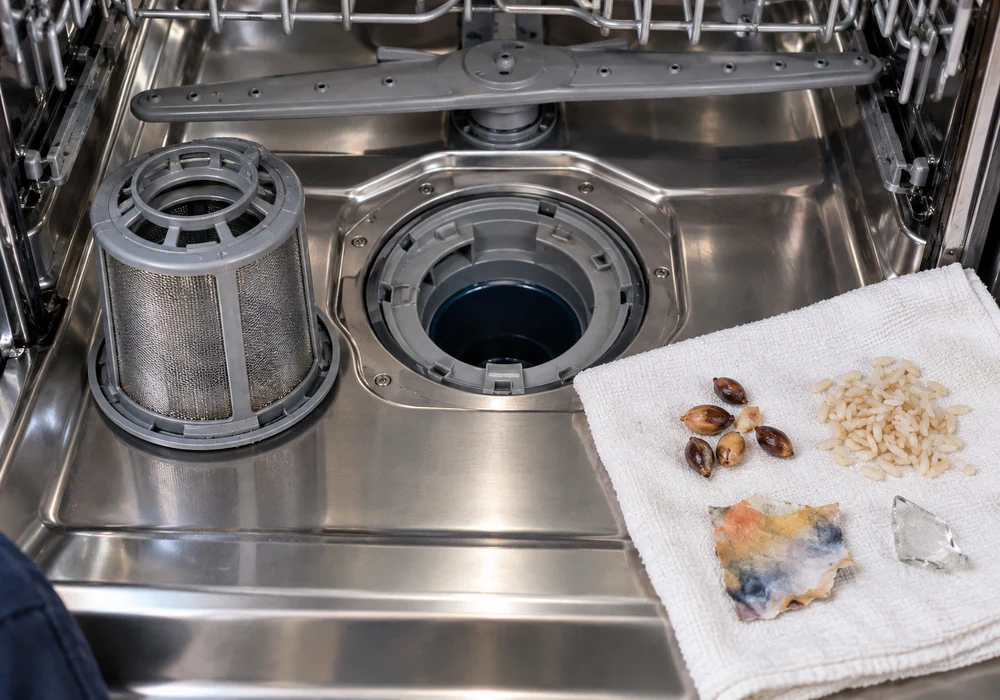
Then look into the recess beneath it. What accumulates there is consistent across every machine we open: fruit seeds, bottle and jar labels, grains of rice, and fragments of broken glass. Use a cloth or gloves rather than bare fingers, because broken glass in a dishwasher sump is common enough to assume it is present.
Once that mass covers the drain opening, the pump cannot move water past it, and the cycle ends with a full base. Clearing it is often the entire repair.
Check two: the garbage disposal plug
If your dishwasher stopped draining shortly after a disposal was installed, stop looking at the dishwasher.
New garbage disposals ship with a moulded plug sealing the dishwasher inlet, because not every installation connects a dishwasher to it. That plug must be knocked out with a screwdriver before the dishwasher drain hose is attached.
When it is missed, the dishwasher has nowhere to drain from its very first cycle. The symptom appears immediately after what was supposed to be an unrelated kitchen improvement, which is why people rarely connect the two. It is a five-minute correction and one of the most frequent findings we report.
Check three: the drain hose and high loop
Look behind the machine for a crushed or sharply kinked hose, which is free to fix.
Then check the high drain loop. The drain hose should rise up under the countertop before dropping to its connection, and it should be secured there. That loop is what stops water running back into the machine. If the clip has failed and the hose has slipped down, water will sit in the base after every cycle with nothing actually broken.
Check four: the air gap
Not every installation has one. If yours does, it is the small chrome cylinder on the countertop beside the faucet.
Air gaps collect debris and block, and the giveaway is water spilling from the cap during a cycle. Lift the cap, remove the inner cover and clear what is inside. It takes a couple of minutes.
The check that decides who you call
Run the sink while the dishwasher attempts to drain.
If the sink drains slowly, or you hear pronounced gurgling, or water backs up into the sink, the restriction is in the shared household drain rather than in the appliance. Gurgling specifically means the dishwasher is pushing water into a line that cannot accept it quickly enough, forcing air back through the sink trap.
That is a plumber’s job, not ours, and finding out in two minutes beats paying a service call to learn the same thing.
One thing not to do
Do not pour drain cleaner into a dishwasher. These products are formulated for plumbing pipework, not for pump seals, plastic components and food-contact surfaces. They can damage the machine, they leave residue where your dishes go, and they will not shift the kind of debris that actually causes this fault.
Equally, never mix cleaning products inside the machine. Bleach combined with some descalers produces hazardous fumes.
What the repair costs
A completed dishwasher repair typically runs $120 to $440 including parts and labor. If the fault is a blocked filter, a slipped high loop or a disposal plug, you are paying for the service call and the clearance rather than for any part. A failed drain pump sits mid range, and a control fault toward the top.