

Why does a dryer stop heating, and is it dangerous?
A tripped thermal fuse is the usual finding, and it tripped because restricted airflow caused an overheat. The vent is the real fault. Treat a burning smell as urgent, switch the machine off at the breaker, and do not run it again until it is inspected.
Call (844) 578-2720 for the next available window.
Published
When a dryer tumbles without heating, the most common finding is a tripped thermal fuse. It is an inexpensive part and replacing it takes minutes. If that is all anyone does, the new fuse will trip too, usually within weeks.
The fuse is a symptom
A thermal fuse is a one-time safety device that permanently opens the heating circuit when the machine overheats. It did not fail randomly. It did exactly what it was designed to do, because the dryer got too hot.
A dryer overheats because the hot air it produces cannot leave. Heat builds in the cabinet, the cycling thermostat cuts the element, the machine cools slightly, the element comes back, and the loop repeats. Each pass stresses the fuse until it opens for good.
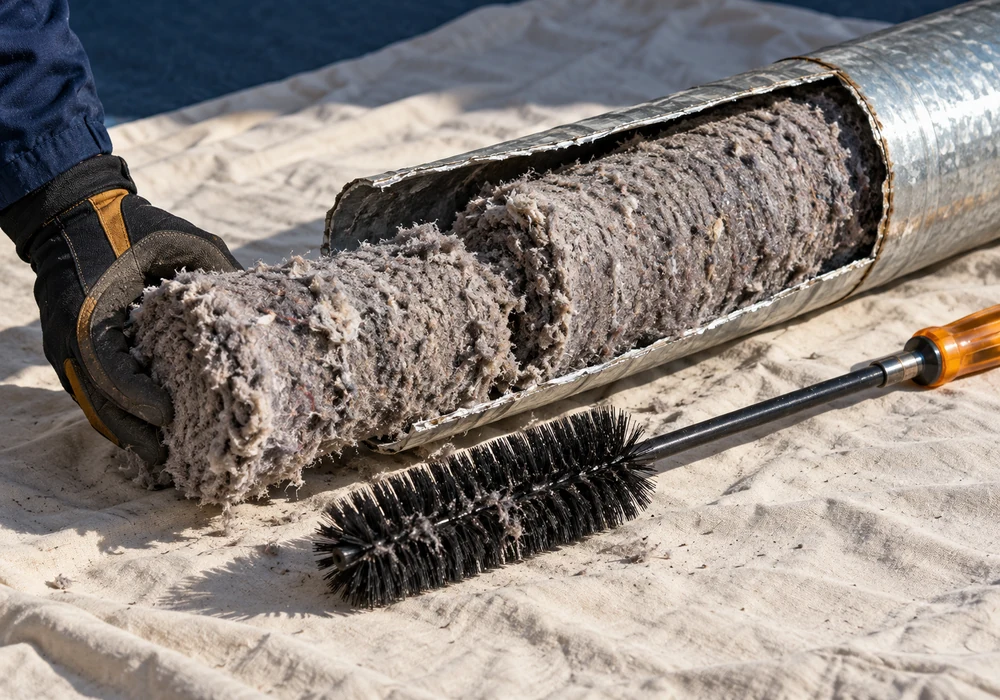
So the fuse failed and the vent caused it. That is why a proper diagnosis checks the entire airflow path before fitting any electrical part: the lint filter and its housing, the transition hose behind the machine, the duct run through the wall, and the exterior vent flap.
Why this is a safety issue, not just an inconvenience
Clothes dryers are a well-documented cause of home fires, and failure to clean them is the leading contributing factor. The mechanism is not mysterious. Lint is highly combustible, and a restricted vent supplies both the fuel and the heat in the same confined space.
This is the reasoning behind the one piece of advice on this page worth following without exception: a burning smell from a dryer should stop the cycle immediately, not at the end of the load. Unplug the machine or switch off its breaker and leave it off until it has been inspected.
The US Fire Administration publishes guidance on home dryer fires, and it is worth reading once if you have never thought about this. The practical measures are modest and they work.
Check your breaker before assuming the worst
This costs nothing and catches a surprising number of people.
An electric dryer runs on a double-pole breaker, supplying two legs of 120 volt power that together give the 240 volts the heating element needs. The motor only needs one leg.
If one half of that breaker trips, the dryer behaves very specifically: the drum tumbles normally, the controls light up, the cycle runs, and nothing heats. It is indistinguishable from a failed element without testing, and switching the breaker fully off and back on sometimes resolves it outright.
Gas dryers do not have this failure mode, so knowing which type you have before you call genuinely speeds up the visit.
Gas dryers fail at the igniter
On a gas dryer the igniter must draw enough current to open the safety gas valve, which is how the appliance confirms the igniter is hot enough to light gas safely.
That produces a distinctive failure. As the igniter ages it still glows, often brightly, but its current draw falls below the threshold. The valve never opens and nothing burns. People reasonably conclude there is a gas supply problem when the igniter is the only part at fault.
One absolute rule applies here. If you smell gas, leave the building with everyone in it and call your gas utility or 911 from outside. Do not switch anything on or off and do not use a phone indoors. That call comes before any repair call.
The maintenance that prevents all of this
It takes about twenty minutes a year.
Clean the lint filter after every load, and wash it in warm soapy water every few months if you use fabric softener or dryer sheets, which leave an invisible film on the mesh that blocks airflow while looking perfectly clean. Have the duct run cleared annually, more often with a long run or a large household. Use rigid or semi-rigid metal duct rather than foil flexible hose where it will fit, because the ribbed interior of flexible hose catches lint. Keep the space behind the machine clear so the transition hose is not crushed. Never vent a dryer into a crawl space, attic or garage.
What the repair costs
A completed dryer repair typically runs $115 to $430 including parts and labor. A thermal fuse, igniter or thermostat sits at the low end, a heating element slightly above, and a control board at the top. Duct clearance, where that is the actual fault, is usually the cheapest outcome and the one that prevents the repeat visit.