

How does hard water damage appliances?
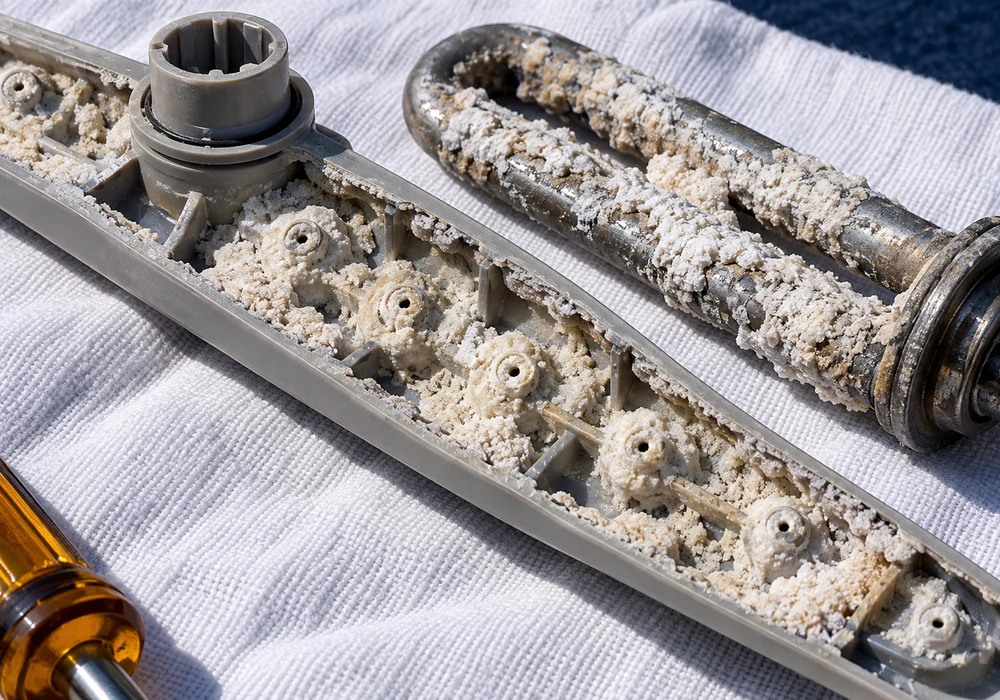
Dissolved minerals deposit scale on every wetted surface, narrowing dishwasher spray jets, insulating heating elements and restricting ice maker valves. Nothing fails suddenly, so performance declines over months without an obvious cause. Regular descaling genuinely extends the life of plumbed appliances.
Call (844) 578-2720 for the next available window.
Published
Hard water is the most underrated variable in appliance life. It is why two identical dishwashers in different cities have noticeably different lifespans, and why appliance performance in parts of California, Texas and Arizona declines in ways that owners rarely attribute to the water.
The decline is invisible, which is the problem
Hard water does not break appliances. It degrades them, slowly, across every wetted surface, and nothing ever fails outright until something finally does.
Dissolved calcium and magnesium precipitate out as scale wherever water sits or heats. That means the inside of spray arms, the surface of heating elements, the clearances inside pumps and valves, and the narrow passages of fill tubes and inlet valves.
Each deposit is small. Together they reduce water pressure, reduce heat transfer and increase friction, all at a rate slow enough that households simply adapt. People start running dishwashers twice, or accept that the ice maker is slow, without connecting either to a cause.
Where it hits each appliance
Dishwashers suffer most. Scale narrows the spray jets, which starves the upper rack first because it sits furthest from the pump. Scale on the heating element insulates it, so the water runs cooler than the cycle intends and detergent works less effectively. Scale in the circulation pump adds drag. The white film on your glassware is the visible version of all three.
Ice makers and refrigerator water systems are the next most affected. The inlet valve and fill tube have narrow passages, and scale plus a saturated filter restricts flow until cubes come out hollow and then stop entirely. Hollow cubes are the early warning worth acting on.
Washing machines accumulate scale on the heating element and in the inlet valves. The effect is less dramatic than in a dishwasher because wash temperatures are generally lower, but it is the same mechanism.
Water heaters, though outside what we repair, matter here because they feed everything else. Scale accumulating in the tank reduces capacity and efficiency, and a heater delivering cooler water makes every connected appliance perform worse.
The three maintenance tasks that work
Descale the dishwasher. Run a dishwasher descaler through an empty hot cycle every few months in a hard water area. This genuinely removes accumulated scale rather than simply cleaning the visible surfaces, and it is the single most effective thing on this list.
Change the refrigerator water filter on schedule. Every six months, and sooner if you notice taste changes or slower dispensing. In hard water the interval shortens. A neglected filter restricts flow long before it blocks completely, and it is behind a surprising share of the ice maker calls we attend.
Clear the spray arms. Unclip them where the design allows, hold them up to the light, and push a toothpick through any jet that looks narrowed. Rinse the arms through from the inside afterwards.
Should you soften the water?
A whole-home softener addresses the cause rather than the symptoms, and in a genuinely hard water area it extends the life of every plumbed appliance in the house, plus the water heater and the pipework.
Whether it pays for itself depends on how hard your water actually is, which is worth testing rather than assuming. In moderately hard areas, descaling maintenance is usually sufficient and far cheaper. In the hardest areas, the softener tends to win on appliance replacement costs alone.
Point-of-use filters help the appliance they serve and nothing else, which makes them a reasonable partial measure for a refrigerator and ice maker without the cost of a whole-home system.
What to tell a technician
If you are in a hard water area, say so when you book. It changes which causes get checked first.
A dishwasher cleaning poorly in a soft water area points at spray arms, loading or a failing circulation pump. The same symptom in a hard water area points first at scale, and the fix is a descale rather than a part. Mentioning it means the technician arrives expecting the right thing, and it means you are less likely to pay for a component that was never the problem.