

How do I choose a good appliance repair company?
Ask how the diagnosis works, what the visit costs if you decline, whether the quote is flat rate covering parts and labor, and what the warranty covers. A company willing to tell you not to spend money with them is usually worth trusting.
Call (844) 578-2720 for the next available window.
Published
Appliance repair is a trade where the customer usually cannot evaluate the work. You cannot tell whether the part that was replaced was the part that failed, and you will not find out for weeks. That asymmetry is why the questions you ask before booking matter more than in most trades.
Ask how the diagnosis works
This is the most revealing question you can ask, because it separates companies that diagnose from companies that swap parts until something works.
A proper answer describes a sequence. For a refrigerator not cooling, that means checking which compartment failed, confirming whether air is moving, inspecting the condenser and defrost components, and testing the relay and compressor draw before considering the sealed system. The sequence exists so the cheap and common causes are eliminated first.
An answer that jumps straight to the expensive component should concern you. So should an estimate given firmly over the phone before anyone has seen the appliance, because the same symptom routinely points at either end of the price range.
Ask about the fee structure, in both directions
Two numbers matter: what the visit costs if you decline the repair, and what the repair costs if you accept it.
A refundable service call, waived when you approve the work, is the most transparent arrangement. You can see both figures and decide. A free diagnosis is rarely free, because the cost is usually recovered inside a higher repair price, and you have no way to see where.
What you should not accept is a diagnosis fee that was not disclosed before the visit, or a repair price quoted only after the appliance has been partly dismantled. Both remove your ability to walk away.
Also ask whether the quote is flat rate covering parts and labor, or an estimate that may move. Flat rate puts the risk of an awkward job on the company rather than on you.
Ask what the warranty covers
The answer should specify a duration and both parts and labor. Ours is 90 days on both, which means that if the identical fault returns inside that window we come back at no further charge.
A parts-only warranty is substantially weaker than it sounds, because labor is usually the larger share of a repair. A warranty with no stated duration is not a warranty.
Ask whether they would repair or replace
This is a test of honesty rather than a request for information.
A technician who recommends repairing everything, regardless of the appliance’s age or the cost of the part, is not giving you a straight answer. Sometimes replacement is clearly correct: a magnetron on a basic countertop microwave, a sealed-system repair on a twelve-year-old refrigerator, a failed motor on a garbage disposal.
A company willing to tell you not to spend money with them is more likely to be telling you the truth when it says a repair is worthwhile.
Check the independent and authorised distinction
Most repair companies, including us, are independent rather than authorised agents of manufacturers. That is not a problem, but it has two consequences worth knowing.
First, if your appliance is still inside the manufacturer warranty, a brand-authorised visit may cost you nothing, so check that before paying anyone. Second, an independent company sources parts rather than drawing on a manufacturer stock, which can mean longer lead times for brand-specific components.
Be wary of any company implying manufacturer endorsement it does not have. Authorised status is specific and verifiable.
Things that should genuinely worry you
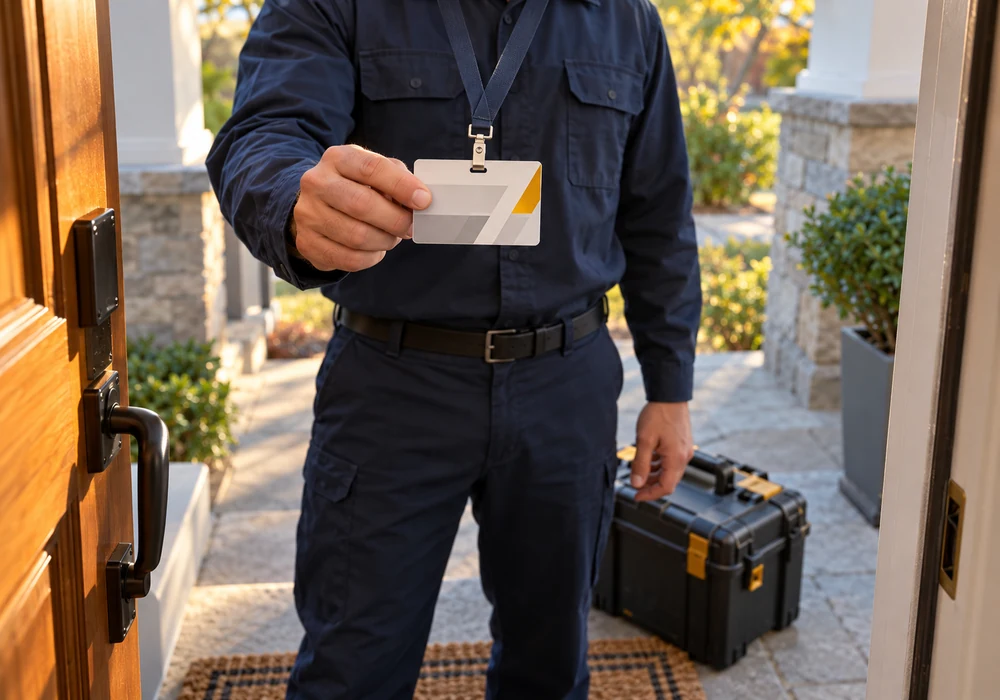
Cash-only payment, or a demand for full payment up front before any work. A refusal to provide a written quote. Reluctance to state a service call fee on the phone. Pressure to decide immediately. No verifiable business identity. Technicians arriving without identification.
Fabricated reviews are worth a mention too, because they are common in this trade. A page of uniformly glowing reviews posted within a short period, with no specific detail about appliances or faults, is not evidence of anything.
What to have ready when you call
Three things make the visit shorter and more likely to finish in one trip.
The brand and model number, usually on a plate inside the door frame, behind a drawer or on the rear panel. A clear description of what the appliance does and when it started doing it. And your ZIP code, so the dispatcher can check coverage and give you a realistic arrival window rather than a guess.
That description genuinely matters. It decides which parts travel on the van, which is the difference between a repair completed today and a diagnosis followed by a return visit next week.