

Why has my ice maker stopped making ice?
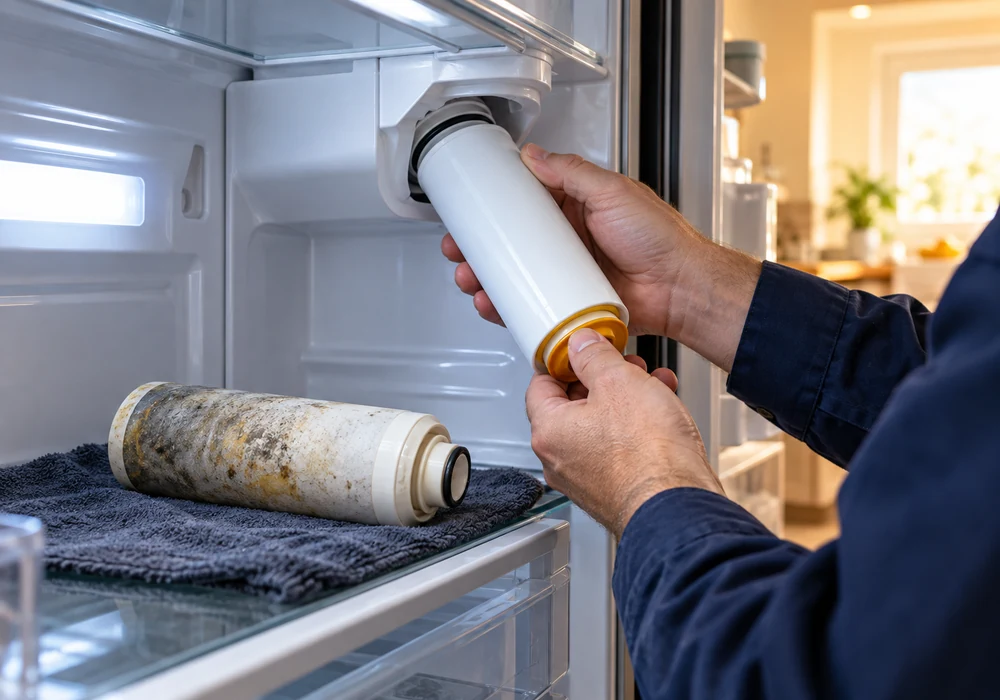
Water is almost certainly not arriving, and the refrigeration system is fine if the fridge still cools. Work backwards along the water path, starting with the filter, then the supply valve, the fill tube and the inlet valve. The filter is the most common answer.
Call (844) 578-2720 for the next available window.
Published
An ice maker is a simple machine attached to a complicated one, which is why people assume an ice maker fault is a refrigerator fault. It usually is not. If the fridge is still cooling, the refrigeration system is fine and the question is only whether water arrived.
The order that saves you money
Work backwards from the mould, and the causes arrange themselves cheapest first. This is not a coincidence; the cheap parts are the ones that wear.
The water filter. The most common cause by a wide margin. Filters restrict flow progressively as they saturate, so performance declines for months before it stops. Check the date. If it is past six months, replace it before doing anything else. This costs the price of a filter and needs no technician at all.
The supply valve. Free to check. Valves behind or beneath a refrigerator get closed or knocked during unrelated plumbing work, and a partly closed valve produces exactly these symptoms. Confirm it is fully open.
The fill tube. A plug of ice in the small tube feeding the mould blocks filling completely. Worth noting that this is both a symptom and a cause, because it recurs until whatever let it freeze is addressed, often the fill tube heater.
The inlet valve. Now we are into parts. The valve admits a measured amount of water, and one that no longer opens fully gives you no ice or persistently hollow cubes.
The module and thermostat. The mould may fill correctly but never cycle to eject. Less common than everything above it.
The test that narrows it in seconds
Run the water dispenser.
If the dispenser is also slow, the restriction is in the shared water supply, which means the filter, the supply valve or the line. If the dispenser runs at full flow while the ice maker produces nothing, water is reaching the refrigerator fine and the fault is downstream in the ice maker itself.
That single observation splits the list in half, and it takes five seconds.
Hollow cubes are the warning you should act on
If your cubes have been getting smaller, or arriving hollow with a frozen shell and a void inside, that is the same fault caught early. Water is arriving but not enough of it, so the mould partly fills and freezes around the gap.
Acting at this stage is worth real money. The same restriction left alone progresses to no ice at all, and a fill tube that repeatedly freezes eventually needs its heater replaced too. Changing the filter when cubes start looking hollow often prevents the entire sequence.
Bad taste is almost always the filter
Ice that tastes or smells wrong has two causes, and both are easy.
The filter stops removing taste and odour long before it restricts flow enough to notice, so a filter well past its interval produces exactly this. Replace it and discard the first few batches.
The other cause is the freezer itself. Ice absorbs odours readily, so strongly flavoured uncovered food nearby transfers into it. Storing food covered solves that.
The one urgent ice maker fault
Everything above can wait for an appointment. The supply line cannot.
These are typically plastic tubing with compression fittings, routed behind a heavy appliance nobody moves, and they fail at kinks or after freezing and splitting. Because the line sits under constant mains pressure, a failure runs continuously, often behind a cabinet, until flooring lifts or a ceiling below stains.
If you find water behind or beneath the refrigerator, close the supply valve first and investigate second. Whenever the unit is next pulled out, inspecting that line costs nothing, and a braided stainless replacement is a worthwhile upgrade.
What the repair costs
A completed ice maker repair typically runs $110 to $330 including parts and labor. A fill tube heater or inlet valve sits at the lower end, and a full ice maker module reaches the top. If the cause turns out to be the filter, which it frequently does, you can resolve it yourself for the price of the filter.