

How do I check whether my oven temperature is accurate?
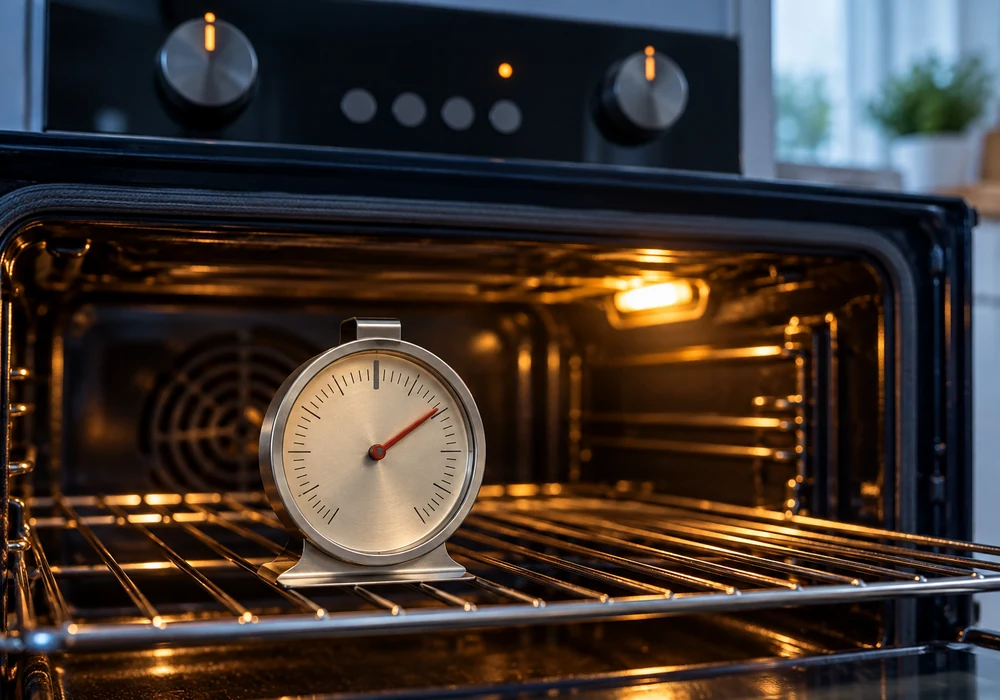
Put an oven thermometer on the middle rack, set 350 degrees Fahrenheit, and read it twenty minutes after the preheat beep. Take two or three readings. A consistent offset points at the sensor or calibration; readings that swing point at a failing sensor or control board.
Call (844) 578-2720 for the next available window.
Published
Baking failures get blamed on recipes, flour and altitude long before anyone suspects the oven. An oven running 25 degrees low will sink cakes and undercook pastry consistently, and most people never test for it because the preheat beep implies everything is fine.
The preheat beep is not a measurement
On many ovens that beep sounds when the temperature sensor first touches the setpoint, which happens well before the cavity walls, the racks and the air have absorbed enough heat to hold it. Put food in at the beep and it enters an oven that is still climbing toward stability.
That alone explains a share of complaints about ovens running cool. The appliance is accurate; the signal is just optimistic.
Test it properly
Put an oven thermometer on the middle rack. Set the oven to 350 degrees Fahrenheit. Leave it running for a full twenty minutes past the preheat beep before reading anything.
Then take two or three more readings over the next half hour. This matters more than the first reading, because the pattern tells you which fault you have.
A consistent offset, say 25 degrees low every time, points at the temperature sensor or at a calibration setting. Many ovens allow a calibration offset through the control panel, and your manual will describe the procedure. That handles small consistent errors without any part at all.
Readings that swing, high then low then high, point at a sensor failing intermittently or a control board mismanaging the heating cycle. Calibration will not help here, because there is no stable error to correct.
Inaccurate and uneven are different faults
It is worth separating these, because they lead to different repairs.
Inaccurate means the whole cavity sits at the wrong temperature. That is the sensor, the calibration or the control.
Uneven means different parts of the cavity are at different temperatures, which is what produces food burnt on one side and raw on the other. On a convection model the first suspect is the fan, because eliminating those zones is its entire purpose, and a silent fan explains uneven results with no temperature error whatsoever. On a conventional oven, uneven points back at the door seal, or simply at an overloaded cavity where air cannot circulate around the trays.
The door does more than you think
An oven door is closer to a wall than a lid, and when it stops sealing the oven cannot hold temperature properly regardless of sensor accuracy.
A gasket that has hardened, split or been distorted lets heat escape continuously. The control compensates by running the elements longer and cycling more often, so energy use rises while results get worse. Because the loss is concentrated where the seal failed, the symptom is usually uneven baking rather than a straightforwardly cool oven.
Hinges are the quieter version of the same problem. As they wear the door sits slightly proud at one corner, and a small gap opens even behind a sound gasket.
Two cues point here before anything electrical: a kitchen that heats up noticeably when the oven runs, and a door that feels warm to stand beside.
A word about the self-clean cycle
Self-clean runs the cavity far hotter than any cooking temperature, and that heat stresses the door latch, the gasket and the control board. Technicians see control failures shortly after self-clean cycles often enough that it is worth mentioning.
If your oven already has a known fault, avoid the cycle until it is repaired. More generally, using it sparingly and cleaning manually where practical extends the life of exactly the components whose failure is expensive.
What the repair costs
A completed oven repair typically runs $130 to $480 including parts and labor. A temperature sensor or door gasket sits at the lower end of that band, hinges slightly above, a convection fan motor mid range, and a control board at the top. Calibration, where that is all it needs, costs nothing beyond the service call.