

What should I check before calling about a washer that will not drain?
Run a drain-only cycle, inspect the drain hose for kinks, run a nearby sink to rule out household plumbing, then clear the pump filter behind the lower front panel. Unplug the machine first and have towels ready, because several litres will come out.
Call (844) 578-2720 for the next available window.
Published
A washing machine full of water at the end of a cycle is a blocked drain path about nine times out of ten. Several of the possible blockages you can clear yourself, and one of them is not the appliance at all. Working through these in order takes twenty minutes and sometimes saves a service call entirely.
Before starting: switch the machine off and unplug it. Standing water and live electrics together are a genuine shock hazard, and none of these checks require power.
Check one: run a drain-only cycle
This confirms what you are dealing with before you touch anything.
Select a drain or spin-only program and listen carefully. If the pump hums or whines while the water level stays put, the pump is being powered and the path is blocked. That is the common case. If you hear nothing at all where the pump should run, either the pump has failed electrically or the machine never commanded it, which points somewhere different.
The important discipline here is to stop running full cycles. A pump grinding against a blockage repeatedly is how a free clearance becomes a replacement pump.
Check two: the drain hose
Pull the machine forward and look at the hose. Two faults are common and both are free to fix.
A hose crushed between the cabinet and the wall, or kinked sharply where it rises, stops water leaving as effectively as any internal blockage. Straighten it and leave clearance when you push the machine back.
Then check how far it enters the standpipe. A few inches is correct. Pushed deeper, it creates a siphon that can either block drainage or continuously drain the drum while the machine is trying to fill.
Check three: run a nearby sink
This is the check that decides which trade you need, and almost nobody does it first.
Run the sink closest to the washer. If it drains slowly, or you hear gurgling, or the standpipe backs up and overflows while the washer pumps, the blockage is in your household plumbing rather than in the appliance.
That matters because a plumber will resolve it and an appliance technician will not. We would far rather you establish this in two minutes than pay a service call for us to tell you the same thing.
Check four: the pump filter
On most front-loaders there is an access panel at the lower front hiding a filter and a small drain hose. This is the most productive check on the list.
Have towels and a shallow tray ready first, because several litres will come out, and it comes out faster than people expect. Use the small drain hose to empty the machine into a tray before opening the filter itself.
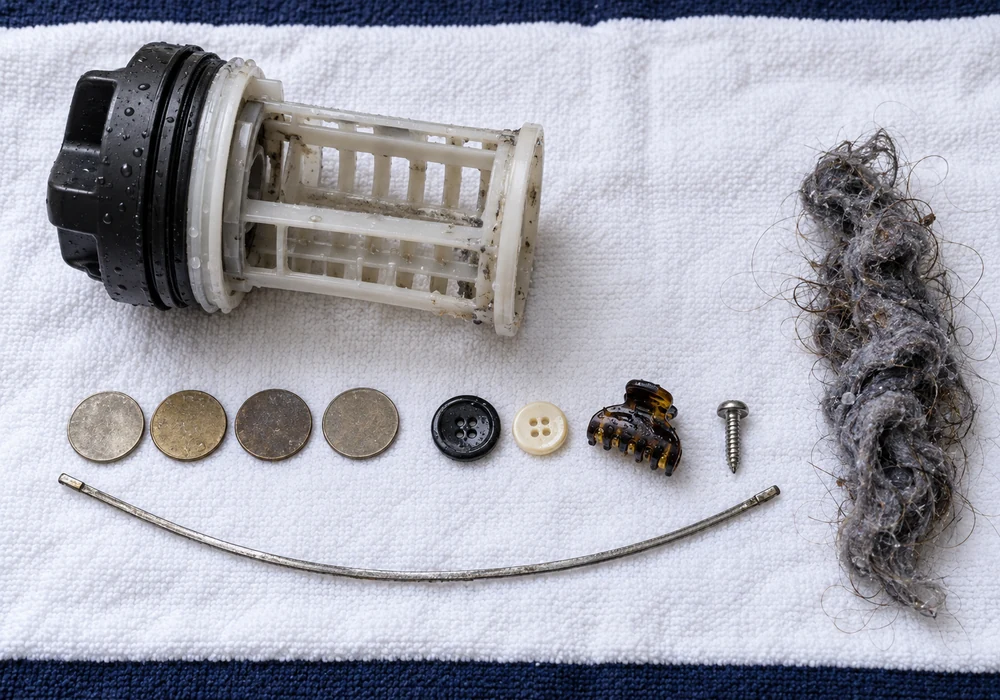
What you find is remarkably consistent: coins, buttons, hair clips, bra wires, screws and twists of fabric from frayed hems. Clear it, rinse the filter, refit it firmly, and run a drain cycle.
Top-loaders generally do not have this access, so the equivalent step is a technician visit.
Check five: the door lock
If the drain works but the machine will not progress, the lock is worth considering.
Many machines will not run the drain and spin phases without confirmation that the door is latched, because spinning an unlatched drum is a safety risk. The lock assembly carries both a latch and a switch, and the switch can fail while the door still appears to close normally.
Close the door and listen for a firm click. A soft close, or one that springs back slightly, points here. Do not try to defeat the interlock, which exists for a good reason.
Getting the water out before anyone arrives
If you need the drum emptied and the filter access is not available, gravity works. Switch the machine off, detach the drain hose from the standpipe, and lower it into a bucket at floor level, swapping buckets as it fills. It is slow but it works, and it prevents a drum of stagnant water sitting over a weekend.
What it costs if it is the pump
A completed washer repair typically runs $120 to $460 including parts and labor, and a drain pump sits at the lower end of that. If the fault turns out to be a blockage rather than a failed part, you are paying for the service call and the clearance rather than for any component.