

What does dishwasher repair involve and what does it cost?
Dishwasher Repair is available across all five states we cover, taking in 60 cities and 2,438 ZIP codes. Completed repairs typically run $135 to $390, with parts and labor both included in that figure. Call (844) 578-2720 and the exact flat price is confirmed on site after the diagnosis, before any work starts.
Call (844) 578-2720 for the next available window.
Signs you need this repair
Any one of these six symptoms is enough to book a diagnosis. Several appearing together usually point at one underlying fault rather than separate problems.
- standing water
- dishes still dirty
- leaking onto the floor
- will not start
- soap door stuck
- grinding noise

What usually breaks
Six components account for the large majority of this work. The technician confirms which one it is on site before quoting anything.
| Part | Symptom it usually causes |
|---|---|
| drain pump | standing water |
| spray arm | dishes still dirty |
| door latch | leaking onto the floor |
| circulation motor | will not start |
| float switch | soap door stuck |
| inlet valve | grinding noise |
How the repair process works
Call and describe it
Tell the dispatcher the symptom, the brand and your ZIP code. That narrows the likely fault before a technician is dispatched and decides which parts travel.
Pick a two-hour window
Choose from the open slots, often the same day. The technician calls ahead before setting off from the previous job.
Diagnosis and flat quote
The actual fault is identified and explained in plain language, then quoted as one flat price covering parts and labor.
Repair completed
Most faults close on the first visit using parts from van stock. The technician confirms the appliance is working before leaving.
What this repair costs
| Repair | Typical range | Market |
|---|---|---|
| Service call and diagnosis | $79 | Waived on approval |
| Dishwasher repair | $135 to $390 | mid-size city |
Typical completed-repair ranges including parts and labor; your technician confirms the exact price on site before any work begins.
Nearly every dishwasher fault is a water fault
A dishwasher has one job: get hot water with detergent in it onto every surface, then get that water out again. Faults fall neatly into those two halves, and knowing which half you are in tells you most of what you need.
Water not arriving means a supply or distribution problem. The inlet valve may be failing, or the spray arms may be blocked. Spray arm holes clog from two directions: food debris from inside, and hard water scale from the supply. Scale is the sneakier of the two because it narrows every hole gradually, so performance declines over months and nobody connects it to a single cause.
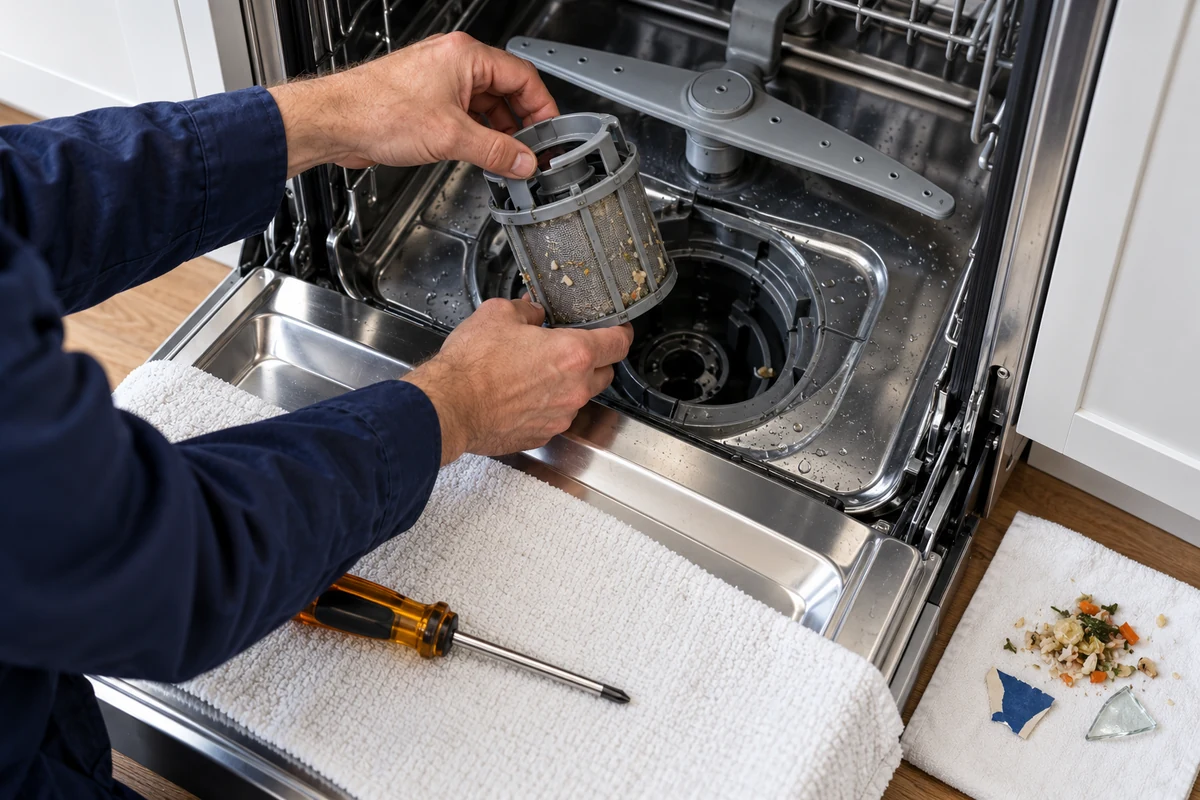
Water not leaving means a drain problem, and this is the most common dishwasher call. The filter and the drain pump impeller collect the debris that gets past scraping. A particularly frequent find is a newly installed garbage disposal with the factory drain plug still in place, which blocks the dishwasher drain completely and leaves a tub full of water from the very first cycle.
The third category is the interlocks. A door latch and a float switch both have veto power over the machine running at all. A dishwasher that is completely dead quite often has nothing more serious than a failed latch switch, which is a cheap part.
Why the detergent and loading matter
Two habits cause faults that look like mechanical problems. The first is over-rinsing. Modern detergents are formulated to work against some soil, and many machines sense how dirty the water is and shorten the cycle when it comes back clean. Rinsing everything spotless first can therefore produce a weaker wash.
The second is loading tall items where they foul the spray arm. If an arm cannot complete its rotation, an entire section of the rack gets no water. People then conclude the machine has lost pressure when nothing has failed. Spin each arm by hand after loading; it takes two seconds and rules out the most common cause of poor results.
Repair or replace a dishwasher
Mainstream dishwashers give roughly 9 to 12 years. Drain pumps, spray arms, door latches, float switches, inlet valves and door seals are all modest parts with contained labor, worth replacing at almost any point in that life.
The replace case is a failed circulation motor or a corroded tub on a machine past about year nine, or a control board where the quote crosses half the price of a comparable new unit. Built-in and premium units shift that calculation, because replacement means matching a cabinet opening and paying for installation, which often makes a borderline repair the better value.

Water and electrical safety
- Close the supply valve under the sink before investigating a leak, and switch off the dishwasher circuit at the breaker before reaching inside the cabinet.
- Never mix cleaning products inside the machine. Bleach and some descalers produce hazardous fumes when combined.
- Standing water reaching an outlet or the subfloor needs the circuit isolated before you mop.
More guidance: CPSC appliance recall notices (opens in a new tab) · FTC Consumer Advice (opens in a new tab)
Efficiency and replacement guidance
Independent guidance on appliance efficiency and replacement timing: ENERGY STAR appliance guidance (opens in a new tab) , Energy.gov energy saving guidance (opens in a new tab) and FTC Energy Labeling Rule (opens in a new tab) .
Brands we service
Related problem guides
Related services
Find this service in your state
Find this service in your city
Dishwasher Repair, common questions
Why is there standing water in the bottom of my dishwasher?
Something in the drain path is blocked. Food debris collects in the filter and the drain pump impeller, and a new garbage disposal installation with the drain plug left in place blocks it completely. A high drain loop that has slipped down will also leave water sitting in the base.
Why are my dishes still dirty after a full cycle?
Usually water is not reaching them. Blocked spray arm holes, an arm that cannot rotate because a tall item is fouling it, or a failing circulation motor all starve the upper rack. Hard water scale narrows those spray holes gradually, which is why the decline often feels slow.
How much does dishwasher repair cost?
Completed dishwasher repairs typically run $120 to $440 including parts and labor. A drain pump, spray arm or door latch sits at the lower end, a circulation motor or control board at the top. A service call covers the diagnosis and is waived when you approve the repair.
Why is my dishwasher leaking onto the floor?
The door seal is the first place to look, particularly at the lower corners where it takes the most wear. Beyond that, a cracked spray arm spraying sideways, a failed door gasket or a leaking inlet valve will all put water on the floor. Close the supply valve and book a diagnosis.
Does hard water damage a dishwasher?
It shortens its life measurably. Scale builds inside the spray arms, the heating element and the circulation pump, reducing water pressure and heat transfer over time. Regular use of a descaling product helps, and in hard water areas it is genuine maintenance rather than an optional extra.
How long should a dishwasher last?
Expect 9 to 12 years from a mainstream dishwasher. Drain pumps, spray arms, latches, float switches and inlet valves are wear items worth replacing well into that span. A failed circulation motor or a corroded tub on an older machine is where replacement generally wins.
Why will my dishwasher not start at all?
The door latch is the usual cause, because the machine will not run without confirmation that the door is closed. A failed float switch that believes the tub is already full will also prevent a start. Both are inexpensive parts, so this is rarely an expensive fault.
Should I pre-rinse dishes before loading?
Scrape off solids but skip the rinse. Modern detergents need some soil to work against, and most machines have a soil sensor that will run a shorter, weaker cycle if it detects clean water. Scraping protects the filter and the pump without undermining the wash.