

What does dryer repair involve and what does it cost?
Dryer Repair is available across all five states we cover, taking in 60 cities and 2,438 ZIP codes. Completed repairs typically run $130 to $380, with parts and labor both included in that figure. Call (844) 578-2720 and the exact flat price is confirmed on site after the diagnosis, before any work starts.
Call (844) 578-2720 for the next available window.
Signs you need this repair
Any one of these six symptoms is enough to book a diagnosis. Several appearing together usually point at one underlying fault rather than separate problems.
- no heat
- takes several cycles
- drum will not turn
- burning smell
- shuts off early
- loud squeal

What usually breaks
Six components account for the large majority of this work. The technician confirms which one it is on site before quoting anything.
| Part | Symptom it usually causes |
|---|---|
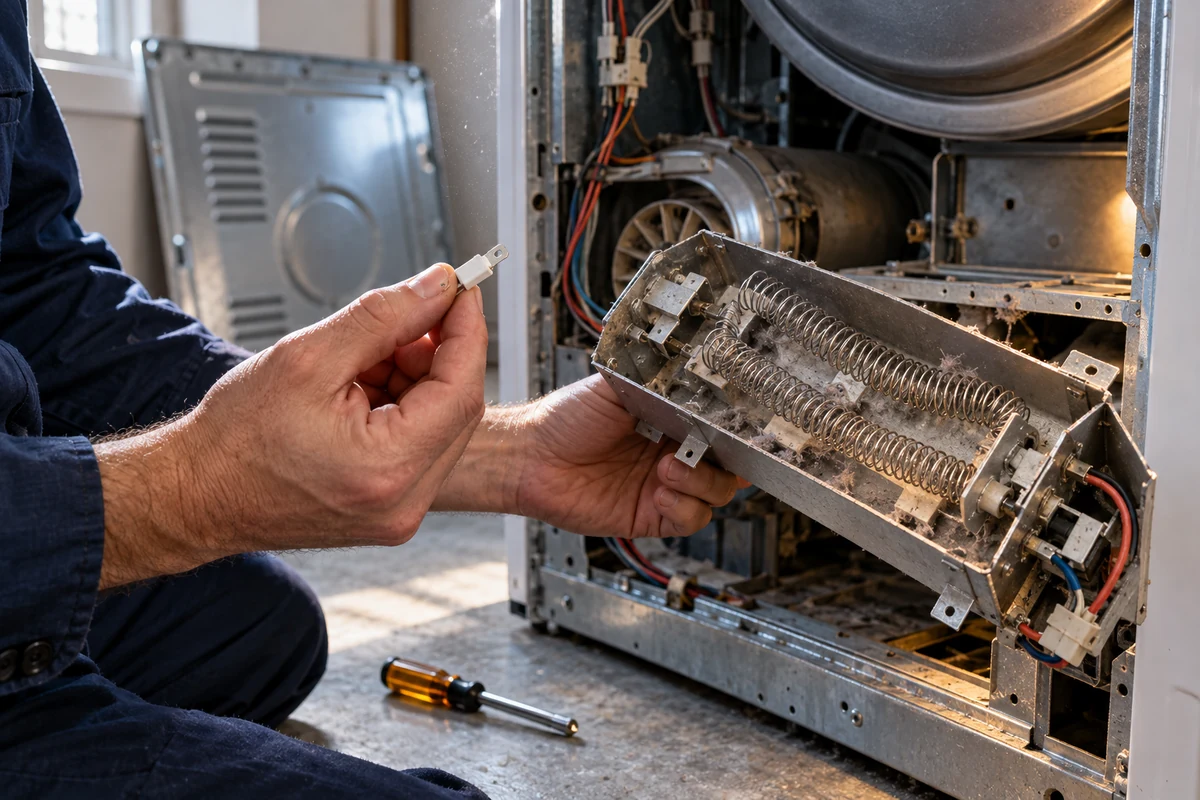
| heating element | no heat |
| thermal fuse | takes several cycles |
| drum belt | drum will not turn |
| idler pulley | burning smell |
| blower wheel | shuts off early |
| cycling thermostat | loud squeal |
How the repair process works
Call and describe it
Tell the dispatcher the symptom, the brand and your ZIP code. That narrows the likely fault before a technician is dispatched and decides which parts travel.
Pick a two-hour window
Choose from the open slots, often the same day. The technician calls ahead before setting off from the previous job.
Diagnosis and flat quote
The actual fault is identified and explained in plain language, then quoted as one flat price covering parts and labor.
Repair completed
Most faults close on the first visit using parts from van stock. The technician confirms the appliance is working before leaving.
What this repair costs
| Repair | Typical range | Market |
|---|---|---|
| Service call and diagnosis | $79 | Waived on approval |
| Dryer repair | $130 to $380 | mid-size city |
Typical completed-repair ranges including parts and labor; your technician confirms the exact price on site before any work begins.
Airflow is almost always the real problem
Most dryer faults that look like heating problems are airflow problems wearing a disguise. A dryer works by pushing heated air through tumbling clothes and then expelling the moisture it picks up. If that air cannot leave the machine, the moisture stays in the drum, the clothes stay damp, and the heat has nowhere to go.
The consequence is a cycle of overheating. Heat builds in the cabinet, the cycling thermostat cuts the element, the machine cools, the element comes back, and the loop repeats. Each pass stresses the thermal fuse until it finally trips, at which point the dryer tumbles with no heat at all. The fuse is the part that failed, but the vent is the reason it failed. Replacing one without clearing the other guarantees a return visit.
That is why a technician checks the full airflow path before touching an electrical component: the lint filter housing, the transition hose behind the machine, and the duct run out to the exterior vent. Crushed flexible hose behind a dryer pushed tight against a wall is a frequent find, and so is an exterior vent flap held shut by lint or a bird nest.
The fire risk is real, and it is preventable
Clothes dryers are a well-documented cause of home fires, and failure to clean them is the leading contributing factor. Lint is highly combustible, and a restricted vent gives it both the fuel and the heat it needs. This is not a scare tactic to sell a service; it is the reason a burning smell from a dryer should stop the cycle immediately.
Practical prevention is simple. Clean the lint filter after every load. Have the duct run cleared annually, or more often if the run is long or the household dries a lot of bedding. Use rigid or semi-rigid metal duct rather than plastic or foil flexible hose where you can, because the ribbed interior of flexible hose catches lint. Keep the area behind and beneath the dryer clear.
Repair or replace a dryer
Dryers are mechanically simple, which makes them good repair candidates for longer than most appliances. Expect 10 to 13 years of service life. Heating elements, thermal fuses, igniters, belts, idler pulleys, rollers, thermostats and moisture sensors are all modest parts with contained labor, and are worth replacing well into a machine’s life.
The replace case is narrower: a failed motor or a cracked drum on an older unit, or a control board on a machine already past year twelve. Apply the fifty percent rule against a comparable new dryer and factor in that a gas model costs less to run than an electric one over its remaining life.

Dryer fire risk
- A burning smell from a dryer is urgent. Stop the cycle, unplug the machine or switch off its breaker, and do not run it again until it has been inspected.
- Lint accumulation in the duct run is a recognised contributing factor in home dryer fires. Clean the filter after every load and have the duct cleared annually.
- Never run a dryer with the duct disconnected or vented into a crawl space or attic. Moist lint-laden air has to leave the building.
- For a gas dryer, any gas odour means leaving the building and calling your gas utility or 911 from outside before anything else.
More guidance: US Fire Administration home fire prevention (opens in a new tab) · CPSC appliance recall notices (opens in a new tab)
Efficiency and replacement guidance
Independent guidance on appliance efficiency and replacement timing: ENERGY STAR appliance guidance (opens in a new tab) , Energy.gov energy saving guidance (opens in a new tab) and FTC Energy Labeling Rule (opens in a new tab) .
Brands we service
Related problem guides
Related services
Find this service in your state
Find this service in your city
Dryer Repair, common questions
Why is my dryer turning but not heating?
On an electric dryer the two usual causes are a burnt-out heating element or a tripped thermal fuse, and the fuse often trips because restricted airflow caused the machine to overheat. On gas models the igniter or the gas valve coils are the common failures. Both are standard van-stock parts.
Why does my dryer take three cycles to dry a load?
Almost always restricted airflow rather than a heating fault. A packed lint filter, a crushed transition hose or a vent run clogged along its length all trap moist air inside the drum. The clothes stay damp, the cycle runs long, and the machine overheats repeatedly in the process.
Is a dryer that smells like burning dangerous?
Yes, treat it as urgent. A burning smell usually means lint is contacting the heating element or the motor is overheating, and clothes dryers are a recognised cause of home fires. Stop the cycle, unplug the dryer or switch off its breaker, and do not run it again until it has been inspected.
How often should a dryer vent be cleaned?
Once a year for a typical household, and more often with a long vent run, a large family or a household that dries bedding frequently. Cleaning the lint filter after every load is separate and does not substitute for clearing the duct itself, where the dangerous accumulation happens.
How much does dryer repair cost?
Completed dryer repairs typically run $115 to $430 including parts and labor. A thermal fuse or igniter sits at the low end, a motor or control board at the top. A service call of $69 to $89 covers the diagnosis and is waived when you approve the repair.
Why does my dryer shut off before the clothes are dry?
A moisture sensor coated in fabric softener residue will report dry clothes that are still damp, ending the cycle early. A cycling thermostat or thermal cut-out responding to an overheat will also stop it. The two causes need different fixes, so the diagnosis matters here.
What is that loud squealing noise when the drum turns?
A worn idler pulley or a failing drum support roller, most likely. Both are inexpensive parts, but running a dryer on a collapsing pulley eventually damages the belt and can score the drum. A squeal that appears at startup and settles is the classic early warning.
Gas or electric dryer, which is cheaper to repair?
Repair costs are broadly similar. Electric dryers fail at the heating element and thermal fuse; gas models fail at the igniter, flame sensor and valve coils. Gas work carries an extra safety step, because any gas repair is leak-checked before the visit closes, which adds a little time.