

What does freezer repair involve?
Freezer Repair is available across all five states we cover, taking in 60 cities and 2,438 ZIP codes. Every visit starts with an on-site diagnosis, so you know which component has actually failed before anything is dismantled. Call (888) 217-4156 and the dispatcher will confirm coverage and the next open window.
Call (888) 217-4156 for the next available window.
Signs you need this repair
Any one of these six symptoms is enough to book a diagnosis. Several appearing together usually point at one underlying fault rather than separate problems.
- not freezing
- heavy frost
- running warm
- seal failing
- loud compressor
- puddle on the floor

What usually breaks
Six components account for the large majority of this work. The technician confirms which one it is on site before quoting anything.
| Part | Symptom it usually causes |
|---|---|
| defrost heater | not freezing |
| thermostat | heavy frost |
| compressor | running warm |
| condenser fan | seal failing |
| door gasket | loud compressor |
| drain tube | puddle on the floor |
How the repair process works
Call and describe it
Tell the dispatcher the symptom, the brand and your ZIP code. That narrows the likely fault before a technician is dispatched and decides which parts travel.
Pick a two-hour window
Choose from the open slots, often the same day. The technician calls ahead before setting off from the previous job.
Diagnosis and flat quote
The actual fault is identified and explained in plain language, then quoted as one flat price covering parts and labor.
Repair completed
Most faults close on the first visit using parts from van stock. The technician confirms the appliance is working before leaving.
Why a freezer fault is more urgent than a fridge fault
A failing refrigerator costs you a few days of fresh food. A failing freezer can cost you months of stored food in a single afternoon, and chest freezers in particular often hold bulk purchases worth several times the price of the repair. That is why freezer calls get triaged ahead of routine bookings when a technician is available nearby.
The useful number is 48 hours. A full freezer, left closed, holds safe temperature for roughly that long. Half full, roughly 24. The single most valuable thing you can do between noticing the fault and the technician arriving is to stop opening the door. Every check costs you hours of that margin.
Move the highest-value items to a cooler packed with ice, decide that in one pass rather than several, and then leave it shut. If the unit has failed completely and you are past the window, food safety guidance rather than appliance advice governs what is still usable.
Frost is a diagnosis, not just a nuisance
Heavy frost build-up is one of the more informative symptoms in appliance work, because it narrows the fault immediately to two systems.
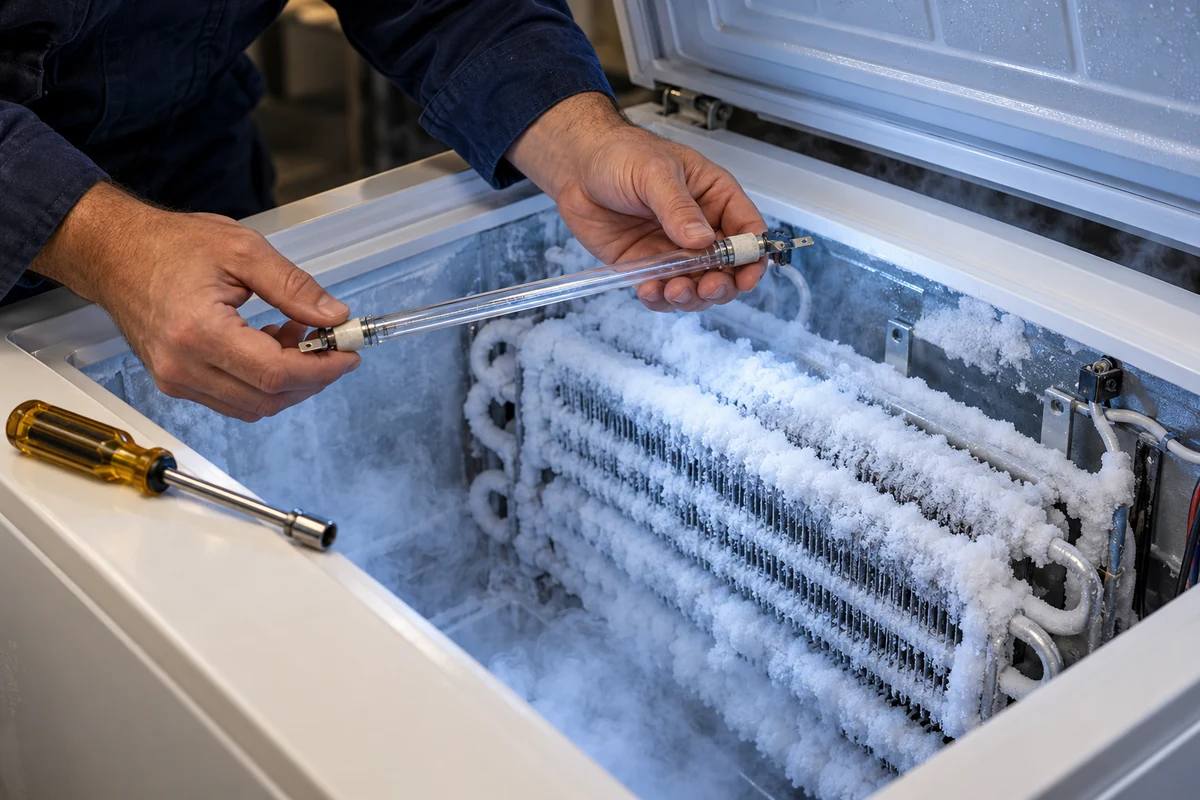
If the defrost system has failed, frost accumulates on the evaporator coil until air can no longer pass through it. The compressor keeps running, the fan keeps turning, and the compartment slowly warms because nothing is actually moving cold air. The failed part is usually the defrost heater or the defrost thermostat, both modest components.
If the door seal has failed, warm moist room air enters continuously and condenses as frost on the first cold surface it meets. The pattern is different, concentrated near the door rather than on the coil. A gasket that has hardened, split or been distorted by something stored against the door is the cause, and that is among the cheapest repairs we do.
Repair or replace a freezer
Freezers are long-lived, typically 12 to 16 years, and chest models often longer. Thermostats, defrost heaters, condenser fans, door gaskets and drain tubes are all worth replacing throughout that span, because the parts are reasonable and these units generally have plenty of life left.
Sealed-system work is the decision point, and age dominates. A compressor or refrigerant repair on a unit past about year twelve usually crosses half the price of a replacement, and the sensible recommendation is a new freezer. Note that any sealed-system repair must be carried out by a technician holding EPA Section 608 certification, which is a legal requirement for handling refrigerant, not a matter of preference.

Refrigerant and food safety
- Sealed refrigerant work requires EPA Section 608 certification by law. Never attempt to recharge a freezer yourself.
- Keep the door closed. A full freezer holds safe temperature for roughly 48 hours, half full for about 24. Each time you open it you lose hours of that margin.
- If water has pooled under the unit and reached an outlet or extension lead, switch off the circuit at the breaker before mopping.
More guidance: EPA Section 608 refrigerant rules (opens in a new tab) · CPSC appliance recall notices (opens in a new tab)
Efficiency and replacement guidance
Independent guidance on appliance efficiency and replacement timing: ENERGY STAR appliance guidance (opens in a new tab) , Energy.gov energy saving guidance (opens in a new tab) and FTC Energy Labeling Rule (opens in a new tab) .
Related problem guides
Related services
Find this service in your state
Find this service in your city
Freezer Repair, common questions
How long will food stay frozen if my freezer fails?
A full freezer holds safe temperature for roughly 48 hours if you keep the door closed, and about 24 hours if it is half full. Opening it to check is the fastest way to lose that margin. Move the most valuable items to a cooler with ice and leave the rest shut.
Why is my freezer frosting over so quickly?
Heavy frost points at the defrost system or the door seal. A failed defrost heater or thermostat means the cycle never clears the coil, so frost accumulates every hour the unit runs. A split or sweating gasket lets warm moist air in continuously, which does the same thing faster.
Why is my freezer running warm but still running?
The compressor can run while the cooling circuit achieves nothing. A coil fully iced over from a defrost failure blocks airflow, a failed condenser fan stops heat leaving, and a sealed-system leak removes the refrigerant that does the work. These are very different repairs at very different prices.
How long does freezer repair take?
Most freezer repairs finish within one to two hours on site once the part is available. The diagnosis alone usually takes twenty to forty minutes. Access and installation type can add time, which is why the dispatcher asks about your setup when you book the appointment.
Is a garage freezer a bad idea?
Only if the unit is not rated for it. Standard freezers are designed for a temperature range typical of a conditioned room, and a hot garage in summer or an unheated one in winter pushes them outside it. Garage-ready models exist and are worth the difference in those installations.
Why is there a puddle on the floor under my freezer?
A blocked drain tube is the most likely cause, backing meltwater up until it overflows the pan. A failed door gasket produces condensation that runs down the cabinet and does the same. Mop it up, check that the door is sealing all the way round, and book a diagnosis.
Chest or upright freezer, which lasts longer?
Chest freezers generally last longer and hold temperature better during an outage, because cold air sinks and stays put when the lid is opened. Uprights are easier to organise but lose more cold air each time the door opens. Both typically give 12 to 16 years.
Do you need a certification to work on a freezer?
For sealed-system work, yes. Anyone handling refrigerant must hold EPA Section 608 certification, and that is a legal requirement rather than a preference. Ask the technician to show you their certification before sealed-system work starts; work outside the sealed system does not require it.