

What does garbage disposal repair involve and what does it cost?
Garbage Disposal Repair is available across all five states we cover, taking in 60 cities and 2,438 ZIP codes. Completed repairs typically run $135 to $390, with parts and labor both included in that figure. Call (844) 578-2720 and the exact flat price is confirmed on site after the diagnosis, before any work starts.
Call (844) 578-2720 for the next available window.
Signs you need this repair
Any one of these six symptoms is enough to book a diagnosis. Several appearing together usually point at one underlying fault rather than separate problems.
- hums but will not spin
- completely dead
- leaking under the sink
- rattling
- draining slowly
- persistent odour

What usually breaks
Six components account for the large majority of this work. The technician confirms which one it is on site before quoting anything.
| Part | Symptom it usually causes |
|---|---|
| flywheel | hums but will not spin |
| splash guard | completely dead |
| mounting gasket | leaking under the sink |
| reset switch | rattling |
| drain elbow | draining slowly |
| motor | persistent odour |
How the repair process works
Call and describe it
Tell the dispatcher the symptom, the brand and your ZIP code. That narrows the likely fault before a technician is dispatched and decides which parts travel.
Pick a two-hour window
Choose from the open slots, often the same day. The technician calls ahead before setting off from the previous job.
Diagnosis and flat quote
The actual fault is identified and explained in plain language, then quoted as one flat price covering parts and labor.
Repair completed
Most faults close on the first visit using parts from van stock. The technician confirms the appliance is working before leaving.
What this repair costs
| Repair | Typical range | Market |
|---|---|---|
| Service call and diagnosis | $79 | Waived on approval |
| Dishwasher repair | $135 to $390 | mid-size city |
Typical completed-repair ranges including parts and labor; your technician confirms the exact price on site before any work begins.
Three faults cover nearly every call
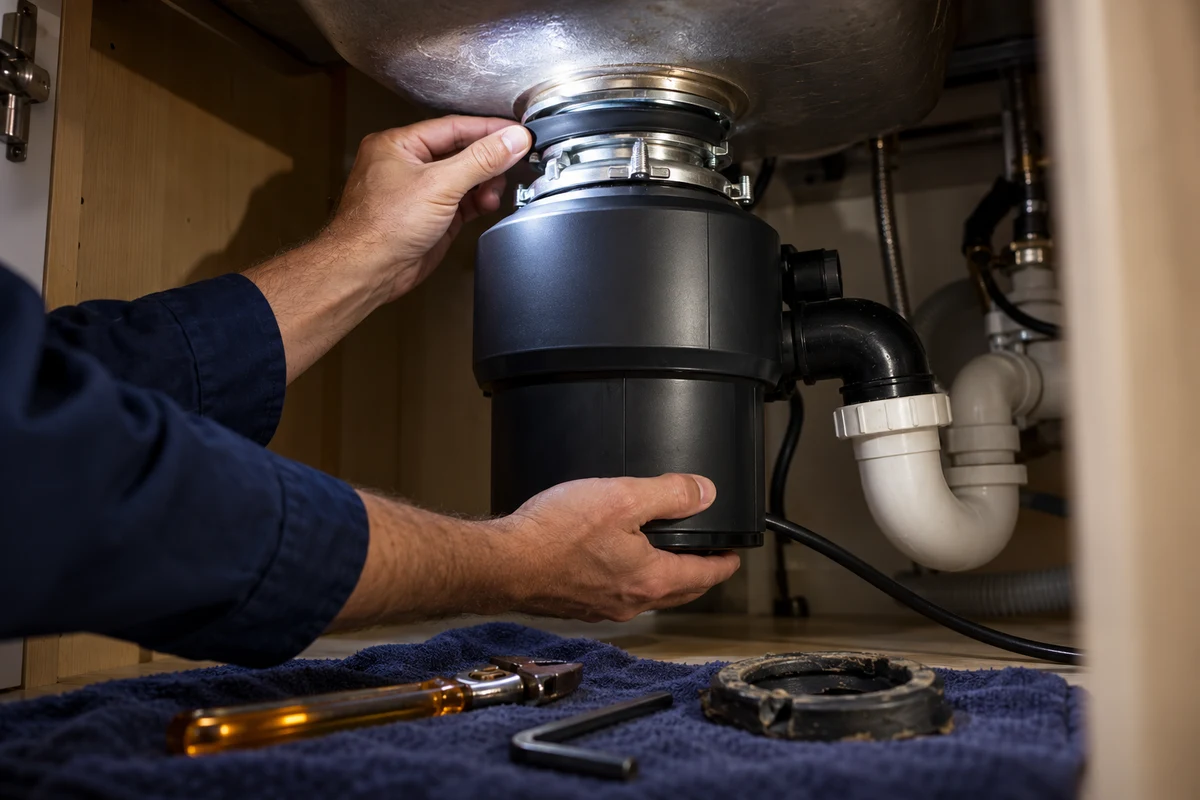
A garbage disposal is a motor, a flywheel and a sealed housing, and it fails in three characteristic ways. Knowing which one you are looking at tells you immediately whether this is a cheap fix or a replacement.
The first is a jam. Something has stopped the flywheel and the motor is stalled against it, which is what the humming is. The important thing is to switch the unit off at the wall straight away, because a stalled motor overheats fast and will eventually destroy itself. Most units have a hex socket in the centre of the underside that lets the flywheel be turned manually to free whatever is caught, with the power off.
The second is an overload trip. Disposals have a reset button on the underside, and it trips after a jam or a heavy load. A completely silent, apparently dead disposal very often needs nothing more than that button pressed, and it is the first thing to check before assuming the worst.
The third is a leak, and this is the one where the location decides everything. Water appearing at the top means the sink flange or mounting gasket seal has failed, which is a straightforward reseal. Water at the side means a connection, usually the dishwasher inlet or the drain elbow, and that is a simple part. Water weeping from the bottom of the body means the internal motor seal has gone, and that cannot be renewed. That unit needs replacing.
What actually causes the jams
Four categories of waste cause most disposal problems, and none of them are obvious if nobody has told you.
Fibrous material is the worst. Celery strings, corn husks, artichoke leaves and onion skins wrap around the flywheel rather than breaking up, and they bind progressively. Coffee grounds and eggshells behave differently: they grind fine but then settle as a dense paste in the trap downstream, so the symptom is slow draining rather than a jam. Grease pours in as a liquid and solidifies as it cools in the pipe. Bones and fruit pits simply stop the flywheel outright.
Two habits prevent most of this. Run cold water, not hot, because cold keeps fats solid enough to be carried away rather than coating the pipe. And feed waste in small amounts with the water running rather than packing the chamber and then switching on.
Repair or replace a disposal
This is one appliance where replacement often makes sense, and we will tell you when. Jams, reset faults, flange and gasket leaks, splash guards, drain elbows and reset switches are all worth repairing, because the parts are inexpensive and the labor is contained.
A failed motor or a leak from the body itself is different. The housing seal is not serviceable, and a replacement mid-range unit costs little more than the labor to attempt a repair. Expect 8 to 12 years of service life, with heavier use at the shorter end of that range.

Disposal safety
- Switch the disposal off at the wall switch and the breaker before putting a hand or a tool anywhere near the chamber. Never reach in with the power live.
- A disposal that hums is a stalled motor. Switch it off immediately, because a stalled motor overheats quickly and will destroy itself.
- Use the hex socket on the underside to free a jam rather than forcing the flywheel from above.
More guidance: CPSC appliance recall notices (opens in a new tab) · FTC Consumer Advice (opens in a new tab)
Efficiency and replacement guidance
Independent guidance on appliance efficiency and replacement timing: ENERGY STAR appliance guidance (opens in a new tab) , Energy.gov energy saving guidance (opens in a new tab) and FTC Energy Labeling Rule (opens in a new tab) .
Brands we service
Related problem guides
Related services
Find this service in your state
Find this service in your city
Garbage Disposal Repair, common questions
Why does my garbage disposal hum but not spin?
The flywheel is jammed and the motor is stalled against it, which is exactly what the hum is. Switch the unit off at the wall immediately, because a stalled motor overheats quickly. Most disposals have a hex socket underneath that lets the flywheel be freed manually once power is off.
Why is my disposal completely dead with no sound at all?
Start with the reset button on the underside of the unit, which trips on overload and is the single most common cause. If resetting does nothing, check the breaker, then the switch. A genuinely failed motor is less common than these three and is diagnosed after they are ruled out.
Why is my disposal leaking under the sink?
Where it leaks tells you what failed. Water from the top means the mounting gasket or sink flange seal; from the side means the dishwasher inlet or drain elbow connection; from the bottom of the body means the internal seal has gone, and that unit needs replacing rather than repairing.
How much does garbage disposal repair cost?
Completed disposal repairs typically run $95 to $280 including parts and labor. Clearing a jam, resealing a flange or replacing a drain elbow sits at the low end. Because a new mid-range disposal is relatively inexpensive, a failed motor usually means replacement rather than repair.
Is my disposal worth repairing or should I replace it?
Jams, reset faults, gasket leaks, splash guards and drain elbows are all worth repairing. A failed motor or a leak from the body itself is not, because the internal seal cannot be renewed and a replacement unit costs little more than the labor would. We will say which you have.
What should never go in a garbage disposal?
Fibrous material such as celery and corn husks wraps the flywheel. Coffee grounds and eggshells form a paste that settles in the trap. Grease solidifies downstream. Bones and fruit pits jam it outright. Cold water and small quantities are the two habits that matter most.
Why does my disposal smell even after running it?
Food residue builds on the underside of the splash guard and inside the grinding chamber where water does not reach. Lift the splash guard and clean beneath it, then grind ice cubes with cold water. A persistent smell after that usually means residue in the trap rather than the unit.
My dishwasher stopped draining after a new disposal was fitted. Why?
New disposals ship with a plug in the dishwasher inlet, and it has to be knocked out before the dishwasher drain hose is connected. If it was left in place, the dishwasher cannot drain at all. It is a five-minute fix and a very common oversight.