

What does refrigerator repair involve and what does it cost?
Refrigerator Repair is available across all five states we cover, taking in 60 cities and 2,438 ZIP codes. Completed repairs typically run $160 to $450, with parts and labor both included in that figure. Call (844) 578-2720 and the exact flat price is confirmed on site after the diagnosis, before any work starts.
Call (844) 578-2720 for the next available window.
Signs you need this repair
Any one of these six symptoms is enough to book a diagnosis. Several appearing together usually point at one underlying fault rather than separate problems.
- not cooling
- freezing food
- water pooling underneath
- loud buzzing
- ice maker dead
- running constantly

What usually breaks
Six components account for the large majority of this work. The technician confirms which one it is on site before quoting anything.
| Part | Symptom it usually causes |
|---|---|
| compressor | not cooling |
| start relay | freezing food |
| evaporator fan motor | water pooling underneath |
| defrost thermostat | loud buzzing |
| door gasket | ice maker dead |
| water inlet valve | running constantly |
How the repair process works
Call and describe it
Tell the dispatcher the symptom, the brand and your ZIP code. That narrows the likely fault before a technician is dispatched and decides which parts travel.
Pick a two-hour window
Choose from the open slots, often the same day. The technician calls ahead before setting off from the previous job.
Diagnosis and flat quote
The actual fault is identified and explained in plain language, then quoted as one flat price covering parts and labor.
Repair completed
Most faults close on the first visit using parts from van stock. The technician confirms the appliance is working before leaving.
What this repair costs
| Repair | Typical range | Market |
|---|---|---|
| Service call and diagnosis | $79 | Waived on approval |
| Refrigerator repair | $160 to $450 | mid-size city |
Typical completed-repair ranges including parts and labor; your technician confirms the exact price on site before any work begins.
Why refrigerators fail the way they do
A refrigerator is the only appliance in the house that never switches off, which is why it accumulates more running hours than anything else in the kitchen. Everything in it is designed around moving heat out of an insulated box, and almost every fault traces back to one of three things: air not moving, heat not leaving, or the control circuit misreading the temperature.
Airflow problems are the most common and the cheapest to fix. The evaporator fan pushes cold air from the cooling coil into the compartments, and when it fails the freezer often stays cold while the fresh food section warms up. That split symptom is diagnostic in itself. A defrost system stuck in the off position produces the same result more slowly, because frost builds on the coil until air cannot pass through it at all.
Heat rejection problems show up as a unit that runs constantly without reaching temperature. Condenser coils packed with dust and pet hair are the usual cause, and in hot garages or kitchens the problem compounds because ambient temperature is already working against the appliance. Cleaning the coils is genuine preventive maintenance rather than an upsell.
Control faults are the ones that confuse people most, because the appliance behaves backwards. A sensor that reports the fresh food compartment as warm will drive the unit to overcool until produce freezes. Nothing mechanical has failed, and the fix is a part that costs a fraction of what the symptom suggests.
Repair or replace a refrigerator
Two numbers decide this. The first is the repair quote against the price of a comparable new unit: if the repair is more than half, replacing usually wins. The second is age. A standard freestanding refrigerator has roughly a 10 to 15 year service life, so a major sealed-system repair at year thirteen is money spent on an appliance already near the end.
Sealed-system work, meaning the compressor, condenser or any refrigerant circuit, is the expensive category and the one where age matters most. Everything outside the sealed system, including fans, relays, thermostats, sensors, gaskets, drain tubes and inlet valves, is normally worth repairing regardless of age because the parts are modest and the labor is contained.
Running cost is the third factor people forget. A refrigerator from the mid-2000s can use roughly twice the electricity of a current model of the same size, so replacing a failing older unit sometimes pays back part of the difference over a few years. Check the current efficiency ratings before deciding, and weigh that against the repair quote rather than treating it as a separate question.
What the visit looks like
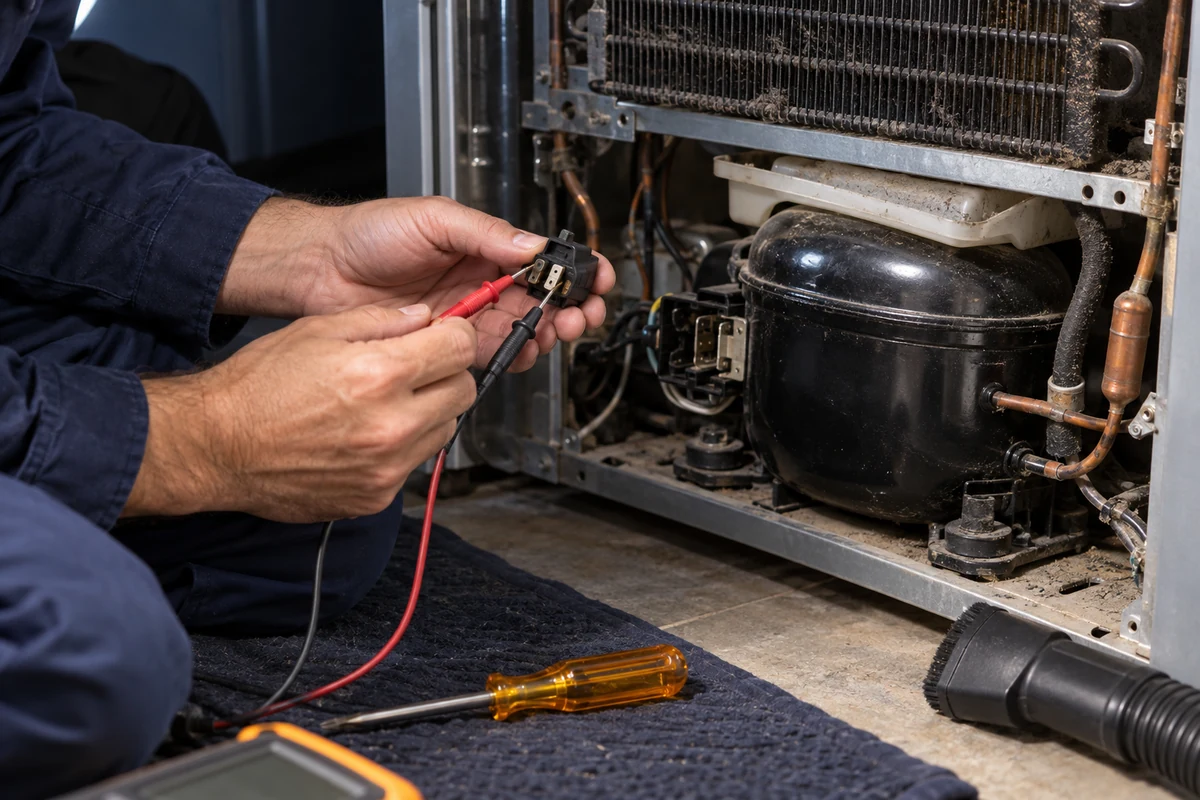
The technician checks compartment and coil temperatures, confirms whether air is moving, inspects the condenser and the defrost components, and tests the start relay and compressor draw. That sequence separates an airflow fault from a heat rejection fault from a sealed-system fault, which is the distinction that determines both the price and whether the repair is worth doing at all. You get the flat price before anything is dismantled.

Refrigerant and electrical safety
- Any work on the sealed refrigerant circuit must be carried out by a technician holding EPA Section 608 certification. This is a legal requirement, not a preference.
- Do not attempt to recharge a refrigerator yourself. Venting refrigerant is illegal and the circuit needs evacuating and weighing to work correctly.
- If the compressor is buzzing loudly and the unit is not cooling, switch it off at the wall. A relay repeatedly trying to start a seized compressor draws heavy current.
More guidance: EPA Section 608 refrigerant rules (opens in a new tab) · CPSC appliance recall notices (opens in a new tab)
Efficiency and replacement guidance
Independent guidance on appliance efficiency and replacement timing: ENERGY STAR appliance guidance (opens in a new tab) , Energy.gov energy saving guidance (opens in a new tab) and FTC Energy Labeling Rule (opens in a new tab) .
Brands we service
Related problem guides
Related services
Find this service in your state
Find this service in your city
Refrigerator Repair, common questions
Why is my refrigerator running but not cooling?
The compressor can run while the cooling circuit does nothing useful. The usual culprits are a failed evaporator fan, a defrost system stuck off so the coil has iced over, or a start relay that lets the compressor hum without engaging. A technician narrows it down by checking airflow and coil temperature first.
How long should a refrigerator last?
Most refrigerators run 10 to 15 years, with built-in and premium units often lasting longer. Past about year twelve, a major sealed-system repair stops making financial sense on a standard freestanding unit. A door gasket, fan motor or relay is still worth fixing at almost any age.
Is it worth repairing a refrigerator that is not cooling?
Usually yes if the fault is a fan, relay, thermostat or defrost component, because those repairs sit well under half the cost of replacement. A failed compressor or a refrigerant leak on an older unit is the point where replacing generally wins. The diagnosis tells you which you have.
Why is there water pooling under my refrigerator?
The most common cause is a blocked defrost drain tube, which backs meltwater up until it spills past the drain pan. A split water inlet line or a cracked drain pan will do the same. Close the water supply valve if the unit is plumbed in, then book a diagnosis.
How much does refrigerator repair cost?
Completed refrigerator repairs typically run $140 to $520 including parts and labor, depending on the component and your local market. A service call of $69 to $89 covers the diagnosis and is waived once you approve the repair. The flat price is confirmed on site before work starts.
Can you repair a built-in or premium refrigerator?
Yes. Built-in refrigeration from brands such as Sub-Zero, Viking and KitchenAid is within scope. These units need the exact model and serial number because mid-production revisions change part fitment, and brand-specific components can carry longer lead times than freestanding appliances.
My refrigerator is freezing the food in the fresh section. Why?
That points at a control fault rather than a cooling fault. A failed thermistor or temperature sensor reports the compartment as warmer than it is, so the unit overcools. A damper stuck open between compartments does the same thing. Both are straightforward parts to replace.
Should I unplug a refrigerator that is making a loud buzzing noise?
If the noise is coming from the compressor area and the unit is not cooling, switch it off at the wall. A start relay that keeps trying to engage a seized compressor draws heavy current and can overheat. Note what the noise sounds like and when it happens, then call.