

What does stove and cooktop repair involve and what does it cost?
Stove and Cooktop Repair is available across all five states we cover, taking in 60 cities and 2,438 ZIP codes. Completed repairs typically run $150 to $420, with parts and labor both included in that figure. Call (844) 578-2720 and the exact flat price is confirmed on site after the diagnosis, before any work starts.
Call (844) 578-2720 for the next available window.
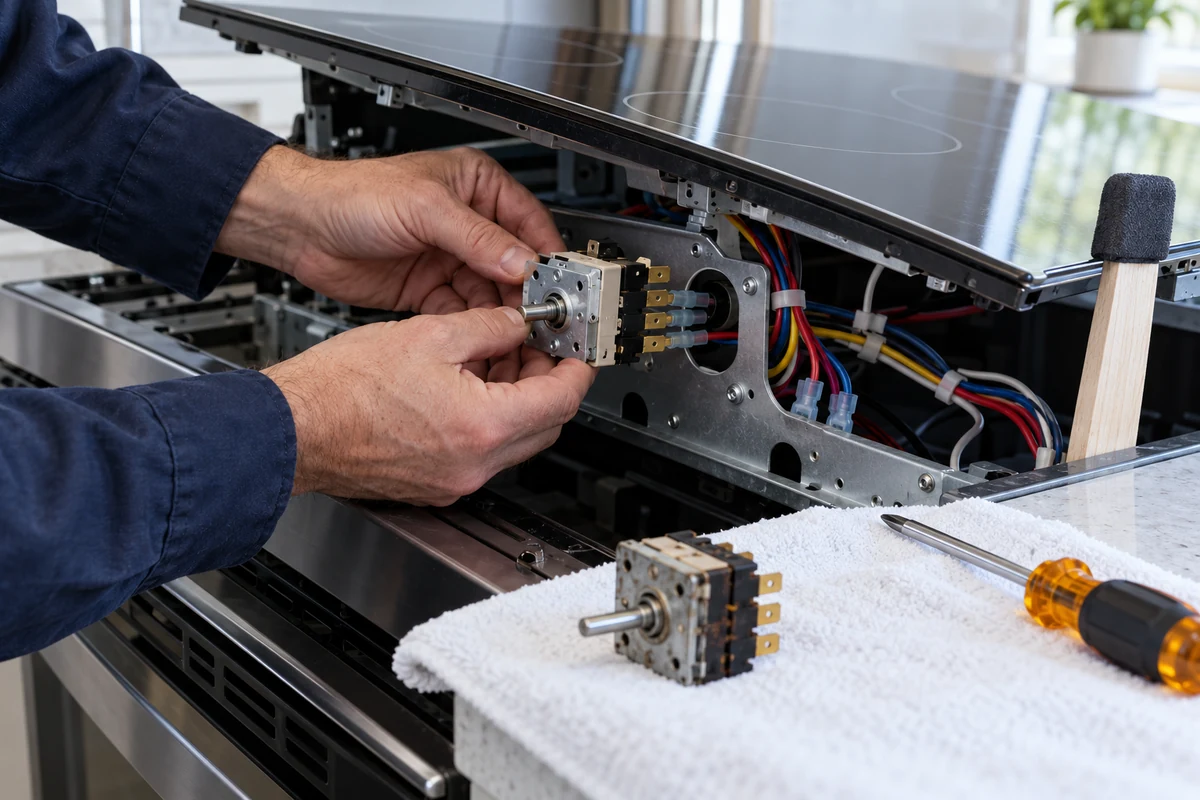
Signs you need this repair
Any one of these six symptoms is enough to book a diagnosis. Several appearing together usually point at one underlying fault rather than separate problems.
- burner will not light
- element stuck on high
- cracked glass top
- endless clicking
- uneven flame
- knobs unresponsive

What usually breaks
Six components account for the large majority of this work. The technician confirms which one it is on site before quoting anything.
| Part | Symptom it usually causes |
|---|---|
| surface element | burner will not light |
| infinite switch | element stuck on high |
| spark module | cracked glass top |
| igniter electrode | endless clicking |
| burner cap | uneven flame |
| glass top | knobs unresponsive |
How the repair process works
Call and describe it
Tell the dispatcher the symptom, the brand and your ZIP code. That narrows the likely fault before a technician is dispatched and decides which parts travel.
Pick a two-hour window
Choose from the open slots, often the same day. The technician calls ahead before setting off from the previous job.
Diagnosis and flat quote
The actual fault is identified and explained in plain language, then quoted as one flat price covering parts and labor.
Repair completed
Most faults close on the first visit using parts from van stock. The technician confirms the appliance is working before leaving.
What this repair costs
| Repair | Typical range | Market |
|---|---|---|
| Service call and diagnosis | $79 | Waived on approval |
| Oven and range repair | $150 to $420 | mid-size city |
Typical completed-repair ranges including parts and labor; your technician confirms the exact price on site before any work begins.
Gas, radiant electric and induction fail in different places
A cooktop looks like one appliance but there are three distinct machines sold under that name, and they have almost nothing in common underneath.
A gas cooktop is a set of valves, burners and an ignition system. Its faults are spark electrodes fouled by spilled liquid, burner ports blocked with debris, seized valve stems and spark modules that fire continuously. These are mechanical, visible and generally inexpensive, which makes gas cooktops good repair candidates for a long time.
A radiant electric cooktop is resistive elements under ceramic glass, switched by infinite switches that cycle power on and off to produce the intermediate settings. Its characteristic faults are a failed element and a failed infinite switch, and a switch that fails closed is the one genuine safety concern because the element then runs at full power regardless of the knob.
An induction cooktop generates a magnetic field with coils driven by a power board, and it fails at the electronics rather than at the cooking surface. Induction units are also more sensitive to cooling: the board needs airflow, and a blocked vent beneath the unit causes faults that look random until the cause is found.
The two symptoms that mean stop using it
Most cooktop faults are inconvenient. Two are not.
An element stuck on high means the infinite switch has welded closed, and the element has no way to stop heating. Switch the circuit off at the breaker rather than relying on the knob, because the knob no longer controls anything.
A persistently yellow or uneven gas flame means combustion is incomplete, and incomplete combustion of natural gas or propane produces carbon monoxide. A blue flame with a small yellow tip is normal. A broadly yellow, lazy or sooting flame is not. Clean the burner ports and reseat the cap first, and if it persists, stop using that burner and have it looked at.
A cracked glass top belongs in the same category for a different reason. The crack lets liquid reach the elements and wiring beneath, and the top cannot be repaired, only replaced.
Repair or replace a cooktop
Gas cooktops are long-lived and repairable, often 15 years or more, because the failing parts are simple and available. Electrodes, spark modules, burner caps, valves and switches are all worth replacing throughout.
Radiant electric sits in the middle. Elements and infinite switches are inexpensive and worth doing at any age. A ceramic glass top replacement is the expensive item, and on an older unit it often crosses half the price of a new cooktop.
Induction is the one where age matters most, because a power board failure on a unit past about year ten frequently makes replacement the better value. Keeping the ventilation path beneath it clear is the single most useful thing you can do to avoid that outcome.

Gas and electrical safety
- A gas odour means leaving the building and calling your gas utility or 911 from outside, before any repair call.
- A yellow, lazy or sooting flame indicates incomplete combustion and therefore carbon monoxide. Stop using that burner.
- An element stuck on high means the infinite switch has failed closed. Switch the circuit off at the breaker, because the knob no longer controls the element.
- Do not use a cooktop with cracked ceramic glass. Liquid entering the crack reaches the elements and wiring beneath it.
More guidance: US Fire Administration home fire prevention (opens in a new tab) · CPSC appliance recall notices (opens in a new tab)
Efficiency and replacement guidance
Independent guidance on appliance efficiency and replacement timing: ENERGY STAR appliance guidance (opens in a new tab) , Energy.gov energy saving guidance (opens in a new tab) and FTC Energy Labeling Rule (opens in a new tab) .
Brands we service
Related problem guides
Related services
Find this service in your state
Find this service in your city
Stove and Cooktop Repair, common questions
Why does my gas burner click but never light?
The spark is reaching the electrode but gas is not arriving, or the electrode is wet or fouled. Spilled liquid in the burner well is the most common cause and often dries out on its own. If it persists, the spark module or the burner valve needs attention.
Why does my electric element stay on high regardless of the setting?
The infinite switch has failed closed. That switch cycles power to the element to create the intermediate heat settings, and when its contacts weld shut the element receives full power constantly. It is a genuine safety issue, so switch the circuit off at the breaker and book it.
My cooktop keeps clicking even when it is off. Is that dangerous?
It means the spark module is firing continuously, usually because moisture has bridged a burner switch or an electrode. There is no gas flowing, so it is not an ignition hazard, but it will not stop on its own and the module can fail from the constant operation.
Can a cracked glass cooktop be repaired?
No, a cracked ceramic glass top has to be replaced rather than repaired, and it should not be used in the meantime. Liquid entering the crack reaches the elements and the wiring underneath. On some models the glass alone is available; on others it comes as an assembly.
How much does cooktop repair cost?
Completed stove and cooktop repairs typically run $115 to $480 including parts and labor. Elements, switches, igniter electrodes and burner caps sit at the lower end. A ceramic glass top or a spark module assembly reaches the top of the range.
Why is my gas flame uneven or yellow instead of blue?
A yellow or uneven flame means the air to gas mixture is wrong, usually because the burner ports are partly blocked by food debris or the burner cap is not seated correctly. Clean the ports and reseat the cap. A persistently yellow flame needs a technician, because incomplete combustion produces carbon monoxide.
Why are my cooktop knobs unresponsive?
On a gas model the valve stem behind the knob has usually seized, often from grease working past the seal. On an induction or electric model with touch controls, moisture under the glass or a failed control board is the likely cause. Both are diagnosed on site.
Can you repair induction cooktops?
Yes. Induction units fail differently from radiant electric, typically at the power board or a coil rather than at a surface element, and they are more sensitive to cooling fan blockage. They need the exact model number because boards are specific to the generation of the unit.