

What does washing machine repair involve and what does it cost?
Washing Machine Repair is available across all five states we cover, taking in 60 cities and 2,438 ZIP codes. Completed repairs typically run $140 to $400, with parts and labor both included in that figure. Call (844) 578-2720 and the exact flat price is confirmed on site after the diagnosis, before any work starts.
Call (844) 578-2720 for the next available window.
Signs you need this repair
Any one of these six symptoms is enough to book a diagnosis. Several appearing together usually point at one underlying fault rather than separate problems.
- will not drain
- will not spin
- leaking
- violent shaking
- will not start
- door stays locked

What usually breaks
Six components account for the large majority of this work. The technician confirms which one it is on site before quoting anything.
| Part | Symptom it usually causes |
|---|---|
| drain pump | will not drain |
| door lock assembly | will not spin |
| drive belt | leaking |
| shock absorbers | violent shaking |
| inlet valve | will not start |
| control board | door stays locked |
How the repair process works
Call and describe it
Tell the dispatcher the symptom, the brand and your ZIP code. That narrows the likely fault before a technician is dispatched and decides which parts travel.
Pick a two-hour window
Choose from the open slots, often the same day. The technician calls ahead before setting off from the previous job.
Diagnosis and flat quote
The actual fault is identified and explained in plain language, then quoted as one flat price covering parts and labor.
Repair completed
Most faults close on the first visit using parts from van stock. The technician confirms the appliance is working before leaving.
What this repair costs
| Repair | Typical range | Market |
|---|---|---|
| Service call and diagnosis | $79 | Waived on approval |
| Washing machine repair | $140 to $400 | mid-size city |
Typical completed-repair ranges including parts and labor; your technician confirms the exact price on site before any work begins.
Why washers fail where they do
A washing machine combines water, movement and electronics in one cabinet, which is why its failures cluster so predictably. The drain path, the door lock and the suspension account for the large majority of calls, and all three are wear items rather than design faults.
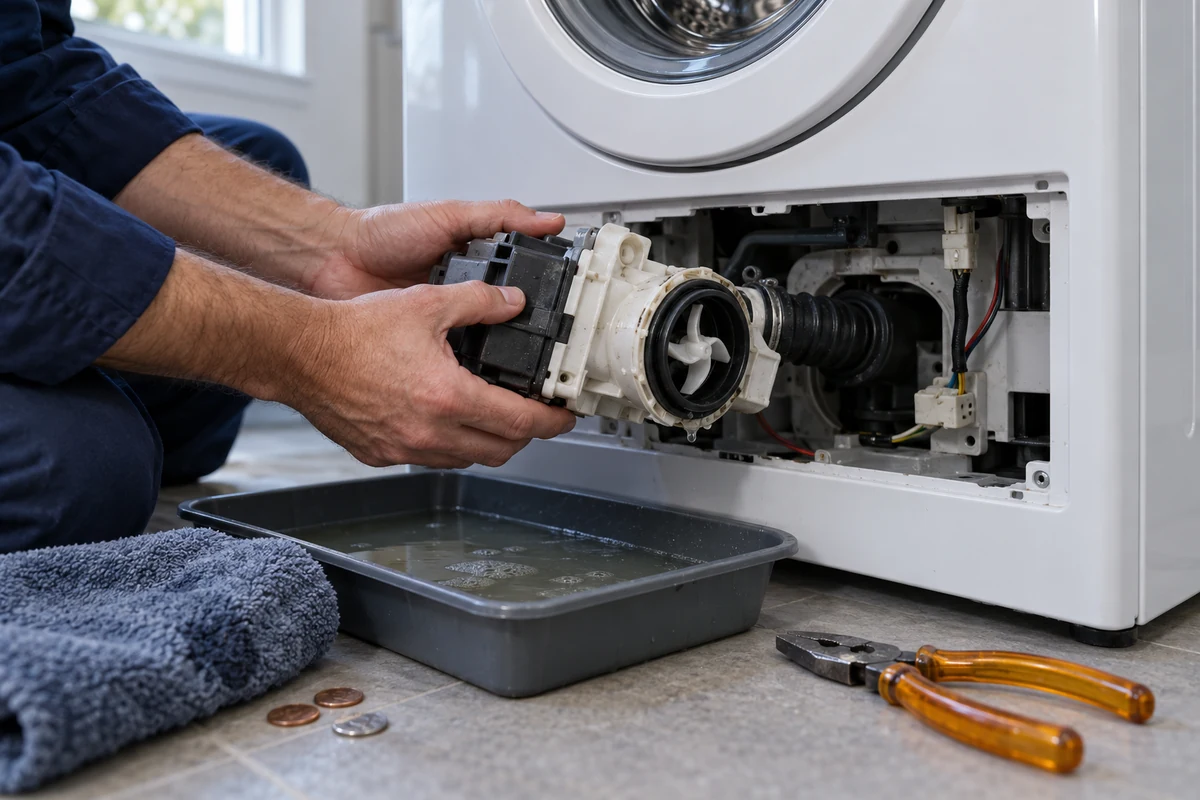
The drain path collects whatever comes out of pockets. Coins, buttons, hair clips and fabric fragments work past the drum and lodge in the pump impeller or the filter housing. The machine senses that water has not cleared, refuses to progress to the spin, and leaves you with a full drum and a flashing display. That is the single most common washer fault we attend, and it is also the cheapest to put right.
The door lock is a safety interlock, and the machine treats it as non-negotiable. If the lock does not confirm a latched door, the drum will not spin at any speed. Because the lock assembly carries both a mechanical latch and a switch, it can fail in a way that lets the door shut normally while the machine still believes it is open.
Suspension wear is the slow one. Shock absorbers and suspension rods damp the drum movement during spin, and as they weaken the drum travels further each cycle. People often live with it for months until the machine starts walking across the floor. Replacing shocks early protects the bearings and the outer tub, which are the parts that end a machine’s life.
Front-load against top-load
Front-load machines use less water, spin faster and extract more moisture, which shortens drying time. The trade-off is a door seal that needs wiping and a suspension system under more stress from the higher spin speed. Their characteristic faults are door seals, drain pumps and shocks.
Top-load machines with an agitator are mechanically simpler and cheaper to repair, but use more water and are harder on fabrics. Their characteristic faults are lid lock switches, drive belts and transmission or clutch wear. High-efficiency top-loaders without an agitator sit between the two and tend to fail at the drive actuator.
Neither type is more reliable in general. What matters more is load habits: consistently overloading any washer accelerates bearing, shock and belt wear far faster than the design difference between the two layouts.
Repair or replace a washer
Apply the same two tests as any appliance. If the quote exceeds half the price of a comparable new machine, replacing is usually better value. If the machine is past about year eleven and the fault is a bearing, outer tub or transmission, replace it. Drain pumps, locks, valves, belts, shocks and control boards are almost always worth repairing, because the parts are reasonable and the rest of the machine typically has years left.

Water and electrical safety
- Close both supply valves behind the machine before investigating a leak, and unplug the washer before touching anything inside the cabinet.
- Standing water that has reached an outlet or an extension lead is a shock hazard. Switch off the circuit at the breaker before mopping.
- Do not defeat the door lock on a front-load machine. The interlock exists because a spinning drum with the door open is genuinely dangerous.
More guidance: CPSC appliance recall notices (opens in a new tab) · FTC Consumer Advice (opens in a new tab)
Efficiency and replacement guidance
Independent guidance on appliance efficiency and replacement timing: ENERGY STAR appliance guidance (opens in a new tab) , Energy.gov energy saving guidance (opens in a new tab) and FTC Energy Labeling Rule (opens in a new tab) .
Brands we service
Related problem guides
Related services
Find this service in your state
Find this service in your city
Washing Machine Repair, common questions
Why will my washer not drain at the end of the cycle?
Nine times out of ten something is blocking the drain path. Coins, hair clips and fabric scraps collect in the pump impeller or the filter, and the machine aborts the spin because it cannot sense an empty drum. A kinked or raised drain hose produces the same symptom without any blockage at all.
Why does my washer not spin even though it drains?
The machine will refuse to spin if the door lock assembly does not confirm the door is latched, because spinning an unlatched drum is a safety risk. Beyond that, a worn drive belt or a failed motor control board will let the drum fill and drain but never reach spin speed.
How much does washing machine repair cost?
Completed washer repairs typically run $120 to $460 including parts and labor, depending on the component and your market. A drain pump or door lock sits at the lower end, a motor control board at the upper. The service call is waived when you approve the repair.
Why does my washer shake violently during the spin cycle?
Worn shock absorbers or suspension rods let the drum move far more than the cabinet can tolerate, and an unbalanced load then turns that into violent movement. On front-load machines the shocks are a wear item. Check first that all four feet are level and the transit bolts were removed.
Is a leaking washing machine dangerous?
It is a property risk more than a shock risk, but water near an outlet or an extension lead is genuinely dangerous. Close the supply valves behind the machine, unplug it, and mop the floor before the water reaches the subfloor. Then book a diagnosis rather than running another cycle.
How long should a washing machine last?
Expect 10 to 13 years from a mainstream washer and a little longer from heavy-duty top-load models. Drain pumps, door locks, belts and shocks are wear items worth replacing at any point in that span. A failed main bearing or outer tub on an older machine is where replacing usually wins.
My washer door stays locked after the cycle. What now?
Most machines hold the lock for a minute or two after a cycle, and many will not release while water remains in the drum. If it stays locked beyond that, the lock assembly or its switch has failed. Run a drain-only cycle first, then call if it still will not open.
Can you repair stacked and compact washers?
Yes. Stacked and compact units are common in apartments and are fully within scope, though access is tighter and the visit can take longer. Tell the dispatcher it is a stacked or closet installation when you book so the right time is allocated.